The short answer: to check the coherence of a text, paste a multi-paragraph article or a link to it into PromoPilot's coherence analyzer, select the language, and click "Analyze." The tool will evaluate the text for free on a 100-point scale and four parameters—lexical cohesion, transition quality, topic consistency, and sentence-start diversity—and highlight specific weaknesses. For example: "74/100, 5 weak transitions, and 2 abrupt topic changes."
I started checking for coherence when I started collecting articles from AI drafts: each paragraph is good individually, but together they read like a list of unrelated notes. The readability index doesn't catch this, but coherence analysis does.
What does text coherence analysis check?
Readability answers the question of "how easy is a sentence to read?" Coherence asks, "is it clear how sentences and paragraphs are connected?" These are different problems, and they require different solutions.
| Parameter | What is he looking at? | Why is this important? |
|---|---|---|
| Lexical cohesion | Repetition of key concepts, connection of adjacent sentences by words | Without it, each sentence hangs separately. |
| Quality of transitions | How a paragraph begins relative to the previous one | Weak transitions are where the reader loses the thread. |
| Coherence of the topic | Does the text deviate from the main idea? | Going off topic blurs the relevance of the query |
| Diversity of sentence beginnings | Monotonous beginnings: “This is…”, “Also…”, “Besides…” | Monotony is tiring and produces a formulaic text. |
| Final assessment | Coherence scale /100 + recommendations | You can compare versions before and after editing. |
Analysis languages: English, Russian, Ukrainian, German, and Polish. The analysis requires a multi-paragraph text—there's nothing to evaluate transitions between in a single paragraph.
How to check text coherence online?
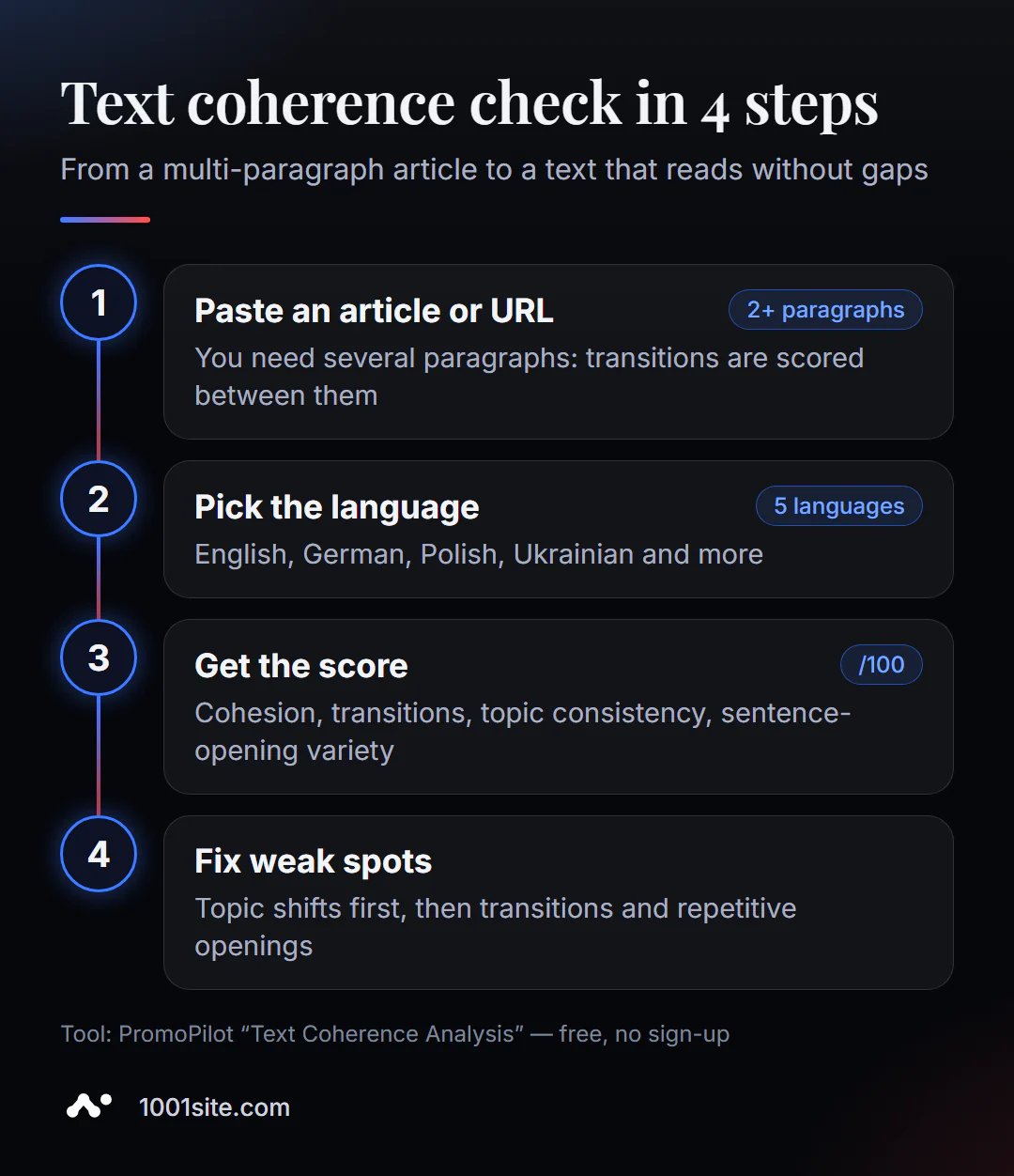
- Discover text coherence analysis —no registration required.
- Paste text from several paragraphs or switch to "Load from URL" and specify the article address.
- Select a language. Please note: English is the default; for Russian text, switch manually.
- Click "Analyze" and get your rating.
- Review the ratings for each parameter and recommendations, correct any weak points, and check again.
This is what the tool looks like: a text field, URL upload, language selection, and a description of the four analysis parameters.
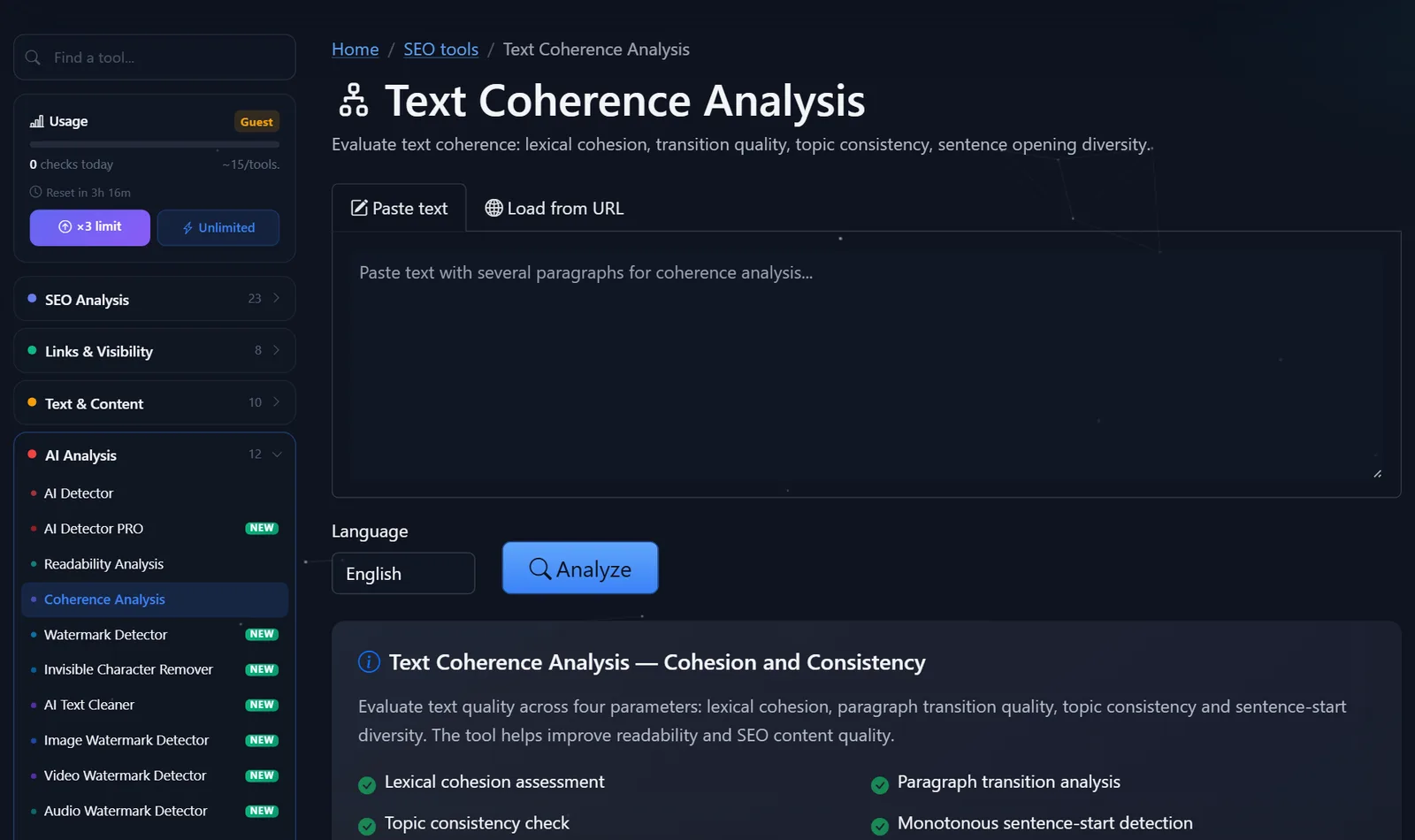
A guest has about 15 checks per day per tool; after free registration, this number triples. This is sufficient for article editing: typically, 2–3 runs are required per text.
How to read the connectivity score and what to correct?
The figure itself is a guideline, not a target. I read the report like this: first, I look at which parameter is declining the most, then I move on to specific areas.
- Topic changes come first. Abruptly going off topic is the most costly mistake: a paragraph about prices in the middle of setup instructions. It should either be moved to its own section or deleted.
- Weak transitions are second. The paragraph begins as if the previous one hadn't happened. It's cured with a single bridge phrase: "We've adjusted the speed—now about the cache," "Hence the main risk:...."
- Cohesion. If adjacent sentences don't share any concepts, add a repeat of a keyword or a referring pronoun. Don't be afraid to repeat a term—it's better in a statement than five synonyms.
- Monotonous openings. Five sentences in a row begin with "Also" or "It"—reverse the word order, start with an action, a number, or a question.
A typical example: in an article about moving a website to a new domain, amidst sections on redirects, there's a paragraph about choosing a CMS. This is a sharp change of topic—it belongs in a separate article. After the move and a couple of bridge phrases, the logic is restored, and the article more accurately addresses its purpose.
Why do AI texts often lose coherence?
The language model writes paragraphs well, but when generating an article in sections, each section is written almost independently. This leads to typical symptoms:
- each section begins with a new introduction, as if there was no article above;
- the same thing is explained twice with different words;
- template transitions: “Now let’s look at…”, “Also, it’s important to note…”;
- The conclusion retells the introduction rather than summing up the sections.
Coherence analysis is a good post-generation filter. If the score is low, it's easier to restructure the article according to plan than to patch transitions one by one. An AI detector will show how similar the text as a whole is to machine translation—there's a separate article about it in this series. For more information on sentence complexity, see the article on readability analysis.
How to write coherently from the very beginning?
Correcting connectivity afterward takes longer than establishing it before. Here are the techniques I use in both manual articles and AI tasks:
- A plan built on bullet points, not topics. Not "Website Speed," but "A Slow Server Is Killing Requests—Here's How to Measure It." When each section has a clear idea, the transition to the next one writes itself.
- One article, one question. Anything that answers another question goes into a separate article and a link to it.
- The last sentence of the section sets the stage for the next one. "We've measured the speed—now we need to figure out what's slowing it down"—and the next section begins with the reasons.
- The key term is the same throughout the article. If you started with "product card," don't switch to "product page" or "product position"—for the reader and the search engine, these are three different things.
- Generate the entire AI article, not section by section, and provide the model with an outline with key points. The coherence will be significantly higher than that of an article assembled from five separate responses.
After such preparation, the coherence analysis usually reveals only minor details - a couple of monotonous introductions that can be corrected in a minute.
Comparison: PromoPilot Connectivity Analysis and Alternatives
There are few free tools specifically for coherence—usually this task is partially solved by writing assistants.
| Tool | What's free? | Restrictions | Who is it suitable for? |
|---|---|---|---|
| PromoPilot — connectivity analysis | Rating /100, transitions, topic changes, monotonous introductions, URL verification | Guest daily limit; not fact-checked | Editing articles and AI drafts |
| LanguageTool | Grammar, punctuation, some stylistic cues | Doesn't evaluate the logic of the text as a whole; extended hints are available in Premium | Final proofreading in many languages |
| Grammarly | Grammar and clarity tips | Works with English; deep style edits are available in the paid version. | English-language texts |
| Hemingway Editor | Highlighting complex sentences | The coherence between paragraphs is not analyzed | Simplification of individual phrases |
Conclusion: writing assistants correct sentences, while coherence analysis looks at the text as a whole—how paragraphs are connected. These tools complement each other.
Find more text and website checks in PromoPilot's catalog of 87 free SEO tools.
Limitations of connectivity analysis?
- Doesn't check facts. A logical text may contain incorrect figures.
- Lists and tables lower the rating. List items are not linked by transitions by definition, so a low rating is normal for them.
- A multi-paragraph text is needed. A short, one-paragraph note will provide little information.
- Five languages: English, Russian, Ukrainian, German, Polish—results are not guaranteed for other languages.
When is a free tool not enough?
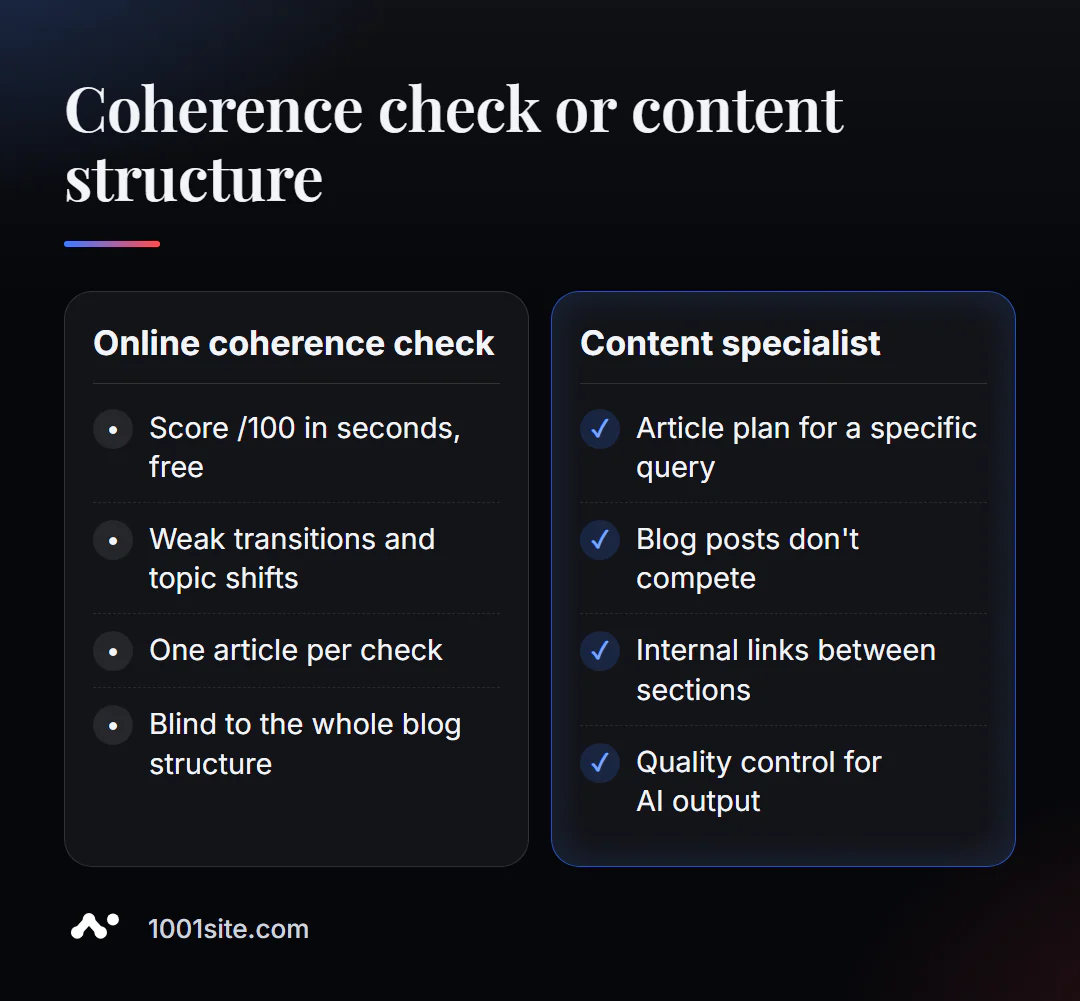
The tool will show weak transitions, but it won't tell you what the article structure should be for the query or how to link blog articles together. You need help if:
- The articles are individually coherent, but the blog doesn't generate any traffic;
- several articles answer the same question and interfere with each other;
- the content is generated in a stream and a quality control process is required;
- You want your website to be cited by AI assistants.
What can I do for your website?
I'm Valeriy Danyuk, a developer and SEO specialist with 12 years of experience and over 200 clients. I build website and content structures so that both individual pages and the entire site respond to client needs.
SEO and content
- Turnkey SEO website audit: section structure, article intersections, interlinking, techniques.
- Autoblog with AI agents: articles are written according to a plan, not in chunks, and are reviewed before publication.
- GEO: How a hotel got featured in ChatGPT, Gemini, and Perplexity recommendations —coherent, structured content is key.
- A tourism portal in 33 languages – a large content structure that remains understandable.
Websites and stores
- An online store powered by WooCommerce with a clear catalog structure.
- Choose a platform – compare Tilda with a subscription fee and a website with AI; you can build a website in minutes on 1001site.
Automation
Send me an article that's "unreadable" via Telegram —I'll show you where the logic breaks.
Result
- Online coherence analysis evaluates text on a scale of /100 and highlights weak transitions and topic changes—free.
- Correct in order: digression → transitions → cohesion → monotonous introductions.
- AI drafts often lose coherence between sections—be sure to check them.
- If the text is coherent but there is no traffic, the problem is in the site structure – an audit or a new site on 1001site will help.
Take your longest blog article and check its coherence for free —weak links can usually be found within a minute.
Sources
- PromoPilot's Text Coherence Analysis tool page - parameters, example, and limitations.
- Official websites of LanguageTool and Grammarly.
- Hemingway Editor - Description of Features.