The short answer: to check the readability of your text, paste it or a link to the page into PromoPilot's readability analysis tool and click "Analyze." The tool will calculate six indices for free—Flesch-Kincaid, Coleman-Liau, ARI, SMOG, Gunning Fog, and Dale-Chall—and display text statistics, an artificiality score, and the appropriate audience. For a typical website, the benchmark is a 7th-8th grade Flesch-Kincaid score.
I check the readability of every landing page before launching an ad: if a person doesn't understand the offer within 10 seconds, they won't read to the button, no matter how much you pay per click.
What does text readability analysis check?
Each index calculates difficulty differently: some by sentence length and syllables, others by letters, and still others by the proportion of "difficult" words. Together, they provide a reliable picture.
| Index | What does it count? | How to read the result |
|---|---|---|
| Flesch Reading Ease | Length of sentences and number of syllables in words | Scale 0-100: the higher, the easier; 60-70 - simple text |
| Flesch-Kincaid Grade Level | The same, but in "school classes" | 7–8 is the norm for web content, 12+ is difficult |
| Coleman-Liau | Letters per word and words in a sentence | Also class level; does not depend on syllable count |
| ARI (Automated Readability Index) | Characters per word and sentence length | Coleman-Liau Quick Check |
| SMOG and Gunning Fog | The proportion of polysyllabic words | Years of study required to understand |
| Dale-Chall | Percentage of words outside the "familiar" list | How much unfamiliar vocabulary is there? |
| Evaluation of artificiality | Repetitions, officialese, machine-like turns of phrase | Highlights bureaucratic and formulaic style |
Plus text statistics and the "optimal audience and difficulty level" output—so you don't have to guess who the text is for.
How to check text readability online?
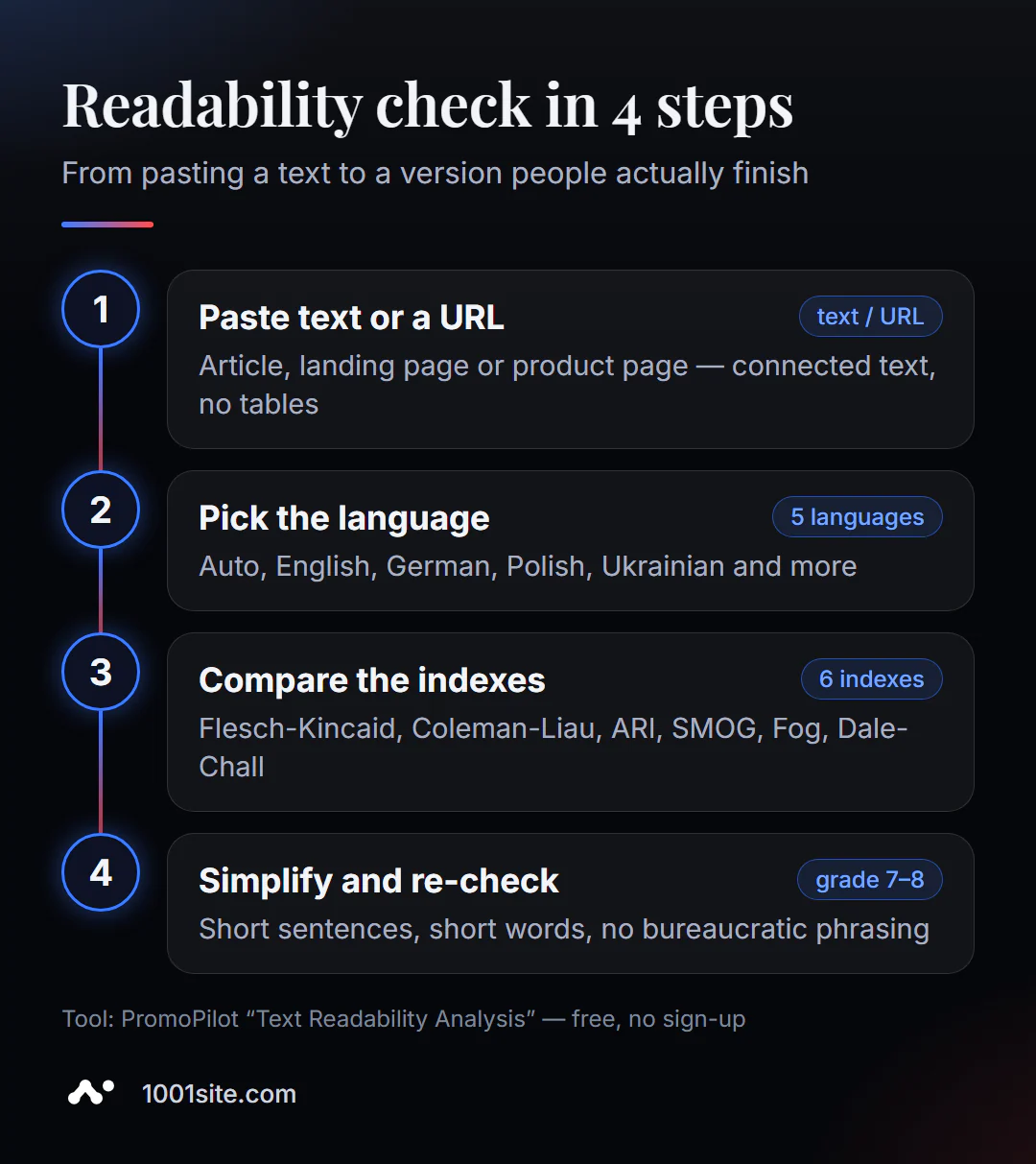
- Open the text readability analysis – it works in your browser, no registration required.
- Paste the text or switch to the "Download by URL" tab to check the finished website page.
- Select a language - auto-detect, Russian, Ukrainian, English, German, or Polish.
- Click "Analyze" and see the scores for each index.
- Simplify the text if the level is higher than your audience needs and check again.
This is what the tool looks like: a text field, download via link, language selection, and a list of indexes it calculates.
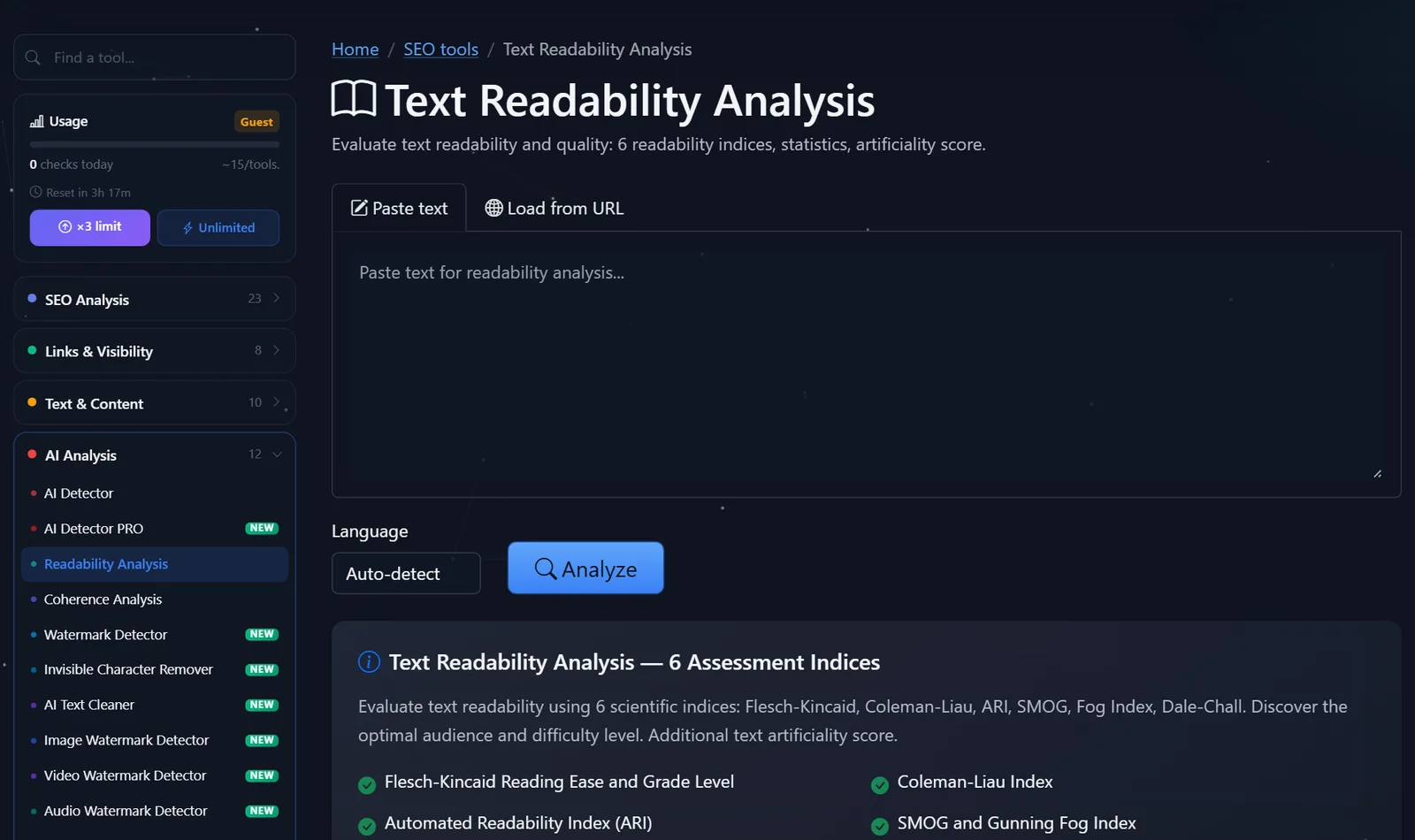
Guests have access to about 15 checks per day, and three times that number after free registration. This is enough to cover all the key pages of a small website.
What level of readability is needed and what should be simplified first?
The right level depends on the reader, not on an "ideal number." My guidelines:
- Landing page, product card, home page — grades 6–8. People scan the page, needing an answer in seconds.
- This blog post is for a general audience—grades 7–9. Terms are welcome, but explanations are needed.
- B2B, medicine, law, technology—grades 10–12 are acceptable: the reader is a professional. But even here, simplicity wins.
If the indices are above the norm, correct them in the following order - from the most effective:
- Cut long sentences. Divide anything longer than 20–25 words into two. This is what drives Flesch and Fog the most.
- Replace long words with short ones. "Optimize" → "optimize," "for the purpose of increasing" → "to increase."
- Eliminate bureaucratic jargon. Verbal nouns and genitive case chains are the main source of "bureaucracy" in assessing artificiality.
- Break up paragraphs and add lists. This keeps the index almost the same, but makes reading easier.
Example: "To increase conversion, optimize the application form" (heavy) → "To receive more applications, simplify the form: just leave your name and phone number" (simple and actionable). The meaning is the same, but there are fewer words, and the reader immediately understands what to do.
Does text readability affect SEO?
There's no direct "Flash Index" factor in search engine algorithms. But readability influences everything that happens after a click:
- Readability. If the first screen is a wall of text with 40-word sentences, the visitor returns to the search results and chooses a competitor.
- Snippets and AI responses. Google, ChatGPT, and Perplexity prefer to cite short, clear fragments: a one-sentence definition, a list of steps, and an answer immediately below the question. A lengthy paragraph won't make it into the response, even if it contains the necessary information.
- Conversion. On a landing page, every extra second spent deciphering a phrase is a chance someone won't click the button.
- Translation. A simple source code is easier to translate—both by machine and by humans. For a multilingual website, this translates directly to cost savings.
That's why I look at readability as part of technical SEO: just like loading speed, it doesn't sell on its own, but it does hinder sales if it's poorly done.
How to read indexes together instead of separately?
Six numbers are confusing until you realize they almost always appear together. If the Flesch-Kincaid index indicates 11th grade, while the SMOG and Fog indices indicate 13-14 years of schooling, the problem lies in long words and terms. If the Coleman-Liau and ARI indices are also high, the problem is also due to sentence length. If only the Dale-Chall index is high, the text contains a lot of rare vocabulary, and it's worth explaining these terms or adding a glossary.
A simple rule: first, look at the Flesch-Kincaid Grade Level as a primary reference, then look for the index that stands out the most—it will tell you the reason. After making adjustments, check again: a good result is a reduction of 2–3 grades without losing the meaning.
Comparison: PromoPilot Readability Analysis and Alternatives
| Tool | What's free? | Restrictions | Who is it suitable for? |
|---|---|---|---|
| PromoPilot — Readability Analysis | 6 indexes, statistics, artificiality assessment, URL verification | Guest daily limit | Checking website pages and articles in multiple languages |
| Hemingway Readability Checker | Class level and highlighting of complex sentences, without word limit | One indicator, English-oriented | Line-by-line editing of English-language texts |
| Microsoft Word | Flesch Reading Ease and Flesch-Kincaid Grade Level | Word is required; statistics must be enabled in the settings | For those who write texts in Word |
| SEO plugins for WordPress | Readability analysis directly in the editor | Only within your site, the set of checks depends on the language | For WordPress website owners |
Conclusion: Hemingway is convenient for line-by-line editing, while Word is better for documents. PromoPilot's online analysis is superior when you need to compare multiple indexes at once or check someone else's page via a link.
Readability is only one aspect of text quality. PromoPilot's catalog contains 87 free SEO tools, including a coherence analysis tool (how logically paragraphs are connected) and an AI detector—these are covered in separate articles in this blog section.
Limitations of readability indices?
- The formulas are designed for English. For Russian and other languages, the absolute value is a guideline; it's more reliable to compare versions and pages with each other.
- The index doesn't understand the meaning. Text consisting of short, meaningless phrases will receive an excellent grade.
- Terminology is inevitable. In a niche text, the word "waterproofing" is irrelevant—explain it, don't throw it out.
- Lists and tables distort statistics. For an accurate assessment, check the coherent text.
When is a free tool not enough?
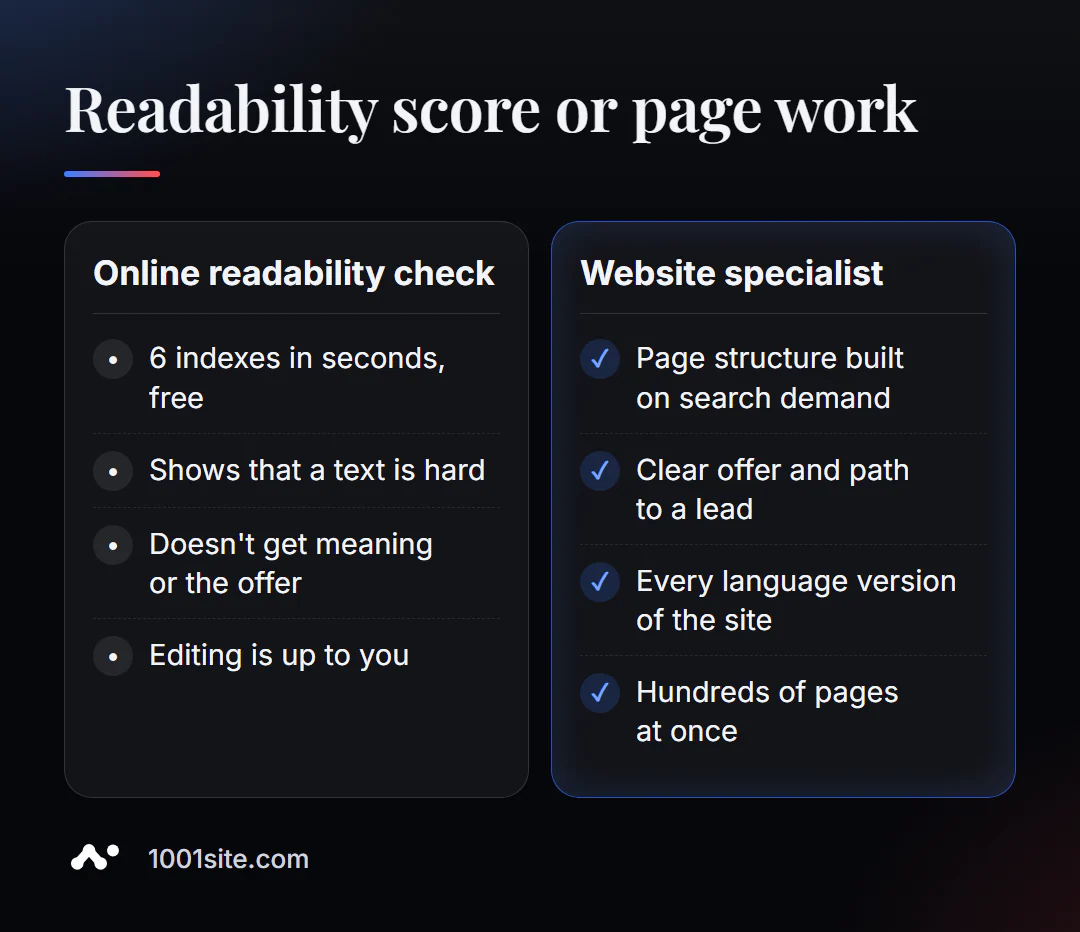
The index shows that the text is heavy, but it won't tell you what to keep, what to discard, or how to structure the page to sell. You need specialist help if:
- the texts are simple, but there are still few applications from the site;
- the site is in several languages, and all versions need to be checked;
- hundreds of texts - product cards, reference books, knowledge base;
- What is needed is not an edit, but a new page structure to meet customer requests.
What can I do for your website?
My name is Valeriy Danyuk, I'm a developer and SEO specialist with 12 years of experience and over 200 clients. I write and redesign web pages so they're easy for people to read and search engines to understand.
SEO and content
- Turnkey website SEO audit: texts, structure, technology – with priorities on what to fix first.
- An SEO blog that attracts organic clients —AI-powered, written in clear language according to preset rules.
- A multilingual website without a translator —so that the text reads naturally in each language.
Websites and landing pages
- A landing page for a new product created in one evening – short, clear texts that lead to a purchase.
- A plastic surgery clinic website powered by AI: a complex topic explained in simple terms and a collection of applications via Telegram.
- How much does it cost? A turnkey website in 2026 is being analyzed; you can build it yourself at 1001site.
Directories and accounting
- The AI-powered equipment repair guide is a technical database that helps technicians find answers in seconds.
Send me a page you think is too heavy on Telegram – I’ll give you some tips on how to cut it.
Result
- Online readability analysis calculates 6 indexes in seconds—free and without registration.
- The benchmark for a website is Flesch-Kincaid grade 7–8; for B2B, higher grades are acceptable.
- The most helpful things are short sentences, short words, and avoiding officialese.
- If the text is simple and there are no applications, the problem is the structure and offer – this requires an audit or a new website on 1001site.
Start with your homepage: check its readability for free, and then check your blog's most visited article.
Sources
- PromoPilot's Text Readability Analysis tool page — list of indexes and recommendations.
- Microsoft Support - Word readability statistics and recommended values.
- Hemingway Editor - Description of the free Readability Checker.