
The short answer: to perform an online keyword density analysis, paste the text or page URL into PromoPilot's Keyword Density Analyzer and click "Analyze Density." The tool will generate tables of the frequency of individual words, two-word and three-word phrases as percentages, filter out stop words (both Russian and English), generate a distribution graph, and provide recommendations—around 2–3% for the primary keyword. Registration is not required.
The first thing I do with text that's "not ranking" is check the word frequency. In half the cases, the problem is immediately obvious: the keyword is repeated in every sentence, or, conversely, a text about laptop repair doesn't contain the words "laptop repair" even once.
What does keyword density analysis show?
Density is the proportion of a word or phrase in a text: the number of occurrences divided by the total number of words, multiplied by 100. If an article has 1,000 words and the phrase "flower delivery" appears 20 times, its density is about 2%.
| Metrics | What is he looking at? | Why is this for SEO? |
|---|---|---|
| 1 gram | Frequency of individual words | It is clear what the text is “really” about from a statistical point of view |
| 2 grams | Frequency of word pairs | Most queries are two words long; this is where spam often hides. |
| 3 grams | Frequency of three-word phrases | Long queries and template phrases |
| Interest | The proportion of each word and phrase in the text | Compare with recommendations and competitors |
| Stop word filter | Removes prepositions, conjunctions, and function words (Russian and English) | The table contains meaningful words, not "and", "in", "the" |
| Schedule and recommendations | Frequency distribution and density tips | Quickly understand if there is a bias |
How to check keyword density online?
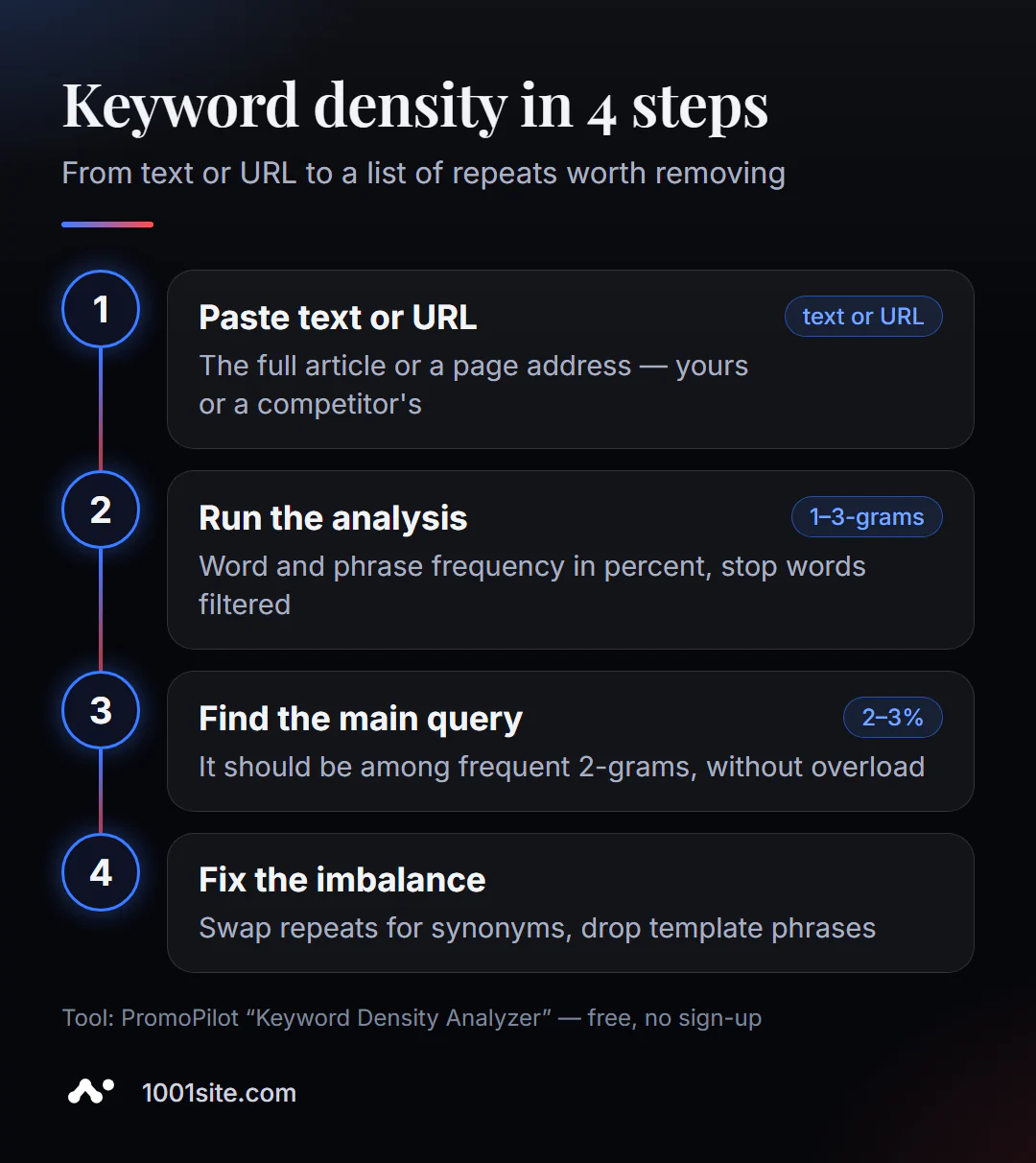
- Open the density analyzer - it runs in your browser.
- Paste the text of the article or the address of the published page.
- Click "Analyze Density" and the result will appear in seconds.
- Look at the 2-gram and 3-gram table: is your main query there and with what frequency.
- Check 1-grams: which words are dominant and whether they match the topic of the page.
- Correct any distortions and check again.
This is what the tool page looks like: a text field, an "Analyze Density" button, and a description of the features below.
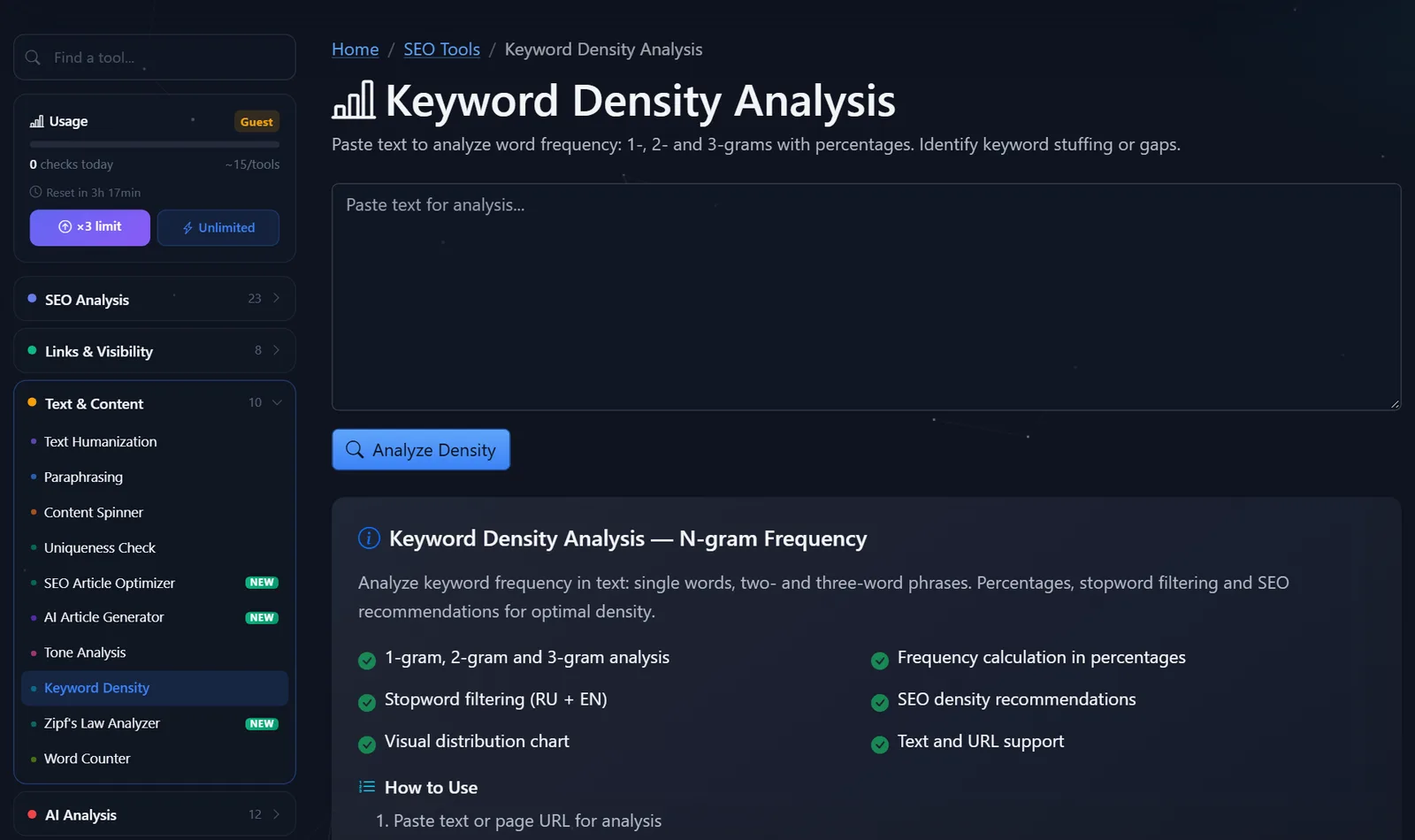
The remaining free checks for today are shown in the "Usage" section of the sidebar; after free registration, this amount is tripled.
How to read the result and what to correct first?
The density number alone doesn't mean anything—what matters is which words are at the top of the table and whether they match the query. My parsing order:
- The main keyword in 2-gram keywords. If you're writing about "laptop repair," this phrase should be among the most frequently searched. If it's not in the table, it's difficult for search engines to understand the topic. Add it to the title, first paragraph, and one or two subheadings.
- Overspam. A keyword density significantly higher than 3% is a sign of overload. A typical example: "Laptop repair in Prague. Our laptop repair service in Prague fixes laptops quickly." Replace some of the repetitions with "service," "master," or "we'll fix it"—the meaning is the same, but it's easier to read.
- Someone else's topic is at the top. If the top 1-gram search results feature the word "company" or brand name, rather than the page's subject, the text is talking about you, not the client's problem. Rewrite the focus.
- Generic 3-gram phrases. "At an affordable price," "in the shortest possible time," "personalized approach to each customer" at the top are signs of thin copy. Remove or replace with specifics.
- Competitor comparison. Paste the URLs of two or three top-ranking pages for your keyword. If everyone else's keyword appears in 1-2% of searches, and yours does in 6%, you've overdone it.
Remember: the 2-3% recommendation is a tool guideline, not a search engine requirement. Google explicitly states that keyword stuffing is a violation of its rules, but it doesn't have a "minimum percentage."
Where should I put keywords to avoid spam?
It's not just the frequency that's important, but also the placement of the keyword. Search engines give more weight to titles and the beginning of the text, so a few precise matches in the right places perform better than twenty random ones. The formula I use for a 1,000-1,500-word article is:
- Title and H1 — the main query in its entirety, closer to the beginning.
- The first paragraph is a natural-sounding query in the first two or three sentences.
- One or two H2 subheadings - a query or a variation of it, if it sounds human-readable.
- The main text consists of word forms and synonyms: “laptop repair”, “fix a laptop”, “service”, “master”.
- Alt for images and page description - one entry each.
- Conclusion - once, in the call to action.
After this arrangement, run the text through the analyzer. If the keyword 2-gram appears in the top rows of the table and the density is within the benchmark, everything is correct. If the keyword is lost among the function words, add the entry to the subheading rather than to the middle of the paragraph.
Comparison: PromoPilot Density Analyzer and Alternatives
You can check keyword density using an online service, a CMS SEO plugin, or manually by searching through the text.
| Tool | What's free? | Restrictions | Who is it suitable for? |
|---|---|---|---|
| PromoPilot — Keyword Density Analysis | 1-, 2-, 3-grams, percentages, RU and EN stop words, graph, recommendations, text or URL | Daily limit | Quickly check any competitor's text or page |
| SEO Review Tools Keyword Density Checker | URL or text density, 1-3 word phrases | Usage credits, English-language interface | English-language sites |
| Yoast SEO | Checking keyword density in the editor | WordPress only, one specific phrase | For WordPress website owners |
| Search Ctrl+F | Counting occurrences manually | No percentages or phrases, just one word at a time | One-time check of one word |
Conclusion: The CMS plugin is convenient for its own pages, but it only shows the phrase you specify. The online analyzer shows all common words and phrases—including those you might not have suspected were overused—and works with other people's pages.
The analyzer is one of PromoPilot's 87 free SEO tools. The word counter helps you calculate text volume and reading time, while the uniqueness checker checks for repeated phrases and compares two texts; both are covered in the adjacent articles in the series.
What are the limitations of density analysis?
First, word forms. The Russian language is rich in endings: "notebook repair," "notebook repair," "notebook repair"—for statistical purposes, these are all different phrases. The overall frequency of the query is higher than what a single table row indicates, so consider all the forms together.
Second, density doesn't measure usefulness. A text with a perfect 2.5% might not answer the reader's question, and then it won't rank. Density is hygiene, not strategy.
Third, when analyzing by URL, the menu, footer, and repeated page sections may be included in the statistics. If the menu contains "services" ten times, this will distort the picture. For an accurate assessment of an article, only include its text.
When is a free tool not enough?
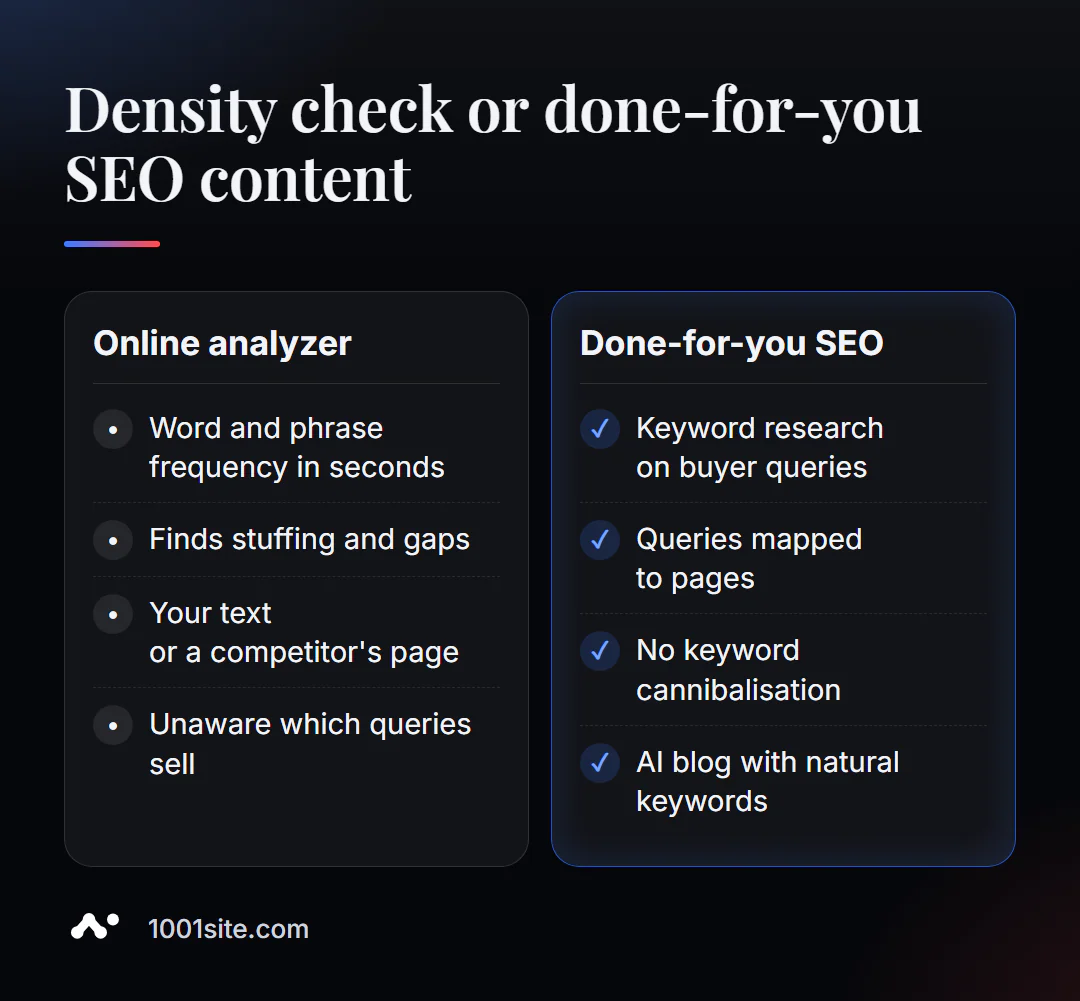
An analyzer shows how frequently words appear. But it won't tell you which queries are driving customers, which pages are competing for the same keyword, or what the site needs. You need a specialist if:
- the density is fine, but the page still doesn't rise in search results;
- several website pages are optimized for the same query;
- it is necessary to collect semantics and distribute queries across pages;
- We need a flow of articles where the keywords are present naturally from the first draft.
What can I do for your website?
My name is Valeriy Danyuk, and I'm a developer and SEO specialist with 12 years of experience and over 200 clients. I handle queries systematically, from semantics to text and publication.
SEO, content and promotion
- Turnkey SEO audit: I check which pages are competing for the same search query, where there's over-spamming, and where keywords are missing.
- AI-powered SEO blog: AI writes, illustrates, and publishes articles tailored to customer needs, driving organic traffic.
- Autoblog with AI agents – an editorial team without humans.
Websites and online stores
- WooCommerce Online Store — 40+ Templates, €299.
- How to transfer your store from Instagram to your website and start attracting customers from search engines; on 1001site products are transferred via a link, and SEO settings are already enabled.
CRM, accounting and automation
- A monthly accounting system for an online store – a project for a company from the Czech Republic.
- CRM with a built-in customer database and decision makers, banchem.sk (Slovakia).
All projects are in the portfolio. Send me the address of the page that's not growing on Telegram - I'll check if the keywords are the issue.
Result
- Density is the proportion of a word or phrase in the text; the tool displays 1-, 2-, and 3-gram percentages.
- Start with 2-grams: is there a main request there and does it not exceed a reasonable 2–3%.
- Consider word forms and compare with top competitors, not with an abstract norm.
- Density is a matter of text hygiene, not a guarantee of rankings; a website with an SEO database set up from day one can be built on 1001site.
Check your keywords: analyze the density for free. If your keywords are OK but you're not getting any traffic, message me on Telegram.
Sources
- PromoPilot's Keyword Density Analysis tool page - n-grams, stop words, recommendations.
- PromoPilot SEO Tools Wiki – Description of metrics and related tools.
- Google Search Central - Spam Policy, Keyword Stuffing Section.
- SEO Review Tools and Yoast SEO are the official pages of these services.