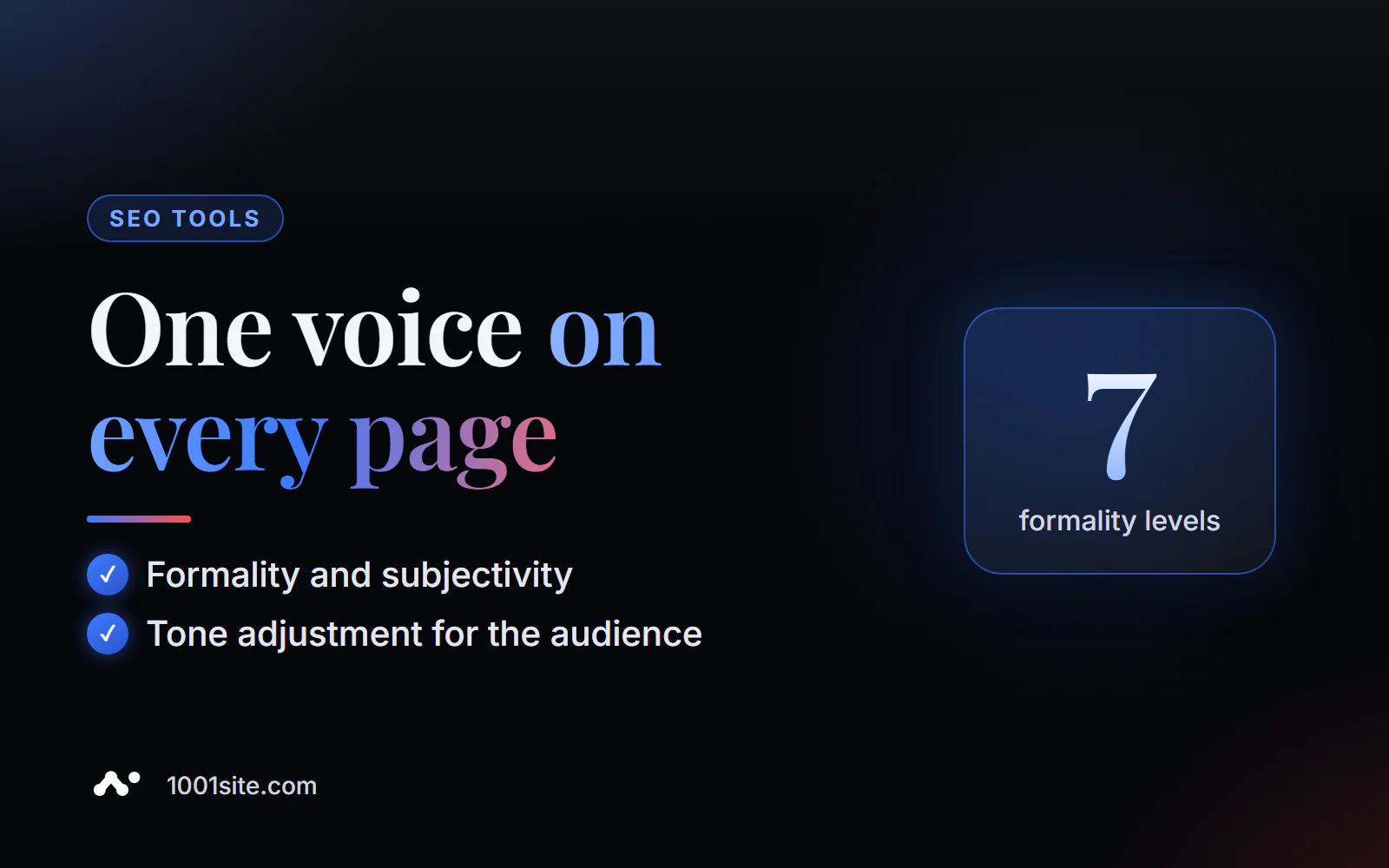
The short answer: to perform an online sentiment analysis, paste the text or a link to a page into PromoPilot Sentiment Analysis, select a language (English, Russian, Ukrainian, German, Polish, French, or Spanish) and the action—"Analysis Only" or "Analysis with Adjustments." Click "Analyze": the tool will display formality on a 7-level scale, subjectivity from 0 to 1, style markers, and tone distribution by category, and, upon request, will rewrite the text in the desired tone. Registration is not required.
When I'm building a website for a client, the copy is often written by three people: the owner, the marketer, and the AI. As a result, the homepage reads like a contract, and the blog like a messaging conversation. A tone analysis, done in a couple of minutes, reveals which pages are out of step with the overall tone.
What does sentiment analysis show?
Here, "tonality" is primarily a matter of style: how formal the text is, how much of a personal assessment it contains, and what phrases set the tone. This isn't the same as analyzing reviews for "positive/negative," although the overall emotional tone is also visible.
| Metrics | What is he looking at? | Why does business need this? |
|---|---|---|
| Formality | The position of the text on a scale of 7 levels - from colloquial to formal | Understand whether the style matches the audience's expectations |
| Subjectivity | Rating from 0 (facts) to 1 (opinions and emotions) | A sales text without facts loses credibility, and is dry and unengaging. |
| Style markers | Formal constructions, colloquial expressions, academic vocabulary | It is clear which words make the text heavy or familiar. |
| Tone distribution | The proportion of text in each tone category | Finds "leaps" - when paragraphs of the same text sound different |
| Correction | Text rewritten in the chosen direction | Quickly even out tone without manually rewriting the page |
An example of the result from the tool description: for a marketing paragraph about a new product, the tone is positive, the formality is average, the subjectivity is 0.63, and style markers are highlighted in the text.
How to check the sentiment of a text online?
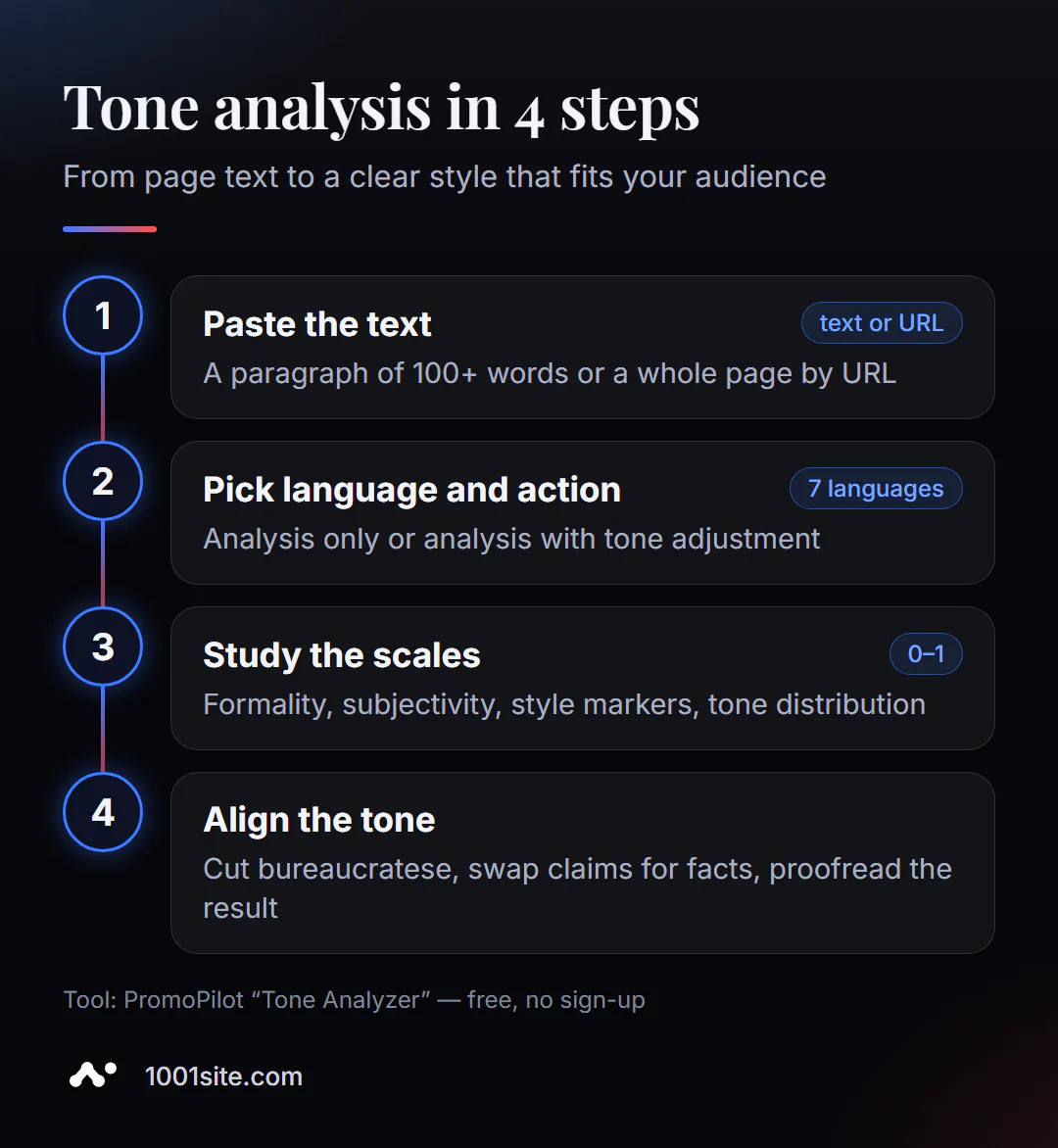
- Open Sentiment Analysis - it runs in your browser.
- Paste text or download a page from a link in the "Download from URL" tab. Use a paragraph or an entire page, not a single phrase.
- Select a language. English is the default; switch to Russian for text.
- Select the action: "Analysis only" if you need diagnostics, or analysis with correction if you want to immediately get a rewritten version.
- Click "Analyze" and look at formality, subjectivity, and markers.
- Compare it to a standard —a text that you think sounds correct—and correct any deviations.
This is what the tool page looks like: a text field, a download link tab, language and action selection, an "Analyze" button, and a description of the metrics below.
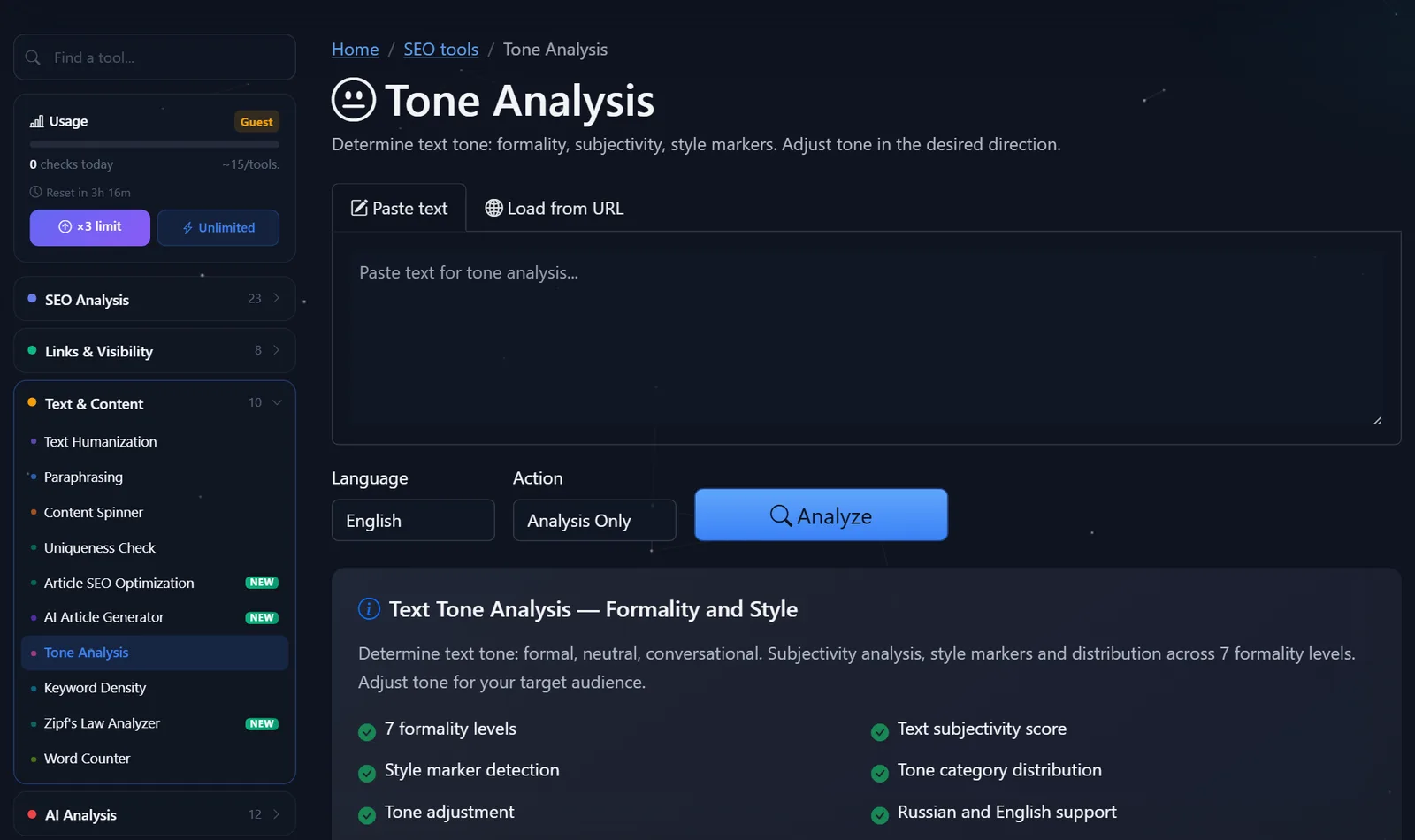
Free checks for today are calculated in the "Usage" section of the side menu; after free registration, the limit is tripled.
How to read the result and what to correct first?
There's no such thing as a perfect tone—there's just a tone that suits your audience. So, first decide what you want your website to sound like, and then compare it to that benchmark.
- Formality doesn't align with the audience. For B2B services and legal topics, medium-high formality is appropriate. For a gift shop or cafe, medium-low formality is appropriate. If a service page for private clients is formal, remove the bureaucratic language: "we deliver" → "we deliver."
- Subjectivity is too high. A rating closer to 1 on a service page is nothing but "best," "incredible," and "unique." Replace ratings with facts: "delivered in 2 hours" is more convincing than "very fast."
- Subjectivity is too low. A value of around 0 in a blog post is a dry summary without any authorial perspective. Add an opinion, a personal example, or a recommendation.
- Tone fluctuations within the text. The distribution shows that some paragraphs are formal, while others are more colloquial. This happens when the text was assembled from fragments. Choose one level and align it.
- Style markers. Look at which words are highlighted as formal or colloquial—often, changing five or six phrases is enough to make the text sound different.
A common mistake is to apply a change to the entire site without testing it. Always proofread rewritten text: terms, prices, and promises must remain accurate.
What tone do different pages of the site need?
Even for the same brand, different pages sound slightly different—it's important to be aware of these differences. Here are the guidelines I give clients before reviewing their texts:
- The homepage and service pages are medium formality, with low to medium subjectivity. Facts, figures, and benefits, without gushing or bureaucratic jargon.
- A blog is a medium-low formality and a prominent author. Readers come for opinions and experience, not information.
- Product cards are generally formal, with minimal ratings. Specifications, sizes, and care instructions are all in the photos, not the adjectives.
- Legal documents and contracts are highly formal and subjective. A "warm" tone is inappropriate here.
- The bot's posts, mailings, and responses are low-formality, with lively turns of phrase, but without familiarity.
A handy trick: choose one page that sounds right, run it through the analyzer, and record the results. This will be your benchmark—compare all new texts to it, including those written by AI.
Comparison: Sentiment Analysis of PromoPilot and Alternatives
The tone and style of the text are checked by different services, and each one looks at it from its own perspective.
| Tool | What's free? | Restrictions | Who is it suitable for? |
|---|---|---|---|
| PromoPilot — Sentiment Analysis | 7-level formality, subjectivity, markers, tone adjustment, 7 languages | Heuristic metrics, daily limit | Align the tone of the website pages and check the text before publishing |
| Grammarly | Tips for Tone in Writing | Focused on English, works inside the Grammarly editor | English-language business correspondence |
| LanguageTool | Grammar and style check in many languages | There is no separate tone scale. | Proofreading for errors and stylistic flaws |
| Hemingway Editor | Highlighting complex sentences and phrases | Readability, not tone; English-oriented | Simplification of English texts |
Conclusion: if you need to measure tone and align it across your website, a tool with a formality scale and adjustments is more convenient. Grammar and readability are best checked separately, for example, using the readability analyzer from this same series of articles.
Sentiment analysis is one of PromoPilot's 87 free SEO tools. It also includes a humanizer for AI drafts and tools for text readability and coherence; each has its own article in the series.
What are the limitations of tone analysis?
First, the metrics are heuristic. The tool detects signs of formal and colloquial style, but it doesn't understand context the way an editor does. Irony, professional jargon, and quotations can all skew the score.
Second, short texts. A ten-word phrase won't provide statistical support, and the results will be random. For reliable results, use a paragraph of at least 100 words or an entire page.
Third, tone doesn't improve content. If a page lacks prices, deadlines, and arguments, proper formality won't save it. Tone is packaging, but content sells.
When is a free tool not enough?
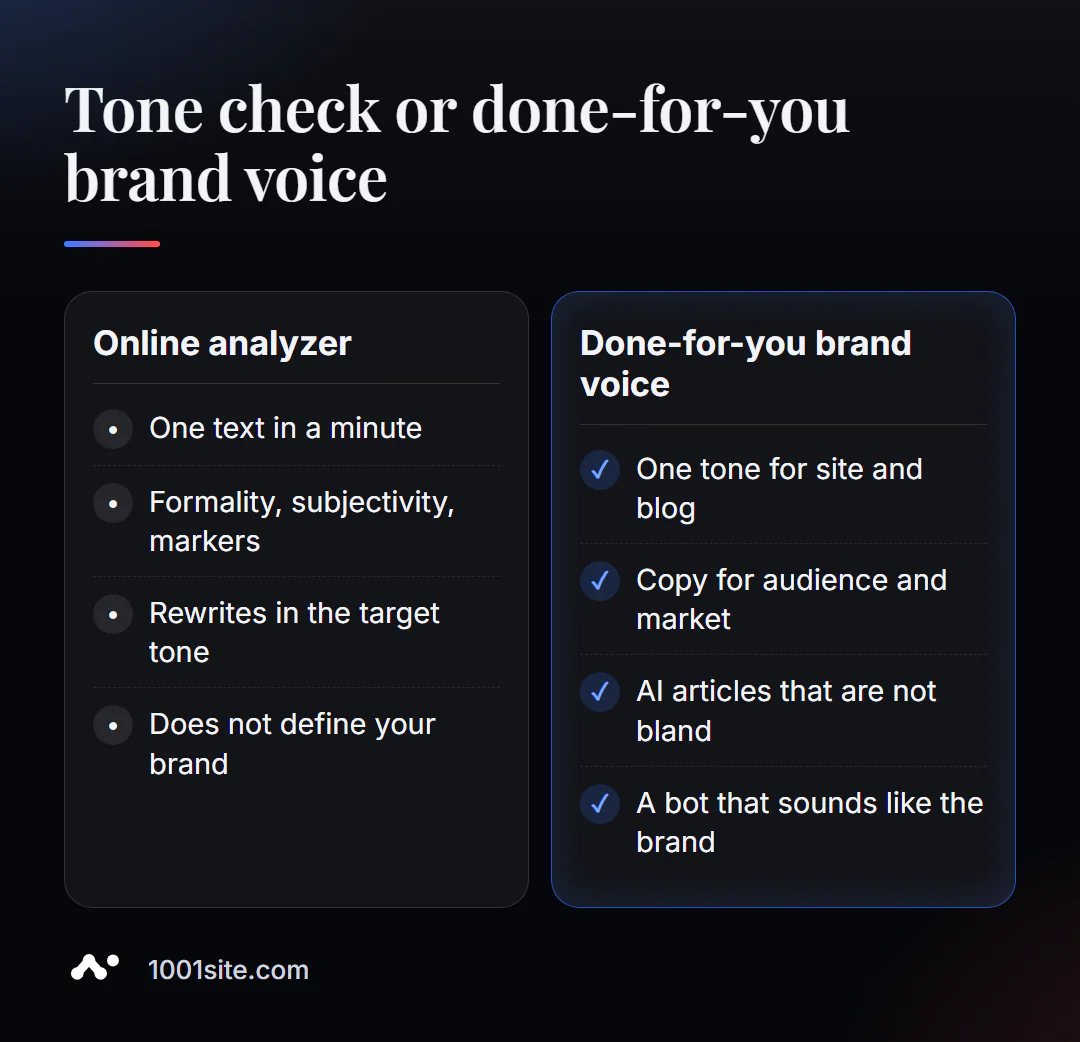
An analyzer answers the question "how does this text sound?" But deciding how a brand should sound and rewriting an entire website and blog to match it is a task of a different magnitude. A specialist is needed if:
- The texts on the site were written by different people, and it sounds like a patchwork quilt;
- You are entering a new market and need to adapt your tone to a different culture;
- a blog with AI articles sounds impersonal and readers don't come back;
- You need a chatbot or AI consultant that speaks in the brand's voice.
What can I do for your website?
My name is Valeriy Danyuk, I'm a developer and SEO specialist with 12 years of experience and over 200 clients. I create websites, blogs, and bots that speak to clients in a single voice.
SEO, content and promotion
- AI-powered SEO blog: articles are written, illustrated, and published by AI using my methodology—and they bring in organic clients.
- Turnkey SEO audit: I analyze not only the technical aspects but also the text—what's stopping visitors from finishing and submitting a request.
- How a hotel got featured in ChatGPT, Gemini, and Perplexity in 5 weeks — using AI assistants to promote its results.
- A tourism portal in 33 languages with RTL support.
Websites and online stores
- A plastic surgery center website with AI and client acquisition via Telegram.
- A website on 1001site in the style of the world's best websites: an AI assistant in the office edits texts with words like "make it warmer," "remove the bureaucratic language."
CRM, accounting and automation
All projects are in my portfolio. Send me a link to your website via Telegram —I'll let you know which pages don't look quite like what your clients expect.
Result
- Sentiment analysis measures formality on 7 levels, subjectivity from 0 to 1, and finds style markers.
- First, determine the right tone for your audience, then correct deviations: officialese, excess of assessments, leaps in style.
- Analyze paragraphs and pages, not individual phrases; always proofread rewritten text.
- Tone is the packaging, but content sells; a website with an AI assistant for editing texts can be built at 1001site.
Check out your website's homepage: analyze its tone for free. And if you need a unified brand voice for your website, blog, and bot, message me on Telegram.
Sources
- PromoPilot Sentiment Analysis tool page — metrics, languages, modes.
- PromoPilot SEO tools wiki - example of analysis results and limitations.
- Grammarly, LanguageTool, and Hemingway Editor are the official pages of these services.