
Accounting and an online store with 30,000 products: the Vertexelektro case study
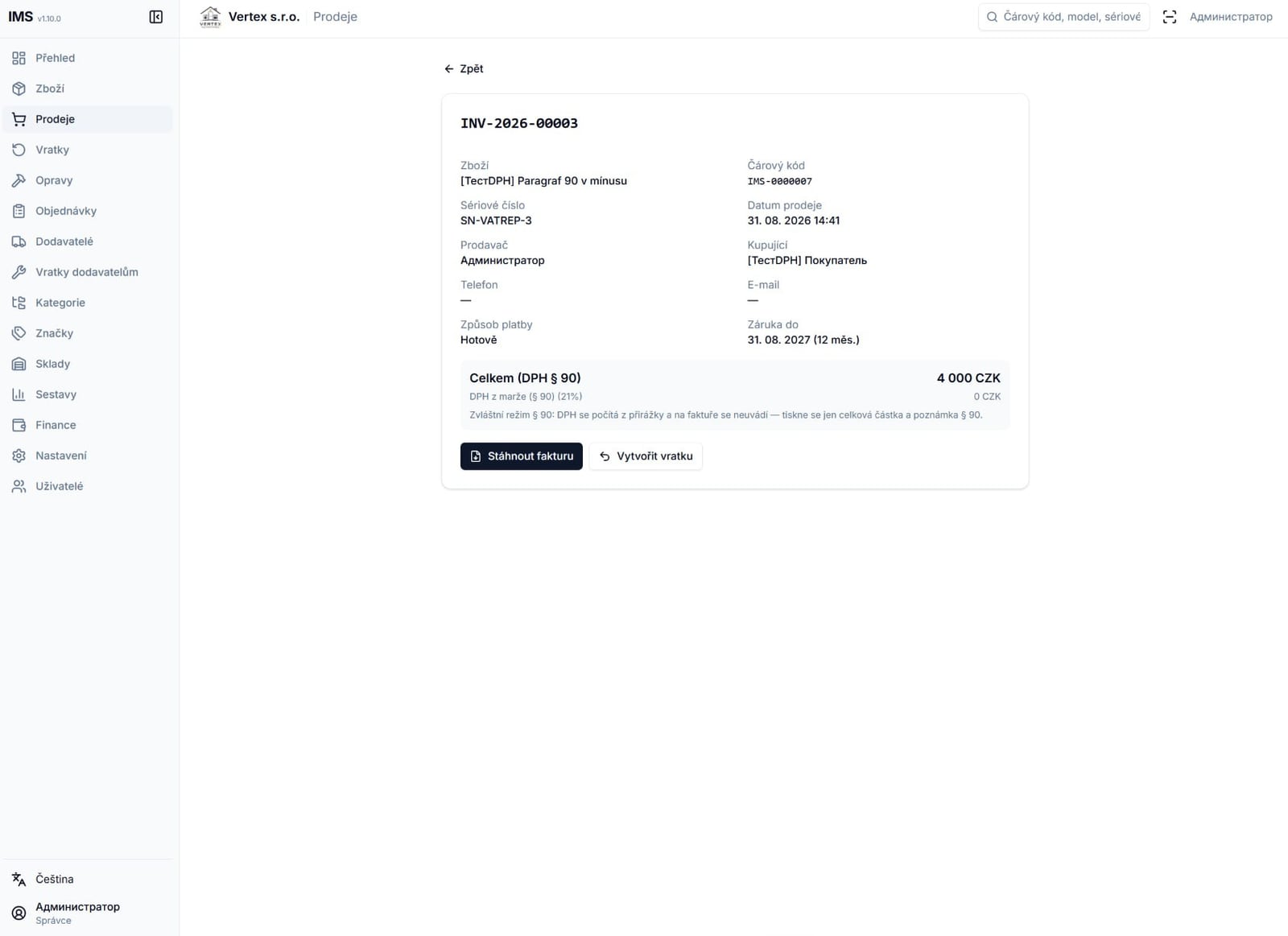
A client for whom we delivered the accounting system and online store lpkelektro.cz in June recommended us to their partners. One of them, the Czech company Vertexelektro, came to us with complete confidence even before the first call. The task was larger: accounting, bookkeeping, and an online store for retail with 30,000 products.
Analyses of such projects are published in full on the channel - from the first brief to the final act: Telegram channel.
How a Client's Recommendation Led to a 30,000-Product Project
In May and June, we built an accounting system and online store for lpkelektro.cz in just one month. The result exceeded the client's expectations, and they immediately recommended us to their colleagues and partners. One of them is Vertexelektro.
The difference from a cold order was noticeable from the very first minute. The manager who recommended us had already seen the results of our work in practice, and Vertexelektro didn't spend a lot of time scrutinizing the contractor, as is typical for projects of this scale.
What Vertexelektro needed
Vertexelektro sells household and small electronics through retail and its own storefront; its product range includes approximately 30,000 items. Three interrelated components were needed: an accounting system, a storefront for customers, and accurate VAT calculations for two different tax regimes simultaneously.
Without a unified system, these three tasks would have been handled separately. The accountant would have manually consolidated sales from the display, while VAT calculations for certain products subject to special treatment would have been handled in a separate spreadsheet outside the system. We designed accounting, bookkeeping, and the display from the start as a single system with shared data.
Build your online store with 1001site AI
How does accounting work with two VAT regimes simultaneously?
Some transactions in the Vertexelektro system are processed under a special regime known in the Czech Republic as "§ 90": VAT is legally calculated only on the markup between the purchase and sale. The accounting system (CRM) ims.vertexelektro.cz manages this regime and the standard 21% VAT separately, but within a single program—the accountant doesn't need separate tables for this.
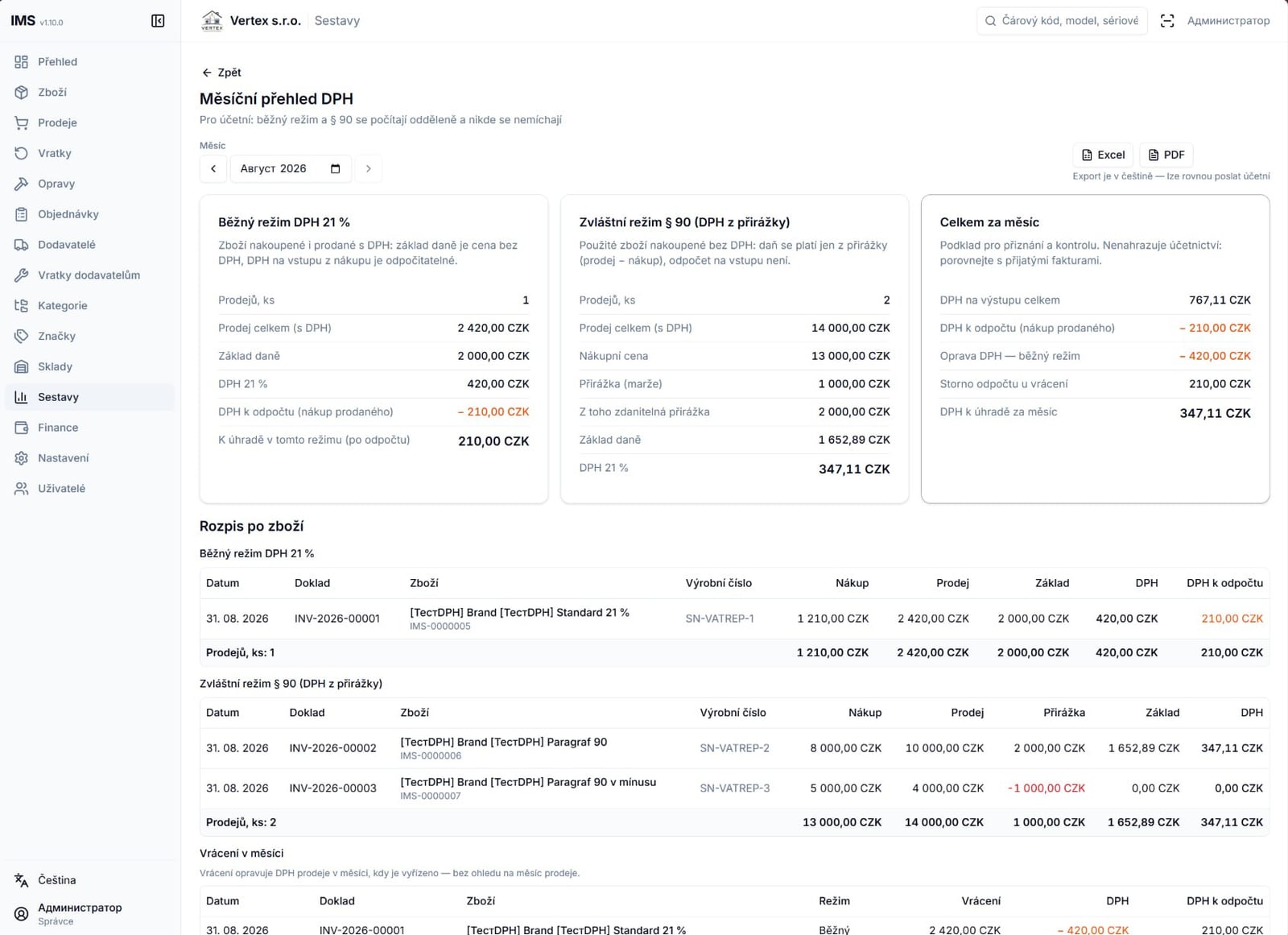
The screenshot above shows a monthly VAT report. On the left is the standard 21% tax regime (tax on the full price), on the right is the special regime (tax only on the markup), and the summary column is "Total for the month"—what to submit to the accountant. Without this distinction, the accountant would manually recalculate each sale and decide which regime to apply each time.
We already implemented a similar logic for separate calculations in the lpkelektro.cz case study. There, the main task was accounting for several warehouses simultaneously.
Analytics and document customization in one place
Vertexelektro's manager sees revenue, purchases, margins, returns, and cash on a single screen with a date-based chart, instead of combining these figures from separate reports. The company data printed on invoices and delivery notes is also entered in this dashboard.
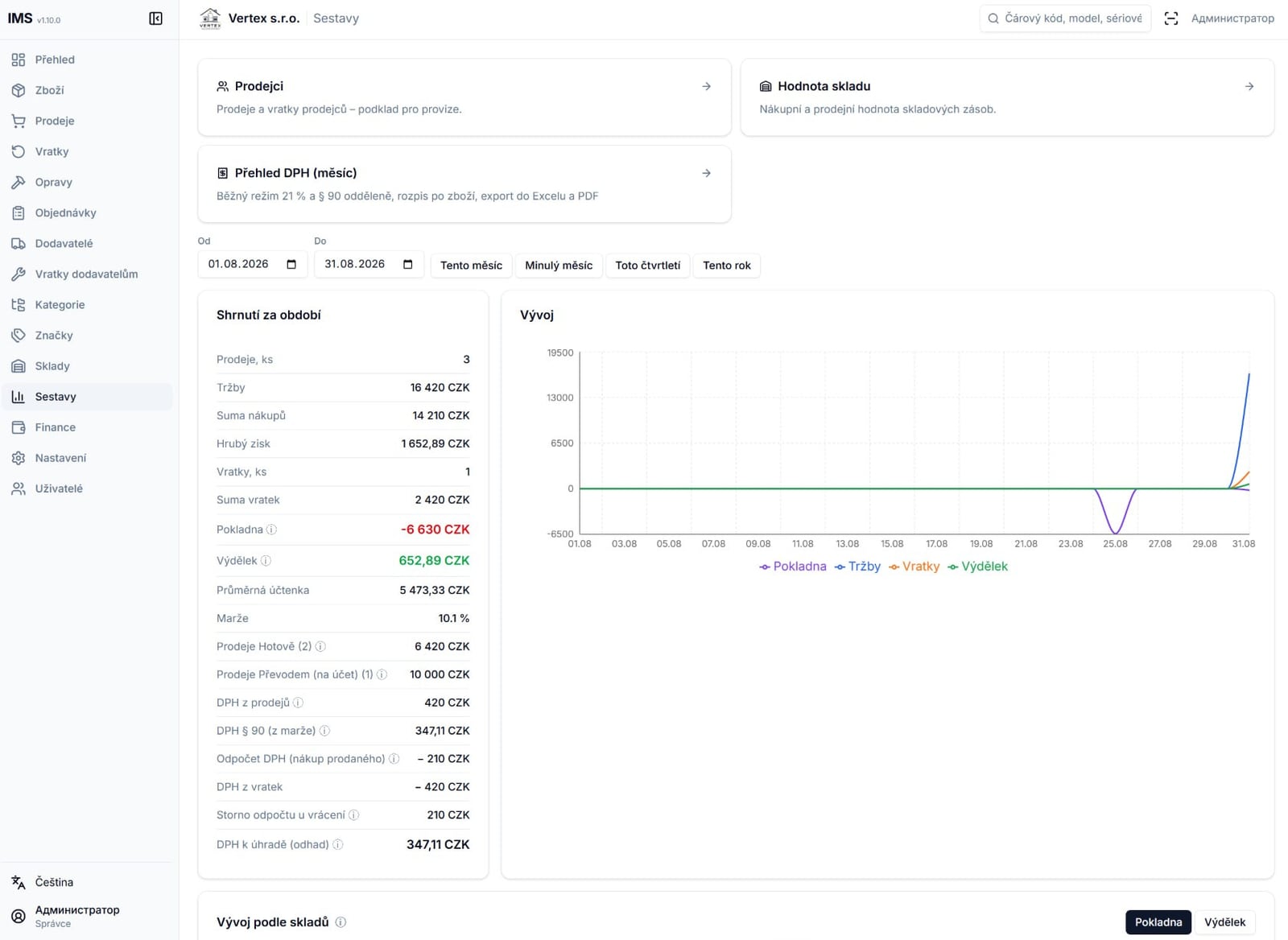
The reports section ("Sestavy" in the interface) offers three sections: vendors and their sales, inventory value, and monthly VAT—each leading to a detailed report with a single click. The graph below shows the dynamics of cash register, revenue, returns, and total profit by day for the selected period.
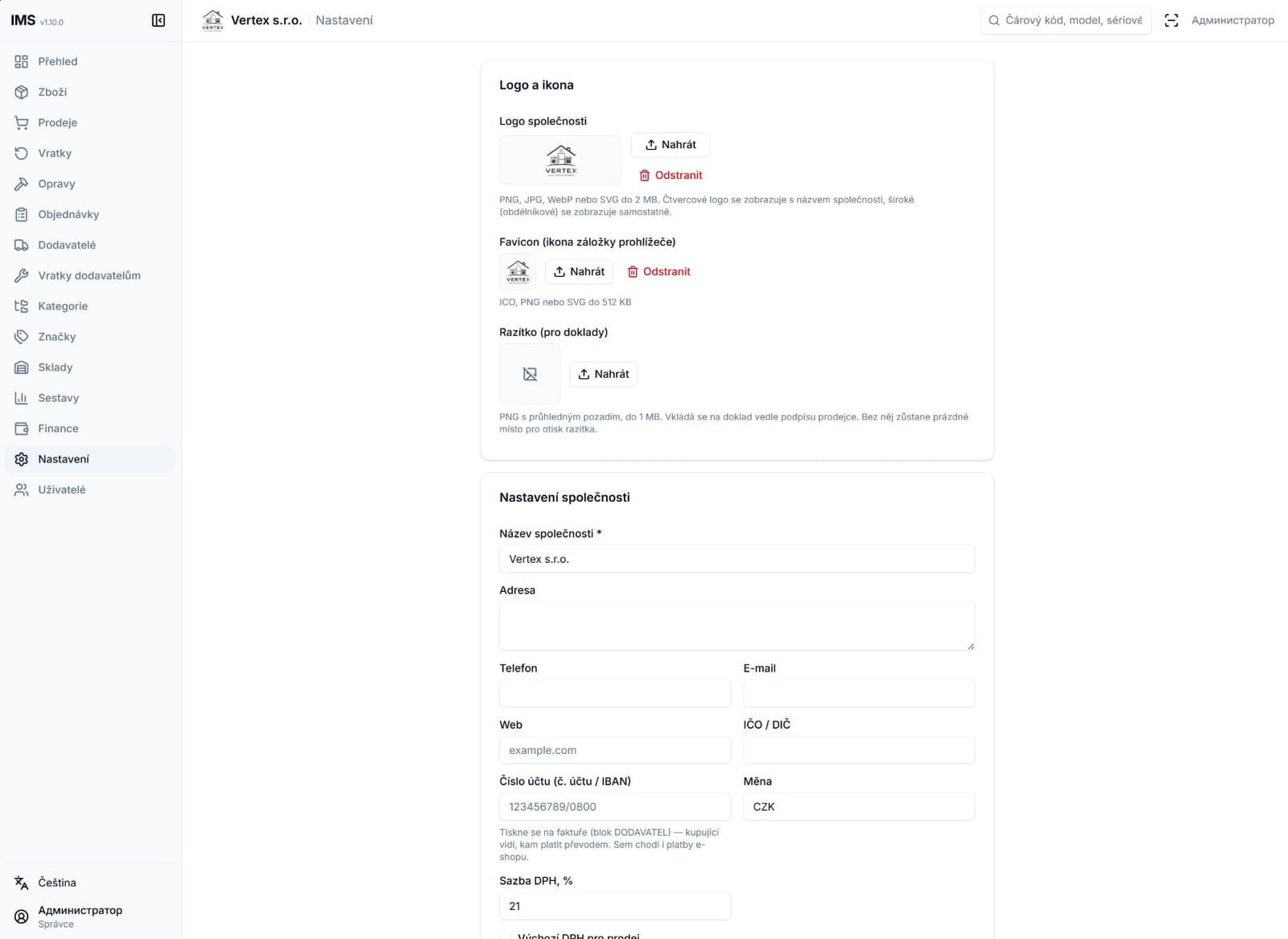
A separate settings screen controls what the buyer sees on the invoice: the company logo, bank details, the bank account number for bank transfer payments, and the default VAT rate. This is a one-time setting, but without it, each document would have to be processed manually.
What does the Vertexelektro display case look like to customers?
The vertexelektro.cz showcase is a mobile catalog with home appliance categories, a search function, and two browsing options: a standard feed and a swipe-based navigation, similar to dating apps. Shoppers select a category using the icon at the top and browse products in a convenient format.
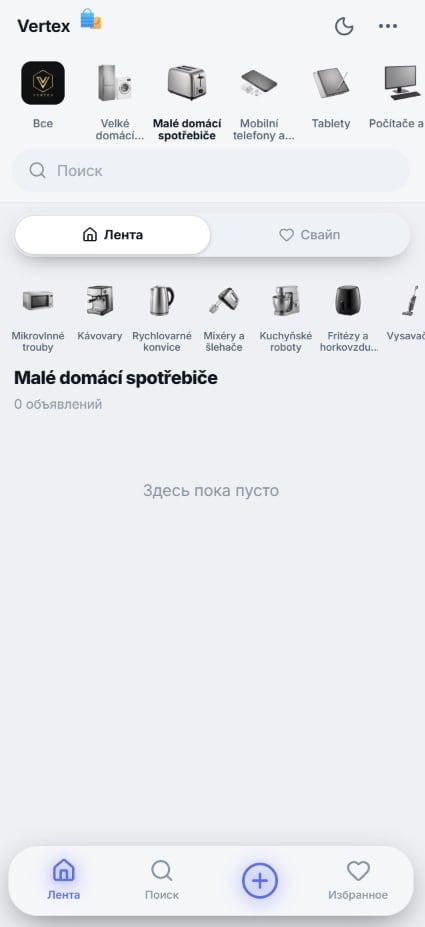
The screenshot shows the "Small Household Appliances" category open, with no products listed. At the time of review, the project was in the final stages of interface testing—the full catalog upload of 30,000 items was completed as a separate step after delivery. The storefront and CRM operate on the same data: what the accountant sees as inventory in the CRM, the customer sees as products in the catalog.
Custom development or a ready-made "Online Store" mode – which one to choose?
A custom development like Vertexelektro's is needed when the storefront can't be separated from its accounting and taxation logic. The ready-made "Online Store" mode is suitable if you need a storefront with a shopping cart and order processing, and the accounting system can be connected externally via an API—a software interface that allows the two systems to automatically exchange data.
| Criterion | Custom CRM + Showcase (Vertexelektro Case Study) | 1001site AI's ready-to-use "Online Store" mode |
|---|---|---|
| What's at the entrance? | Catalog, warehouse, accounting, two VAT regimes in one logic | List of products, catalog by link or table |
| Launch date | Custom development for your specific task | The site is assembled in 2-7 minutes, accounting integration is separate |
| Calculation of VAT under special regimes | Built into the accounting system itself | Does not fit into the ready-made mode - remains on the side of external accounting |
| Who is it suitable for? | Retail with complex taxation and warehouse logic | A store, services, or expert without such logic or with a ready-made external accounting system |
1001site AI's "Online Store" mode can receive products and inventory from an external accounting system via an API key and report sales in return. The difference is that the accounting system itself, like Vertexelektro's, is built separately for a specific business process. The ready-to-use mode only connects to such a system externally, via an API.
The result and what's next
The ims.vertexelektro.cz CRM and the vertexelektro.cz storefront are operational: the special VAT regime (§ 90) is calculated automatically and separately from the standard regime. The full catalog upload of 30,000 items was completed in a separate step after the main system was delivered.
Beyond the technical aspects, this project also had a marketing component: the client contacted us without a single cold call—on the recommendation of a colleague who was already our client. Word of mouth was built on the previous project: the delivery was on time, and the result works. A separate advertising campaign was not required.
Who is this approach to accounting and online stores suitable for?
This integration of accounting, bookkeeping, and storefront is suitable for retail businesses with a large product range and unique tax or warehouse logic—precisely where a pre-built solution doesn't fully address the need. If the task is simpler and only a storefront with a shopping cart and order information is needed, and an accounting system is already in place or not needed at all, a custom development of this scale is not required.
- Retailers with goods under different tax regimes (regular VAT and the special regime § 90 with calculation based on the markup) need a CRM that calculates both regimes separately.
- A catalog containing tens of thousands of items, which must match the warehouse stock, requires a display and accounting system based on the same data.
- A simple catalog without such logic—it's faster to build a website on 1001site AI and connect the existing accounting system separately.
Readers' Questions
What is the special VAT regime "§ 90" in Vertexelektro CRM and why is it needed?
Some transactions in the Vertexelektro system are processed under a special regime known in the Czech Republic as "§ 90": by law, VAT is calculated only on the markup between the purchase and sale. The CRM calculates the standard 21% regime and this special regime separately and does not confuse the two. Without this, the accountant would have to manually post sales between the two systems.
Is it possible to build a catalog of 30,000 products faster than with custom development?
Yes, if the catalog is simply a product showcase, without a built-in accounting system for a specific business process. 1001site AI populates the catalog using a link to the old website, feed, or table, and publishes the site in 2-7 minutes. Custom development, like Vertexelektro's, is needed when the storefront needs to be seamlessly integrated with its accounting system and a special tax regime.
How does a custom CRM with accounting differ from 1001site AI's ready-made "Online Store" mode?
1001site AI is a ready-to-use model: a website with a shopping cart, order, and payment system is assembled using a style and link, and an external accounting system can connect to it via an API. With Vertexelektro's CRM, it's the opposite: the accounting system, bookkeeping, and storefront were built from scratch for specific tax and warehouse logic; there's no ready-made template for this combination.
Why is the showcase in the screenshot empty? The project has 30,000 products, after all.
At the time of this review, the project was in the final stages of testing—the launch was still a step away. The "Small Appliances" section in the screenshot is open without any products: this is a test build of the interface before the bulk catalog upload; the store wasn't populated yet.
Sources
- The author's post on Telegram channel: https://t.me/promtvibeadd/442
- The previous project referenced in the post (lpkelektro.cz): https://t.me/promtvibeadd/378
- Customer showcase: https://vertexelektro.cz/
- Client CRM (public login page): https://ims.vertexelektro.cz/
- 1001site AI Online Store Mode: https://1001site.com/wiki/mode-shop/
Similar accounting and trading logic can be found in the cases of lpkelektro.cz, a car dismantling company with an ERP and Telegram bot, and banchem.sk, a CRM with a customer database. If your task is simpler, 1001site AI builds a website or online store from a link or description in minutes, and connects to the accounting system via API.
Project links
Discussion
Post and comments in Telegram channelБизнес с ИИ | Через замочную скважину · 21 September 2026
Questions and Answers
What is the special VAT regime "§ 90" in Vertexelektro CRM and why is it needed?
Some transactions in the Vertexelektro system are processed under a special regime known in the Czech Republic as "§ 90": by law, VAT is calculated only on the markup between the purchase and sale. The CRM calculates the standard 21% regime and this special regime separately and does not confuse the two. Without this, the accountant would have to manually post sales between the two systems.
Is it possible to build a catalog of 30,000 products faster than with custom development?
Yes, if the catalog is simply a product showcase, without a built-in accounting system for a specific business process. 1001site AI populates the catalog using a link to the old website, feed, or table, and publishes the site in 2-7 minutes. Custom development, like Vertexelektro's, is needed when the storefront needs to be seamlessly integrated with its accounting system and a special tax regime.
How does a custom CRM with accounting differ from 1001site AI's ready-made "Online Store" mode?
1001site AI is a ready-to-use model: a website with a shopping cart, order, and payment system is assembled using a style and link, and an external accounting system can connect to it via an API. With Vertexelektro's CRM, it's the opposite: the accounting system, bookkeeping, and storefront were built from scratch for specific tax and warehouse logic; there's no ready-made template for this combination.
Why is the showcase in the screenshot empty? The project has 30,000 products, after all.
At the time of this review, the project was in the final stages of testing—the launch was still a step away. The "Small Appliances" section in the screenshot is open without any products: this is a test build of the interface before the bulk catalog upload; the store wasn't populated yet.
Subscribe to my Telegram channel
In the channel « Бизнес с ИИ | Через замочную скважину», I watch and talk about how clients who have contacted me use AI in their businesses. I encourage discussion—let me know in the comments, and I'll respond directly.
Similar projects
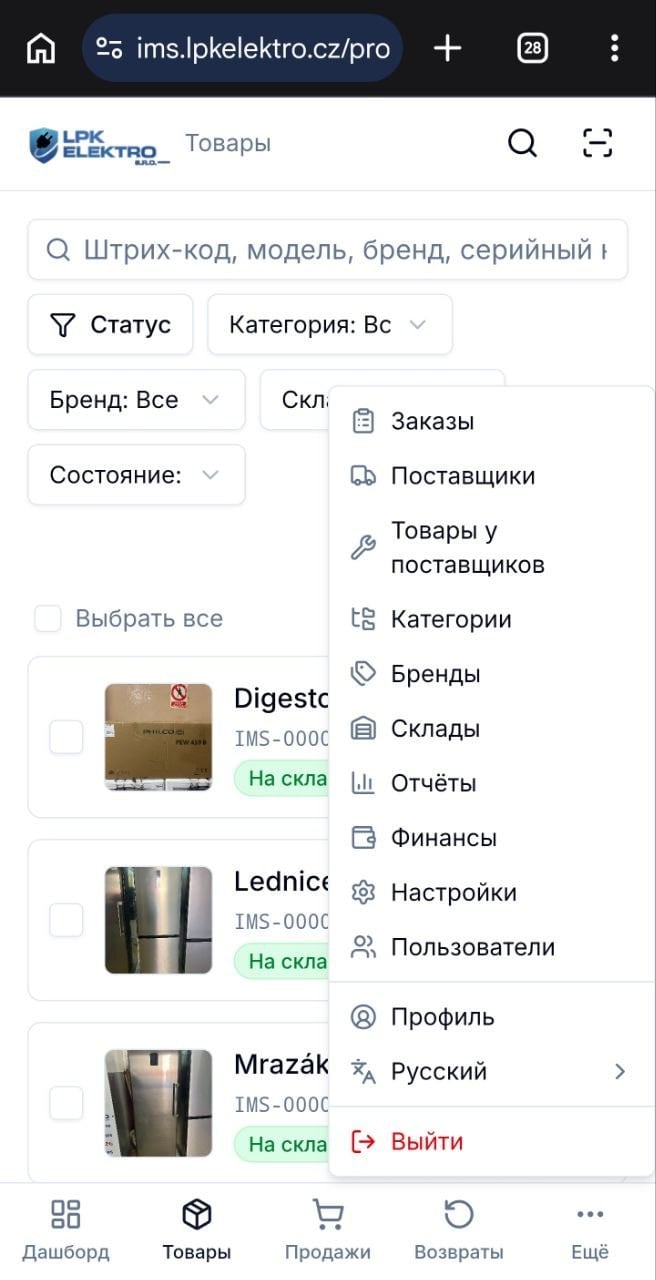
Monthly Accounting System for an Online Store: The lpkelektro.cz Case Study
Timeline, retail automation, analytics, and equipment.
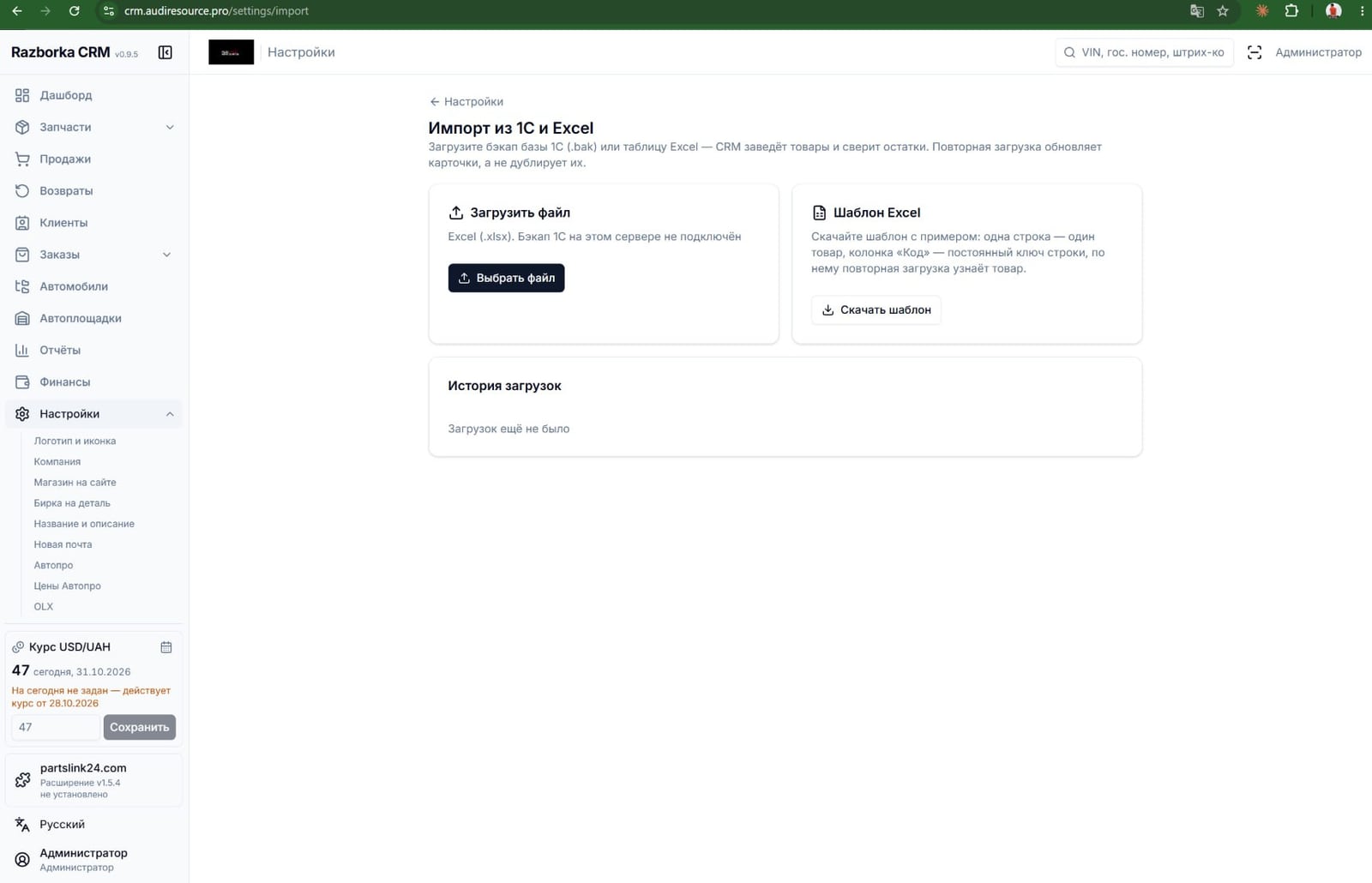
Import from 1C for auto dismantling: residuals and barcodes without duplicates
The fourth CRM case for Audi Resource: synchronization with 1C via GUID, balances without duplicates, barcodes and label printing, automatic publication on bulletin boards.
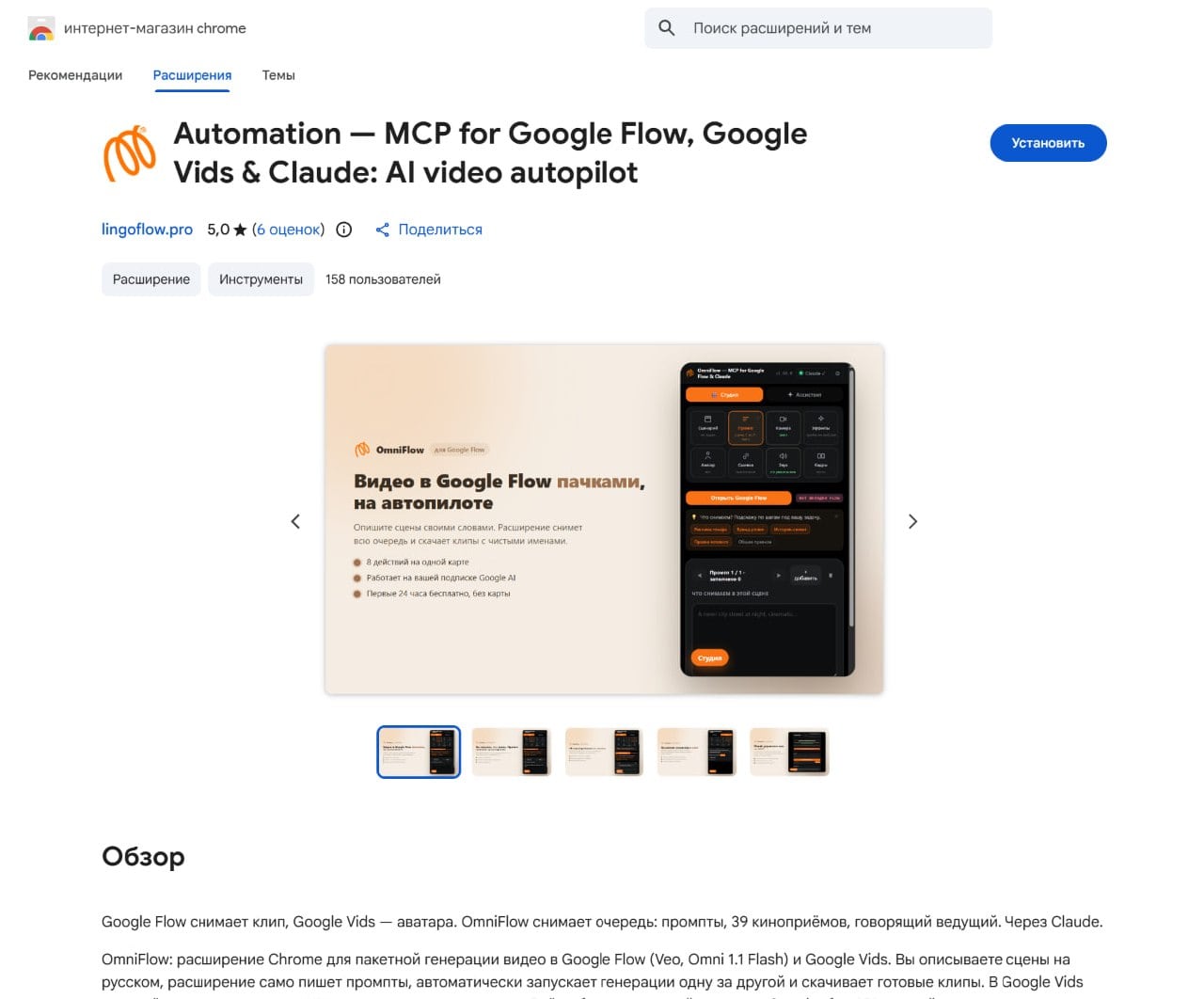
OmniFlow: How to shoot batches of videos in Google Flow and Google Vids
Case Study: The OmniFlow Chrome extension captures videos in batches to Google Flow and Google Vids via Claude —without API keys or per-second fees.