Auto parts have a requirement that T-shirts or hand creams don't: they must physically fit the buyer's specific car. Building a website for such a store can be done as quickly as for any other— 1001site AI transfers the catalog via a link and assembles the storefront within 2-7 minutes after payment. However, two aspects of this niche work differently than in a regular store: matching the part to the car and relying on photos if the part is not new. We'll explore what a ready-made website covers and what remains your responsibility, using three real-life auto dismantling case studies as examples.
Why is an online auto parts store more complicated than a regular one?
In short: a part is tied not to a size or color, but to the year, make, and model of a specific car. If you put this issue off until later, the catalog will have to be rebuilt from scratch when buyers start to get confused.
In a typical clothing store, a product has several variations—size, color. In auto parts, the number of items for a single part can reach dozens. Flxpoint, an automation service for auto parts dropshippers, puts it this way: "Even a single part, such as a headlight bulb, can turn into dozens of separate items in stock due to different cars" (translation) - flxpoint.com. This leads to a typical beginner's mistake: they initially build a storefront like any other product, but then try to add car-specific selection after the launch, forcing the catalog structure to be completely redesigned.
How to transfer a spare parts catalog to a website without manual entry?
In short: 1001site automatically takes the catalog from wherever it currently resides—from an old website, from Instagram or Facebook profile, from a Telegram channel, or simply from a spreadsheet—and organizes it into cards without manually entering each item.
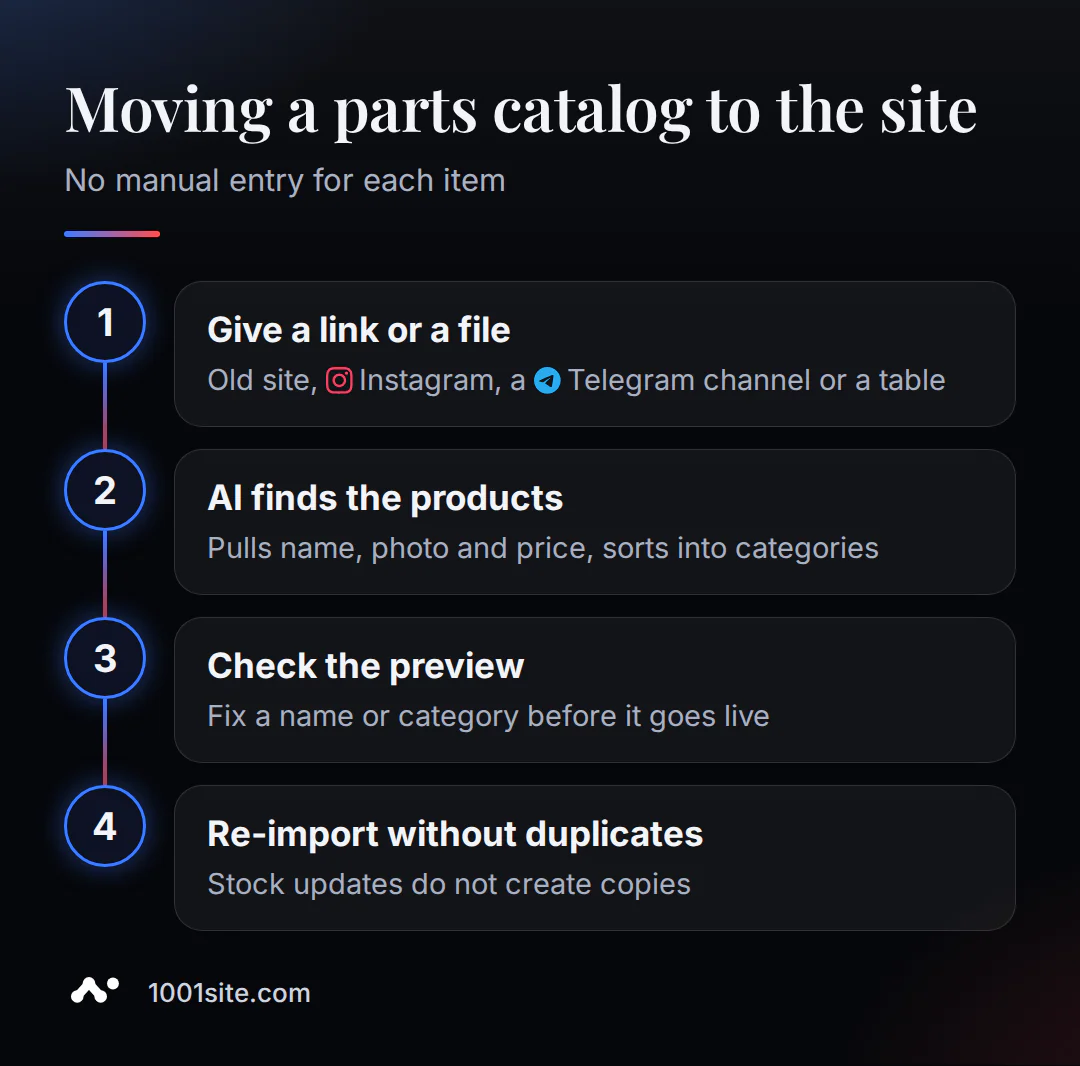
The process is the same regardless of where the parts are currently being recorded from:
- Give the AI assistant a link or file. This could be a link to an old website, an Instagram profile, a Telegram channel, or a simple spreadsheet with a list of details.
- The AI assistant finds product items. It takes the name, photo, and price, and organizes them into categories—separately by brand, model, and part type.
- Check the result in the preview. You can open each detail and adjust the title or category before the card goes live.
- Repeated import without duplicates. When a supplier updates inventory, 1001site matches the items against the card and updates it on-site—no duplicates.
All that's left to do now is finalize your store. 1001site AI will build a website in your style and transfer your parts catalog via link or table —no need for a programmer. For a full list of supported file formats and links, see the product transfer knowledge base at this link.
How can a buyer know if a part will fit their car?
In short: there's no automatic VIN matching in the ready-made "Online Store" mode—you select the right part for your car (called "fitment" in the industry). A clear name and a category by make and model are sufficient; large sites build an entire separate program around trust in fitment.
In the auto parts industry, there are industry standards for part compatibility data—ACES and PIES—supported by the Auto Care Association and distributed by the SEMA Data Co-op ( semadata.org). This is a reference infrastructure for large catalogs; a small shop doesn't need to set it up from the start. In practice, a small shop can use other tools: a clear name with the make, model, and year, a separate section for each line, and a detailed description of which modification the part is compatible with.
eBay built its Guaranteed Fit program on a similar idea: sellers fill out a compatibility chart, and buyers see a "fits your vehicle" label. The platform explains it this way: "It's important to eBay that buyers trust that the parts and accessories on our platform will fit their vehicle as advertised" (translation) - export.ebay.com. The same principle works more simply for your store – through the name, category, and description in the product page.
Which photos of used parts inspire confidence, and which ones are off-putting?
In short: a buyer of a used part is looking for photos of that particular part from several angles and an honest description of its condition – a stock photo of a new part from the manufacturer's catalog does not inspire confidence.
A close-up shot of the connector, fasteners, and wear areas is essential—the buyer is already taking a risk by purchasing an uninspected part, and they're looking for photos to confirm the seller isn't hiding it. The condition description should be specific: "minor scratches on the housing, tested under load, working" is more convincing than a general "in good condition." For a new part, the opposite applies: a manufacturer's catalog photo is sufficient if the part number matches exactly, and the unopened packaging itself confirms the condition. For a used part, there's no such shortcut—the buyer is forced to rely solely on the photo and description.
How does the store accept orders and payments without any modifications?
In short: the buyer pays by card through Stripe or Monobank, and your order, along with the ingredients and amount, is sent to you via a Telegram bot. You can submit it for assembly immediately after notification.
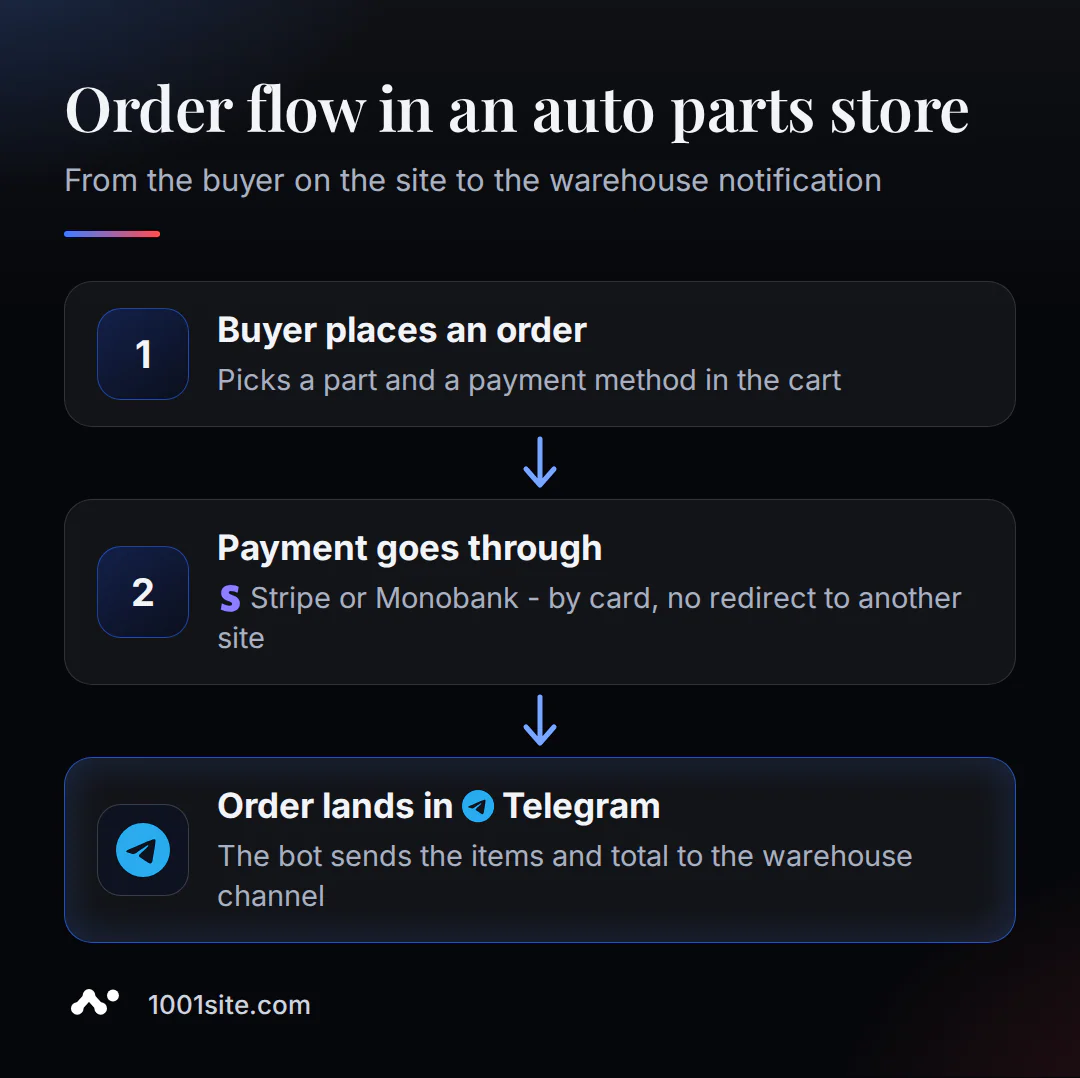
Setting up your account takes just one login. In the "Integrations" section, link Stripe (cards accepted worldwide) and Monobank —then the buyer selects their payment method directly in the cart. For notifications, you'll need your own Telegram bot: set it up via @BotFather. Then, simply add it to a work channel or warehouse group—every order, along with a list of parts and total, is added there, while the manager stands by the rack, phone in hand.
When is a ready-made system sufficient, and when is a custom ERP needed, as in auto dismantling cases?
In short: for a catalog organized into categories and options, the ready-made "Online Store" mode is sufficient. When parts counts in the thousands and inventory is required by photo or voice, a customized ERP system—a warehouse accounting system tailored to a specific process—comes into play; this is how three real-life auto dismantling cases are structured on a single platform.
For Adam, the owner of razborkaua.pro, manual data entry was his biggest pain point: a part is removed and photographed, and then someone has to manually enter the name, condition, and price into a spreadsheet. The solution was a combination of ERP, a website, and an AI-powered Telegram bot: a warehouse manager photographs the part or describes it verbally directly in Telegram, the bot recognizes the part and creates a card.
A second client of the same platform, Alexander, added a different set of customizations: integration with Nova Poshta, automatic pricing based on avto.pro data, and automatic card publishing on multiple platforms. Upon accepting the completed work, he briefly said, "What, was that even possible?"
The third client, Oleg, the owner of Audi Resource in Lutsk, had a different task. A part is purchased in one currency and sold in another, and by evening the owner should see a single profit figure. The client himself came up with the formula "daily exchange rate - income - expenses - adjustment," and the developers codified it.
All three are custom-designed for a specific warehouse; you can't set them up in an evening in your office.
| What is needed | Ready-made "Online Store" mode | Custom ERP (as in case studies) |
|---|---|---|
| Filling the catalog | via a link, table, or Instagram profile | integration with specific supplier sources |
| Creating a part card | manually or via link transfer | Based on a photo or voice description, the AI creates a card itself |
| Payment | Stripe, Monobank | under the client's accounting system, including multi-currency |
| Order notifications | Telegram bot channel | A dedicated Telegram bot for warehouse managers with a searchable database |
| Launch date | on my own in the evening | individually, case by case - from 6 days |
How do I enable product display in Google Shopping?
In short: 1001site provides a ready-made feed for Google Merchant Center - all you have to do is connect your account and ensure the price and availability on your site are up-to-date; Google does the rest.
Google scans product pages directly: " Google checks your site for new products at least once every 24 hours" (translation) - support.google.com. The requirement is simple: the price, currency, and availability must be visible on the product page. If the catalog contains several hundred items updated by a link transfer, the feed picks up the current data without manually uploading a file.
How much does it cost to open such a store?
In short: the flat rate plan costs €45 per month, with the first month being €25 with the current promo code. Catalog transfer, payment processing, and a Google Shopping feed are included in this price. There is no separate surcharge for the "auto parts" category.
There's no free plan or trial period, but you can cancel your subscription at any time, and your site will remain available until the end of your current month. Another option is to order the entire catalog from the 1001site team: a one-time payment of €1,650, with hosting for the first year included as a separate gift, valued at €540. The best deal for your catalog size is estimated in the article "How Much Does a Turnkey Website Cost?"
Who is suitable for self-assembly and who for a turnkey order?
In short: self-assembly is suitable if the catalog fits into categories and options, and you're prepared to manage photos and inventory yourself. When the volume and complexity of inventory grows to the level of the three cases above, it's time to consider custom development.
A small auto dismantling shop or a store with one or two suppliers usually fits into a ready-made model: transferring the catalog via a link, Stripe and Monobank for payment, and a Telegram bot for orders. A special case is a business without its own warehouse, where the supplier delivers the parts themselves: this is a different model, dropshipping, and it has its own rules for order acceptance and customer liability – these are discussed in the article about a dropshipping store without a warehouse. But when the warehouse grows to thousands of items, accounting by photo, voice, or multiple currencies, this is a case study of three auto dismantling cases, a custom development tailored to a specific process. Build your auto parts store on 1001site AI and decide as you go which of the two approaches is more suitable for you.
Sources
- Auto Care Association/SEMA Data Co-op - ACES and PIES Parts Interoperability Standards
- eBay - Guaranteed Fit program
- Google Merchant Center - Site Crawl Help
- Flxpoint - The Complexities of an Auto Parts Catalog for Dropshippers
- Barn2 - auto parts on WooCommerce
- Shopify - Auto Parts Dropshipping
- AUTODOC - Press Release on the Company's Growth in Europe
- Prom.ua - How to sell auto parts on the marketplace
- Rubicon Automotive Group - How to Identify a Quality Used Part