You don't have physical inventory—you only have a website. The buyer pays you, and the supplier assembles and ships the package. To launch a dropshipping website without a warehouse, you don't need a warehouse or a starting stock—you just need a catalog, a way to accept payments, and a way to notify you of new orders. The article explains what's your responsibility in this model, and what isn't, and how to set up a store like this without manually entering each product.
What is a dropshipping store without a warehouse?
In short, this is an online store where the roles of the seller and the warehouse are separated - you manage the storefront and communicate with the buyer, while the supplier stores the goods and ships them directly to the buyer.
The only difference from a traditional online store is where the product is sourced at the time of ordering. The storefront, shopping cart, checkout, and payment process are the same in both cases. The difference begins after payment: in a traditional store, you pack and ship the package yourself, while in dropshipping, the supplier does this based on your request—and you receive the difference between the selling price and the supplier's price.
Who is responsible to the buyer if the goods are sent by the supplier?
In short: you, not the supplier, are responsible—legally, the buyer deals with your store. If the product doesn't arrive, arrives incorrectly, or wasn't shipped at all, you, not the supplier's warehouse, are responsible for the claim—even if you've never seen the product yourself and merely passed on the order.
This is the point that really confuses newcomers. The European Consumer Centres Network, which unites consumer centres across the EU, puts it bluntly:
"Dropshippers, as sellers of goods, have a direct responsibility to consumers and cannot redirect them to the manufacturer" (translation).
This is a general principle of seller liability to the buyer. In practice, it also applies to delayed shipments, product substitutions, or unfulfilled orders—regardless of who physically collects the package, the buyer files a claim with you, not the supplier's warehouse. In the EU , the Consumer Rights Directive 2011/83/EU also applies: 30 days for delivery from the date of order (unless you specify a different period) and 14 days for returns without explanation—these timeframes are common for distance selling, not just dropshipping. In the US, there's a similar principle: the Federal Trade Commission requires shipping within the advertised timeframe and an honest description of the product and delivery time. The supplier's contract describes their obligations to you, but does not relieve you of your obligations to the buyer.
How to fill a catalog without manually entering each product?
In short: 1001site transfers products via a link to the supplier's website or their product file (feed), via a TikTok profile, via a link to a post or Reels on Instagram and Facebook, via a public Telegram channel, or via a spreadsheet—no need to enter cards manually.
Give the AI assistant a link to the supplier's catalog – it will automatically find product pages, extract the title, photo, price, and description, and organize them into categories on your website. A preview shows exactly what was found before it goes live – you can cancel or edit it before publishing. This isn't exclusive 1001site: in 2026, similar AI catalog scanners with supplier links will also be offered by standalone dropshipping services like AutoDS – indicating this is a general market trend, not a one-off move by a single designer.
Understanding the catalog transfer yourself is half the battle. 1001site AI will build a website in your style and populate your catalog using a supplier link or table —without the need for a programmer or manual entry of each product page. A detailed breakdown of which links and files are suitable for transfer can be found in the knowledge base on transferring products using links.
How can I avoid duplicate products when updating my catalog again?
In short: duplicates appear when, during a repeated catalog transfer, a product receives a new ID instead of updating the old card - 1001site verifies the products during a repeated import and does not create duplicates.
This is a common technical issue for those setting up supplier synchronization for the first time on other platforms: the same item appears on the storefront twice under different numbers, and the customer sees "two identical pots" in the catalog. Technically, this is because the system matches products not by name, but by an internal identifier. If this identifier changes between uploads, a new card is created instead of updating the old one.
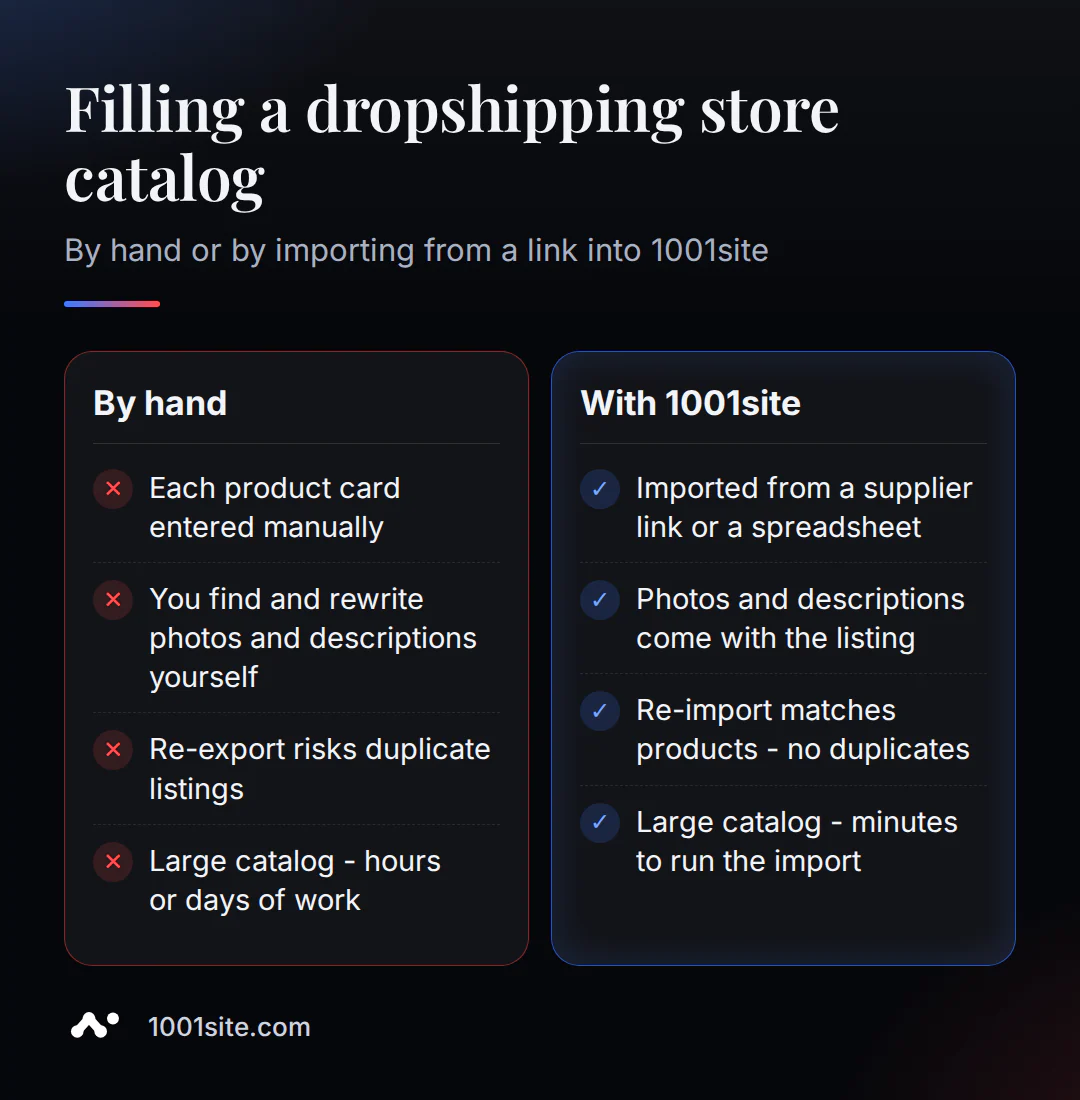
| What are we comparing? | With your hands | From 1001site |
|---|---|---|
| Adding a product | Hand-printed card: photo, name, price, description | by link to the supplier or by table |
| Re-updating the catalog | risk of duplicates with each new export | re-import without duplicates |
| Time to add a directory | hours or days for manual entry | minutes to start the transfer |
| Photos and descriptions | search and rewrite yourself | are transferred along with the card |
How to choose a supplier to avoid problems with delivery and returns?
In short: check actual delivery times and reviews before your first order, don't buy a supplier's entire catalog without focusing on a niche, and don't base your business on a single supplier.
Three things that most often fail newbies in dropshipping:
- Too broad a product range without a niche. In a review of common dropshipping mistakes, Printful cites this as the main reason for startup failure: "Choosing the wrong or too broad a niche can create a host of problems" (translation) – it's harder to build a brand and explain to customers how your store is different from hundreds of similar ones.
- Delivery takes longer than promised on the website. You have no direct control over how quickly the supplier assembles and ships your package, so the delivery times on the website should be realistic, not optimistic.
- One supplier for the entire store. If they run out of stock or lose contact, all your orders are immediately stopped. It's smarter to work with multiple suppliers across different categories.
Before adding a supplier to your catalog, review their return policy separately from your own. What you promise to the buyer on your website and what the supplier is willing to accept back from you are two different documents. They don't always match.
How does the buyer pay and how do you know about a new order?
In short: the buyer pays by card through Stripe (globally) or Monobank, and your order is sent to you via a Telegram bot—with the amount and items—to be passed on to the supplier.
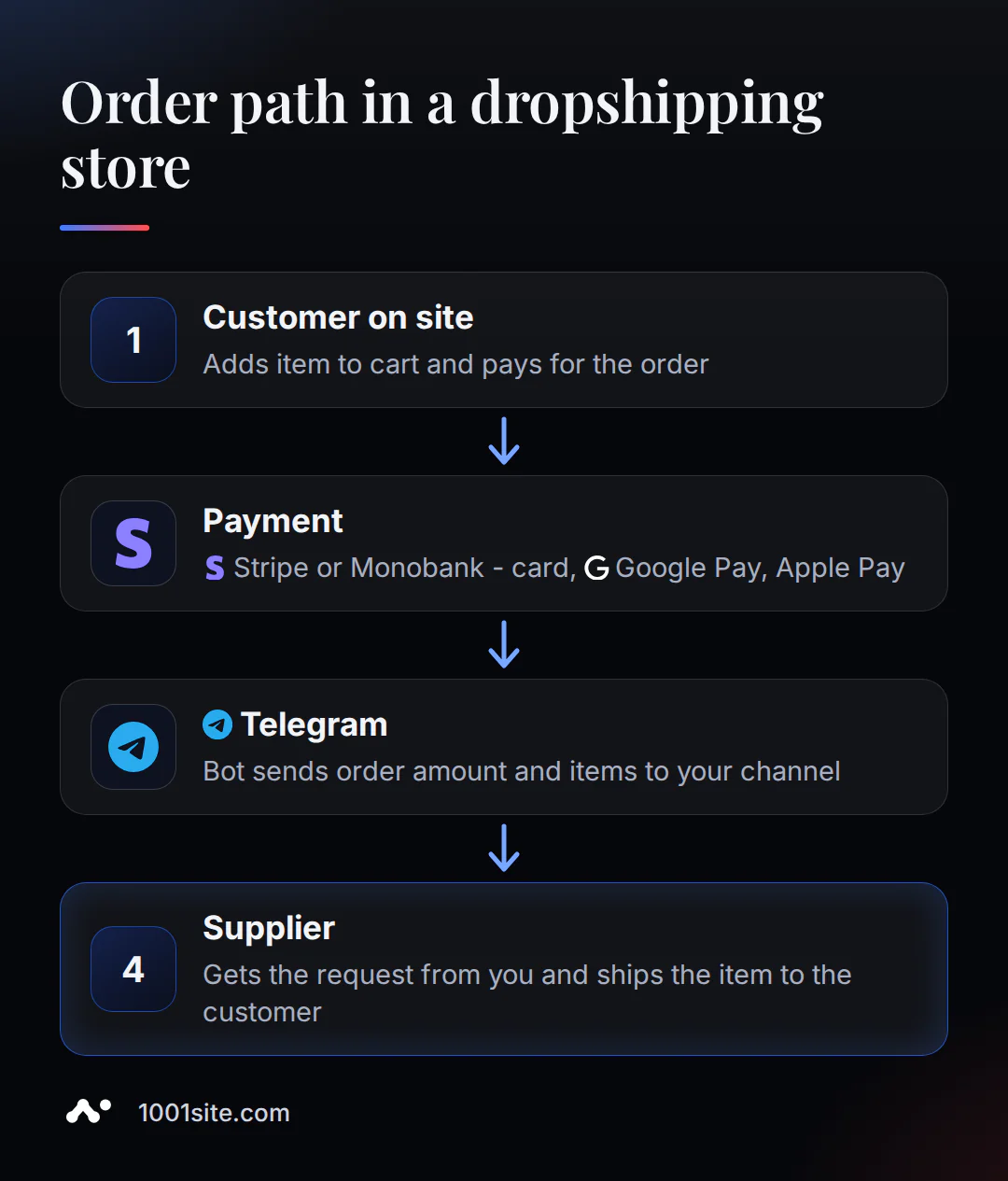
Payment and order acceptance are configured in the "Integrations" section of your account: simply insert a Stripe key or Monobank token, and the buyer will see available payment methods in their cart. Order notifications are handled by a separate bot: create it with @BotFather, add it as an administrator to your channel or group, insert the token in your account, and each new order, including the amount and items, will be sent there. Then you submit the order to the supplier—manually or through their interface, depending on how they work.
How much does it cost to open a dropshipping store?
In short: the "All Inclusive" plan is €45 per month, the first month with a promo code is €25; there is no additional charge for filling the catalog or accepting payments.
The plan covers the entire website—the store, catalog transfer via link, payment, and order notifications are included in the plan and are not sold separately. There is no trial period or free plan, and you can cancel your subscription at any time—the site remains operational until the end of your paid period. For those who prefer to have their store built and populated, there's a "Turnkey" plan—a one-time fee of €1,650, with 12 months of hosting included. For a cost comparison between a website builder and a one-time development, see "How Much Does a Turnkey Website Cost?"
Who is the dropshipping model suitable for and who is it not?
In short: this model is suitable for narrow niches with a clear supplier – auto parts, accessories, home goods, and handmade goods – sold through a partner manufacturer. It's not suitable for those who value same-day delivery or quality control in the warehouse.
Auto parts sellers are often looking for this format. They offer a specific part for a specific car model, which they don't need to stock themselves: they can upload it via a link to the supplier's catalog and sell it under their own brand. The same principle applies to accessories, household goods, and niche cosmetics—anywhere catalog breadth is more important than instant shipping from their own warehouse. If same-day delivery or in-house quality control before shipping is critical for your business, dropshipping isn't suitable, and it's better to consider a regular online store with its own warehouse (the same approach as 1001site, but without the need to transfer products from the supplier).
Sources
- TechTarget - Defining the Dropshipping Model
- European Consumer Centres Network - Dropshipper's responsibility to customers in the EU
- Fulfillment.wiki - EU Consumer Directive 2011/83/EU
- Dropbuild - FTC Rule on US Shipping Times
- US Chamber of Commerce (CO-) - Model Basics and Risks
- Avalara - Sales Tax and Dropshipping in the US
- Printful Blog - Common Mistakes When Starting a Dropshipping Business
- ClaimLane - Return Management for Dropshipping
- Craftshift - Technical Reason for Duplicate Items When Re-Importing
- AutoDS - Catalog Automation for Dropshipping in 2026
Understanding the model is the first step, building the website is the second. 1001site AI will populate your catalog with a supplier link and set up payment and order notifications in one place.