Your website ranks in the top three Google results for a given query, but when a client asks ChatGPT, Gemini, or Perplexity which businesses in their area can be trusted, your name isn't included. This isn't a glitch or " Google machinations": AI assistants select search sources differently than regular search results. Some of these rules are automatically implemented by the website if it's built correctly, while others need to be manually verified. We'll explore 7 GEO checks for small business websites—what differentiates real work from agency myths, and which of these checks 1001site AI already resolves automatically.
Why are you on Google but not on ChatGPT?
In short: positions in regular search results and the presence of an AI assistant in the response are two different source selection mechanisms, and one does not guarantee the other.
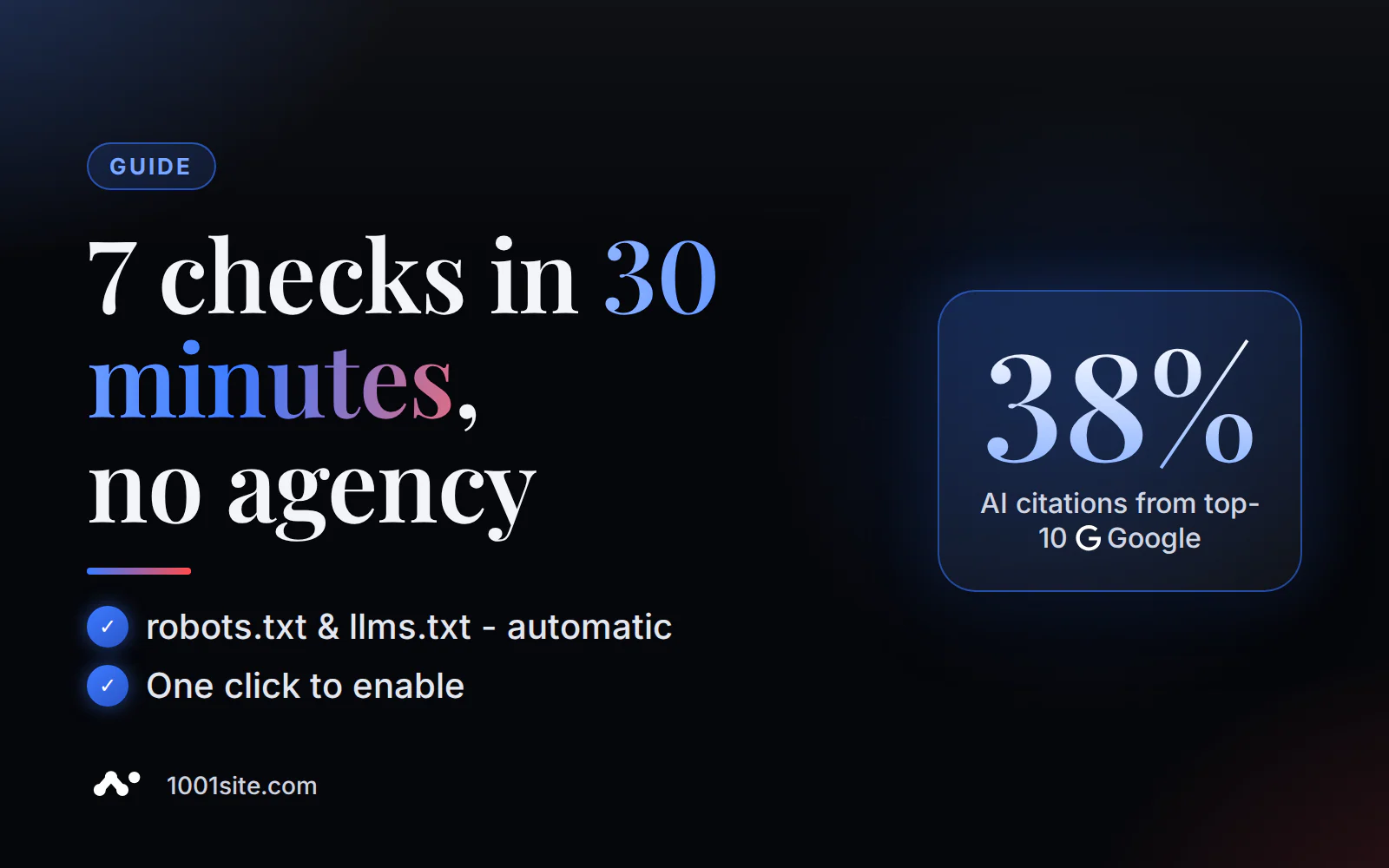
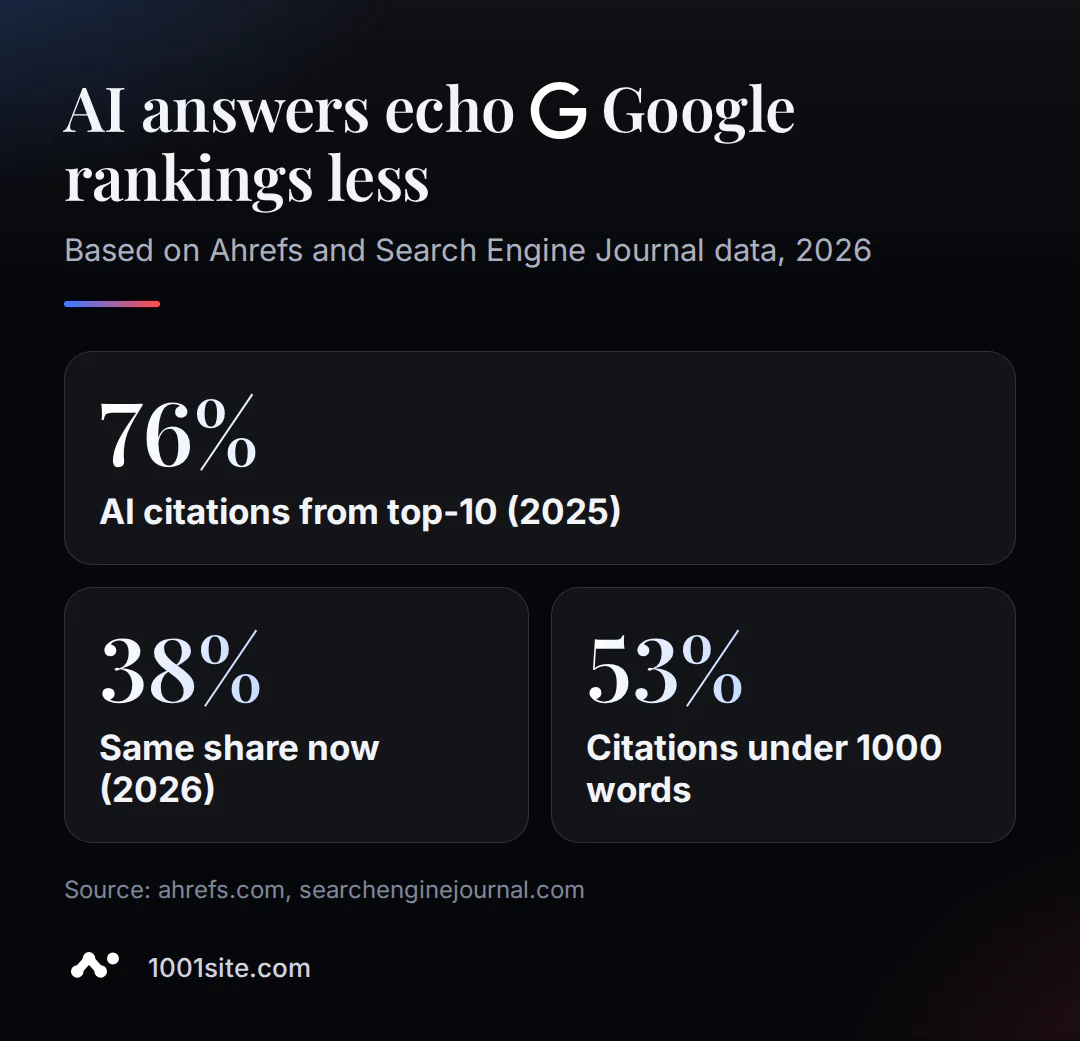
On October 15, 2026, Google redesigned AI Overviews and AI Mode: sources in the results became more visible, and thumbnail cards for news topics were added ( similarweb.com). Against this backdrop, Ahrefs recorded a more alarming figure for website owners. The share of pages cited by AI Overviews specifically from the top 10 organic search results fell from 76% to 38% ( ahrefs.com) – Search Engine Journal also reported this ( searchenginejournal.com), citing Ahrefs. Simply put: being number one in Google is no longer the same as being a source for an AI answer. On October 27, 2026, a separate free tool for auditing small business visibility specifically in AI search was released – independent confirmation that the problem is widespread ( streetinsider.com).
What is GEO really – and what does llms.txt have to do with it?
In short: GEO (generative engine optimization) is a set of technical and substantive conditions under which an AI assistant can read, understand, and cite your page; llms.txt is just one small item in this set, not a magic button.
The first controlled study on the topic was conducted by a group from Princeton: adding exact citations, direct quotes, and statistics to a page increased the likelihood of a source being included in an AI response by up to 40% (KDD 2024, arxiv.org/abs/2311.09735). llms.txt is an instruction file for AI assistants, similar in meaning to robots.txt for regular search engines. It is quickly gaining popularity among large e-commerce platforms, but no independent study has yet confirmed a direct link between the presence of this file and citation frequency. A reasonable position: adding it doesn't hurt and requires no effort if you do it yourself; expecting increased visibility from a single file is not worth it.
Check 1-3: Are you blocking AI bots yourself?
In short: the most common reason for a business's invisibility in AI responses is its own robots.txt, which blocks ChatGPT, Gemini, and Perplexity bots from accessing the site; content usually has nothing to do with it.
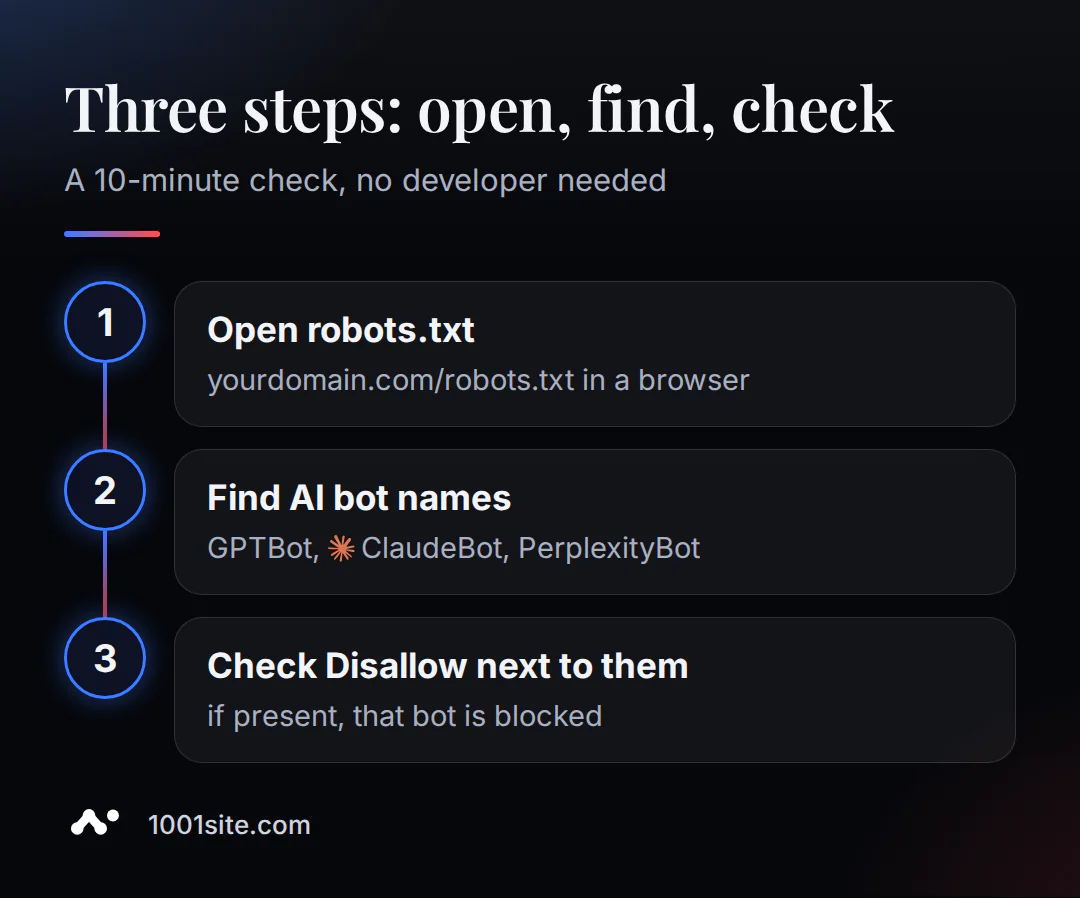
- Open
вашдомен.ком/robots.txtin your browser. This is a text file that every website has. - Find the lines with bot names —
GPTBot,Claude Bot,PerplexityBot,Google -Extended. Some platforms and CMSs have these closed by default "just in case," even though the owner hasn't requested it. - Make sure there's no
Disallow: /next to the bot you're looking for. If there is, there's a technical reason for its invisibility that no text or advice article can fix.
If the bot list and Disallow values don't mean anything to you, that's okay. There's no need to manually understand robots.txt syntax. 1001site AI reduces this check to a single checkbox—we'll cover it in the ready-made solutions section below.
Test 4-5: Does the reader get the answer right away, without a long introduction?
In short: according to practitioners' observations, the majority of pages that are most frequently cited by AI assistants have a direct answer to the question in the first 100 words—the page simply doesn't survive to be cited if it adds unnecessary introduction before the answer.
This pattern is called BLUF (bottom line up front): first the direct answer, then the explanation and details. An important caveat: the Perplexity ranking formula is not officially published; it's an observation by practitioners based on independent samples of cited pages, not a verified algorithm. But even as a working hypothesis, the rule is sound: an "About Us" page that begins with a three-paragraph story of the company's founding is more difficult to rank for than a page that provides the answer immediately.
Is microdata necessary? And does it really increase citations?
In short: microdata (Schema.org) is a mandatory hygiene minimum for regular SEO and Rich Results in Google, but a large study did not find its independent effect on citation frequency in AI responses.
This is one of the most common paid tips from agencies: "Add microdata, and AI will start citing you." One major SEO study from 2026 tested this on a large sample of pages with added JSON-LD markup and found no significant increase in citations in AI Overviews, AI Mode, or ChatGPT. This doesn't mean microdata is useless—it's still important for organic search and for helping Google understand price, availability, and product photos. But selling it as a separate "GEO lever" is an exaggeration that's not worth overpaying for.
How does 1001site close these checks automatically?
In short: 1001site AI does some of the above automatically when creating a website and when saving each product - without manually editing files.
According to the 1001site knowledge base, when a website is created, robots.txt is automatically generated with permissions for search and AI bots, as well as llms.txt with instructions for assistants. When a product is saved, structured data for Google Rich Results, an entry in sitemap.xml, and a preview for social media are created. A separate toggle switch, "Enable site for AI indexing," in the "SEO and promotion" block, disables all checks 1-3 from this analysis: enabled, GPTBot, Claude Bot, and PerplexityBot see the site, and products can be included in assistants' responses; disabled, bots are blocked in robots.txt. The "SEO Analyzer" also checks with one click what's configured and what needs improvement—it's the same self-checking principle discussed in this article, only integrated into the dashboard. For businesses looking to go beyond a one-time switch, the "AI and MCP " section offers catalog export as a knowledge base for Gemini Gem or NotebookLM—learn more in the article about connecting Claude, ChatGPT, and Gemini. 1001site AI already includes these checks when creating a website —no need to configure them separately.
How much does it cost - and how much would it cost separately?
In short: basic GEO hygiene, discussed above, is included in the standard website builder plan; as a separate agency service, it typically costs between €1,400 and €4,500 per month.
According to HubSpot, the budget for a GEO agency for a small business is typically €1,400-€4,500 per month, but free tools are sufficient for the first 3-6 months if the basics are already in place: microdata, company profile, FAQ, and unified business data across all platforms ( blog.hubspot.com).
| Option | What's included | Price |
|---|---|---|
| GEO agency (HubSpot rating) | Audit, micro-markup, company profile, management | 1400-4500 €/month |
| 1001site AI, “All inclusive” tariff | Robots.txt, llms.txt, structured data, AI indexing switch, SEO analyzer - already on the site | 45 €/month (first month with promo code - 25 €) |
A separate agency invoice for GEO hygiene is not required - it is included in the tariff.
What should I do if the checks have been passed, but there are still no applications?
In short: being quoted and being recommended by an assistant are different levels, and the mere fact of being mentioned does not equal a flood of requests the next day.
This is the main trap of expectations: a business owner enables AI indexing, sees a mention of the website in the assistant's response, and expects requests the next day. No one can guarantee a specific result here: indexing and mentions by AI bots do not guarantee requests. A reasonable next step is not to abandon the checks halfway through. Exactly the same set of conditions (open bots, structured data, a clear website structure) has already led a specific business to be recommended by three assistants – as discussed in the case study about a hotel that was recommended by ChatGPT, Gemini, and Perplexity.
Sources
- Google AI Overviews and AI Mode, updated 10/15/2026 - similarweb.com
- Ahrefs, share of AI Overviews citations in the top 10 - ahrefs.com/blog/ai-overview-citations-top-10
- Search Engine Journal, an analysis of the same Ahrefs study - searchenginejournal.com
- StreetInsider launches free AI visibility audit for small businesses, October 27, 2026 - streetinsider.com
- Aggarwal et al., "GEO: Generative Engine Optimization", KDD 2024 - arxiv.org/abs/2311.09735
- HubSpot, GEO for small businesses on a budget - blog.hubspot.com
- SEO and AI indexing - 1001site knowledge base
You can check your website on all these points yourself in half an hour. If you don't have a website yet or it's built on a website builder without these settings, 1001site AI will build it with built-in AI indexing from day one.