
How to give a partner a personal store using a single phone number
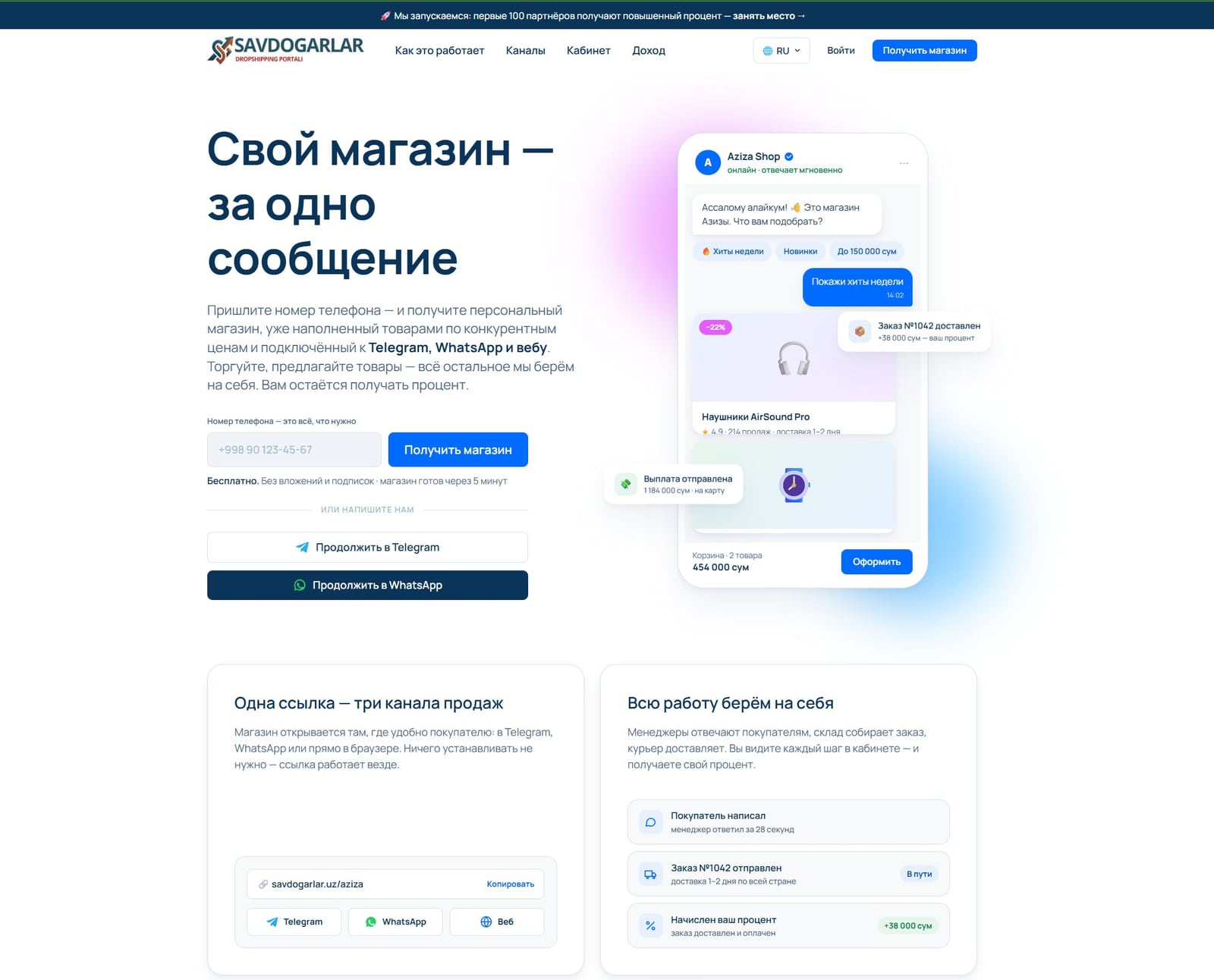
A customer from Uzbekistan had previously managed dropshipping stores on Telegram, but only manually: he created a channel for each partner, added products himself, and calculated payments to each partner and how much. The goal was to eliminate this manual work and create a common catalog from which partner stores could be assembled independently. This is how the dropshipping platform for partners, Savdogarlar ("Merchants" in Uzbek), was born—a single product catalog and a personal store for each seller.
What is this project: a unified catalog and partner stores
The dropshipping model: the seller (dropshipper) sells from someone else's catalog for a commission, without maintaining their own warehouse or purchasing the product in advance. Savdogarlar's entire system is based on five principles:
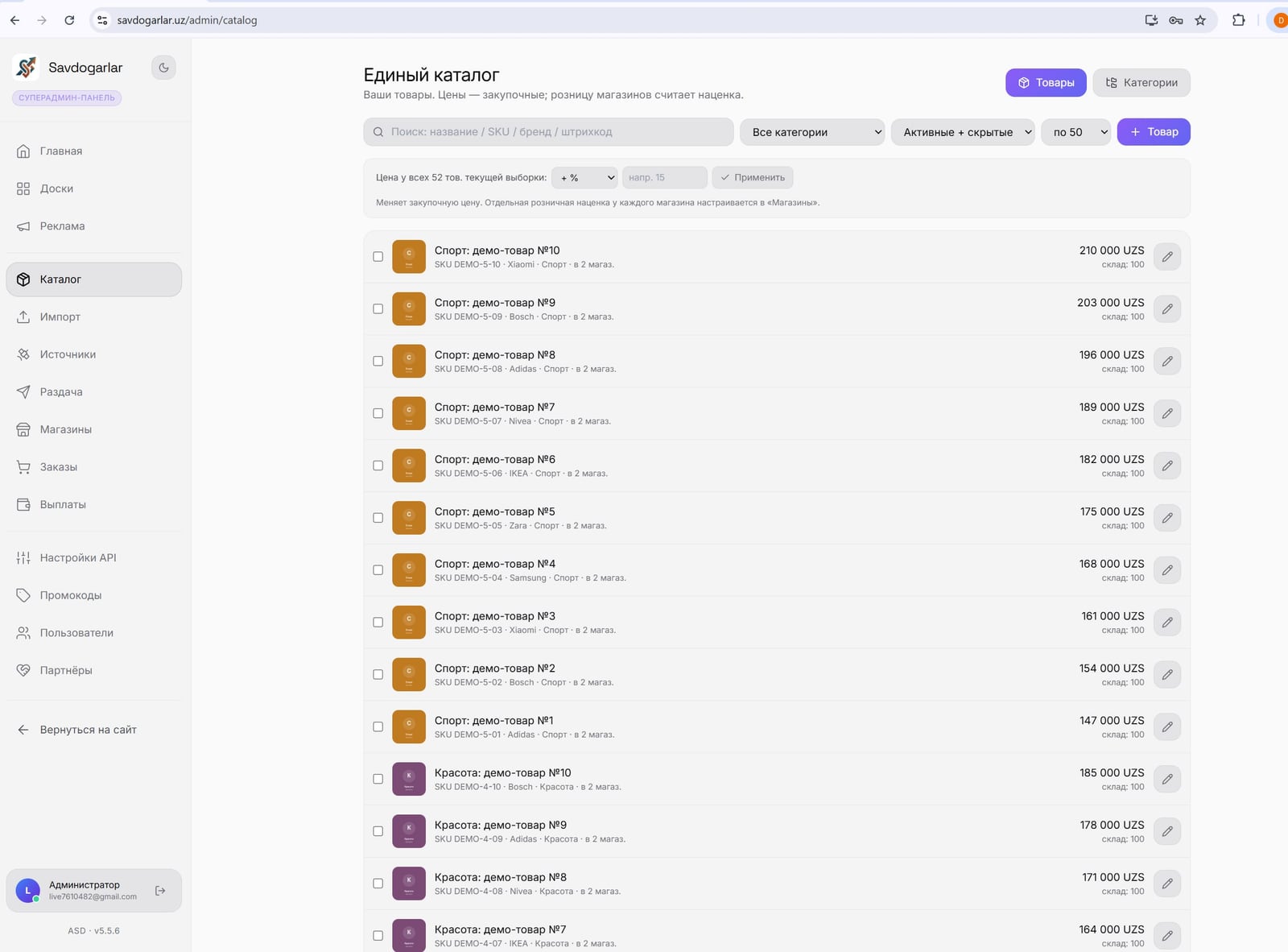
- Unified catalog - one general list of products for the entire platform.
- Unlimited number of stores - a personal store for any number of dropshippers.
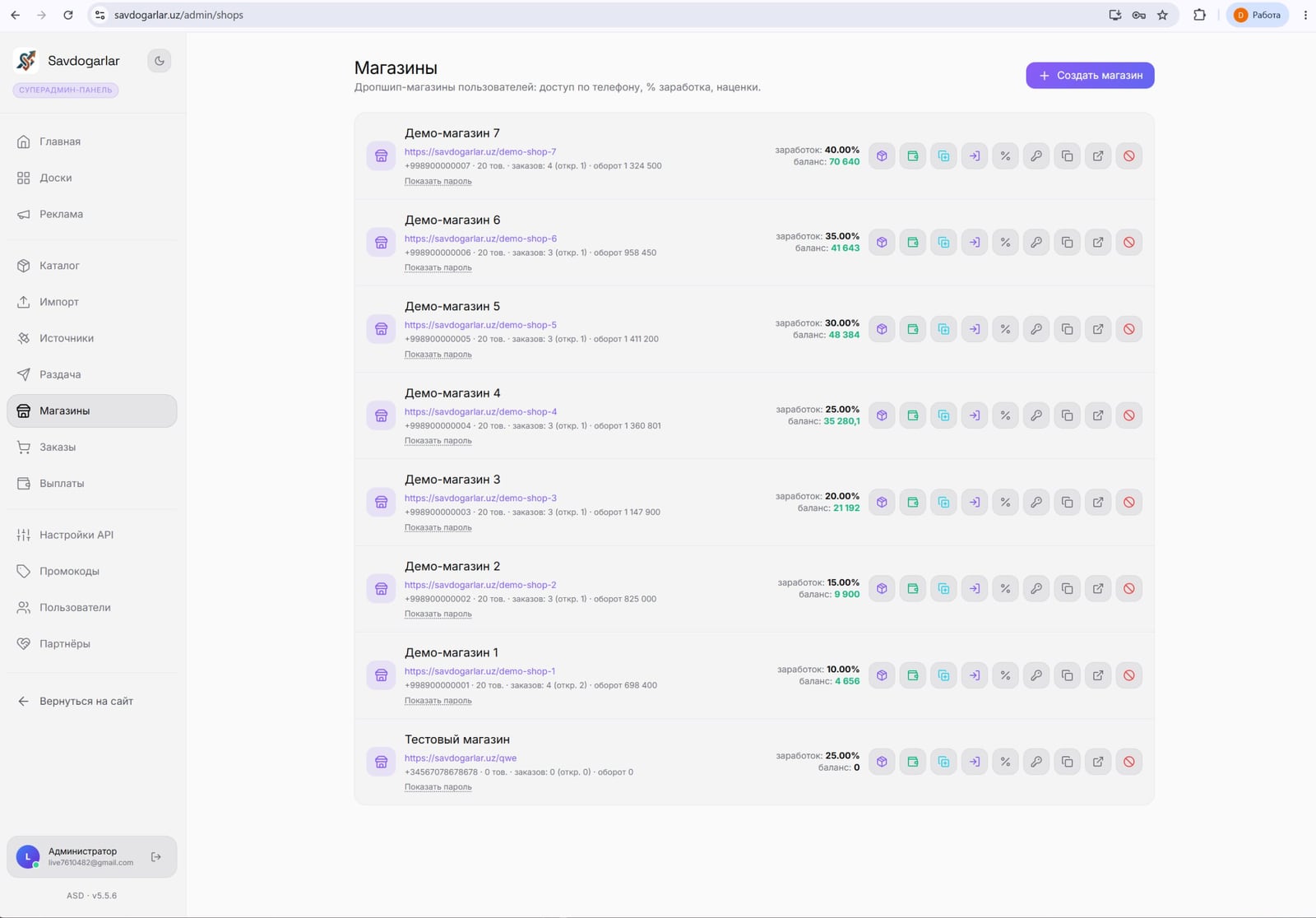
- Affiliate percentage - each seller has their own percentage of sales, either general or individual.
- Centralized management – all orders and customer correspondence are handled by the customer, who accepts payment and ships the goods.
- Transparent analytics – in their personal account, dropshippers can see what they've sold and how much they've earned.

The entire catalog lives in one place: purchase prices, SKUs, and inventory—retail markups are set individually for each store. If a supplier's purchase prices increase for an entire batch of products at once, there's no need to change the product cards one by one—the catalog offers bulk adjustments: select products, set a percentage, and apply it to the entire selection at once.
How does a dropshipper get his own store?
In short: send a phone number and receive a ready-made store, already filled with products at current prices, without registration, passwords, or manual catalog settings.
The store opens wherever it's convenient for the buyer—on Telegram channel, a WhatsApp channel, or simply via a web link like savdogarlar.uz/имя-магазина. This is a single store across three channels: the dropshipper doesn't need to manage three different storefronts.
Why did you choose Uzbekistan?
The choice of messenger is no accident: according to Uzbek media estimates (2024-2025), Telegram is the country's main messenger. It is used by approximately 25 million people – the majority of Uzbekistan's internet audience. Building a platform for dropshippers in a location where the audience already resides makes sense – especially since the client had previously managed similar stores in the same Telegram channels and knew them from the inside.
Where do goods come from and how are prices synchronized?
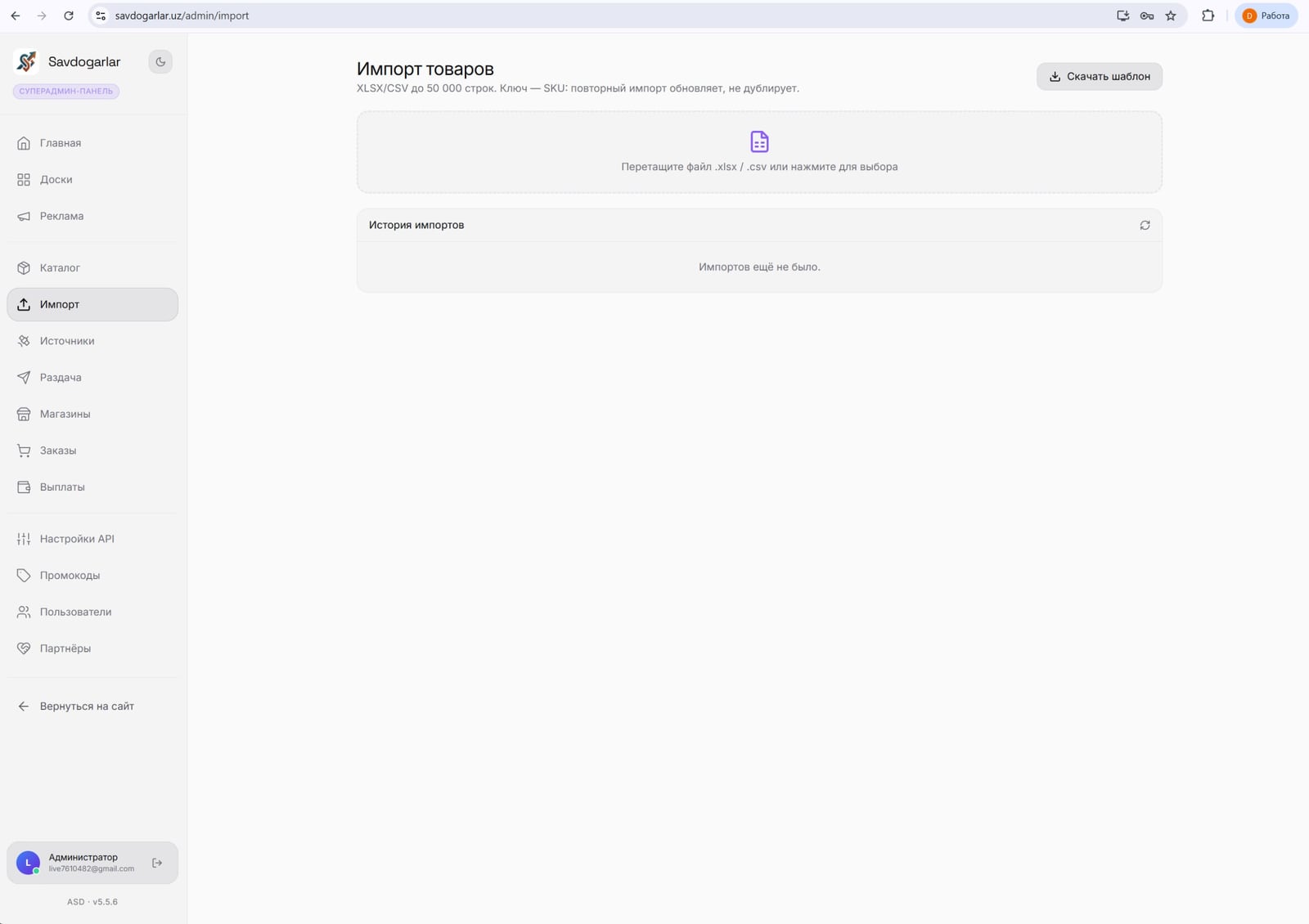
Savdogarlar connects to Apify, a platform for collecting data from product displays using ready-made tools (Apify calls them Actors). A single Apify token connects multiple sources simultaneously—in the project interface, this means Ozon, Wildberries, or "another actor" via a link. Products with all their attributes are added to a single catalog and then distributed via stores' auto-subscriptions.
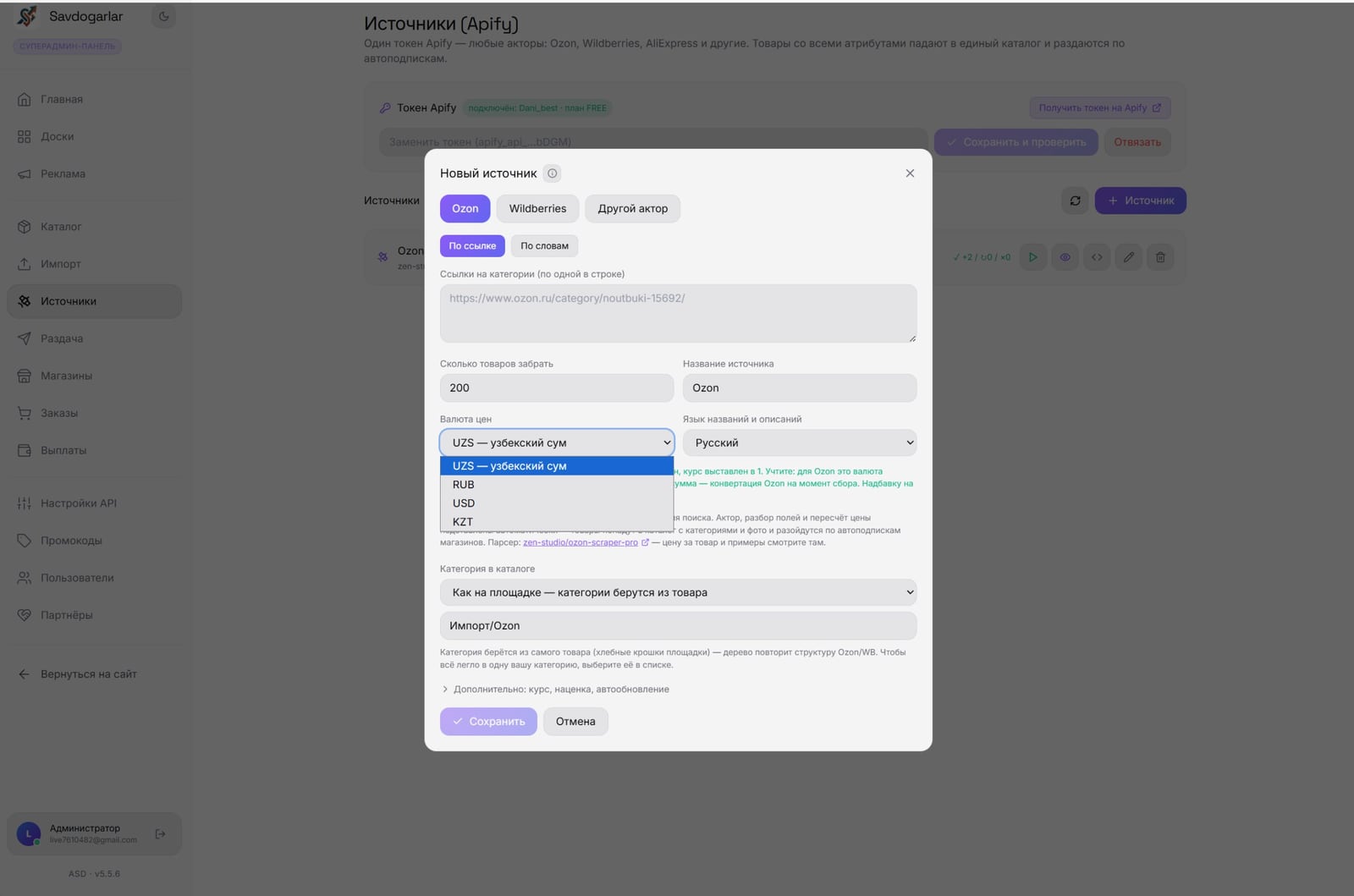
This also solves the issue of price updates: if a product on the source platform increases in price or runs out of stock, the catalog is updated along with it, eliminating the need to manually check hundreds of items. For catalogs not available on marketplaces, there's a separate method: upload your own file.
How are goods distributed between stores?
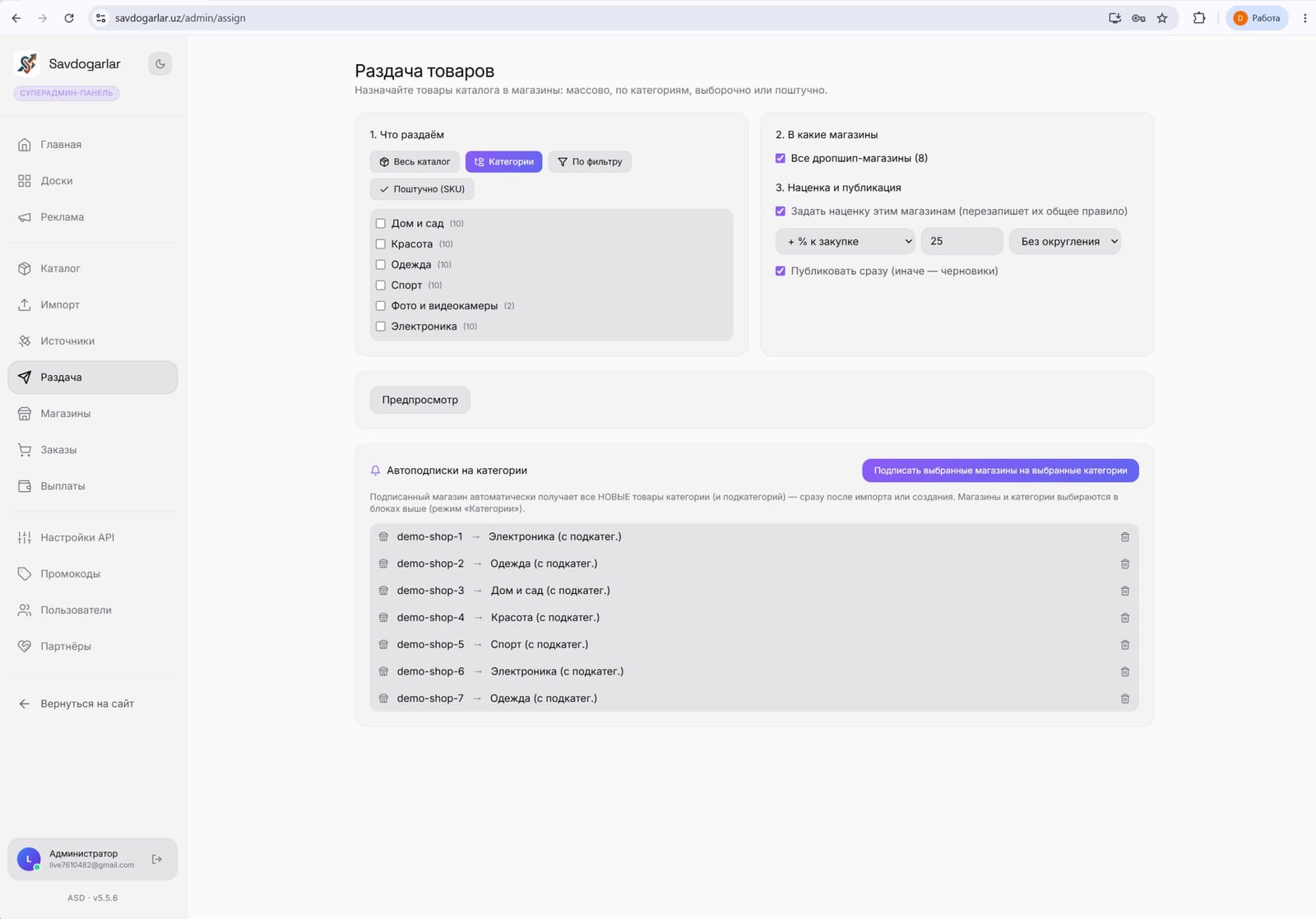
Manually distributing products from the general catalog to stores individually is a time-consuming process, especially when there are dozens of stores. In Savdogarlar, this is accomplished through a dedicated screen: the administrator chooses what to distribute—the entire catalog, specific categories, products by filter, or individually by SKU—and to which stores, with a general markup or a specific markup for each store. There's also an automatic subscription: a store is assigned to a category once, and all new products in that category are automatically added to it, without re-distribution.
Who accepts orders and corresponds with customers?
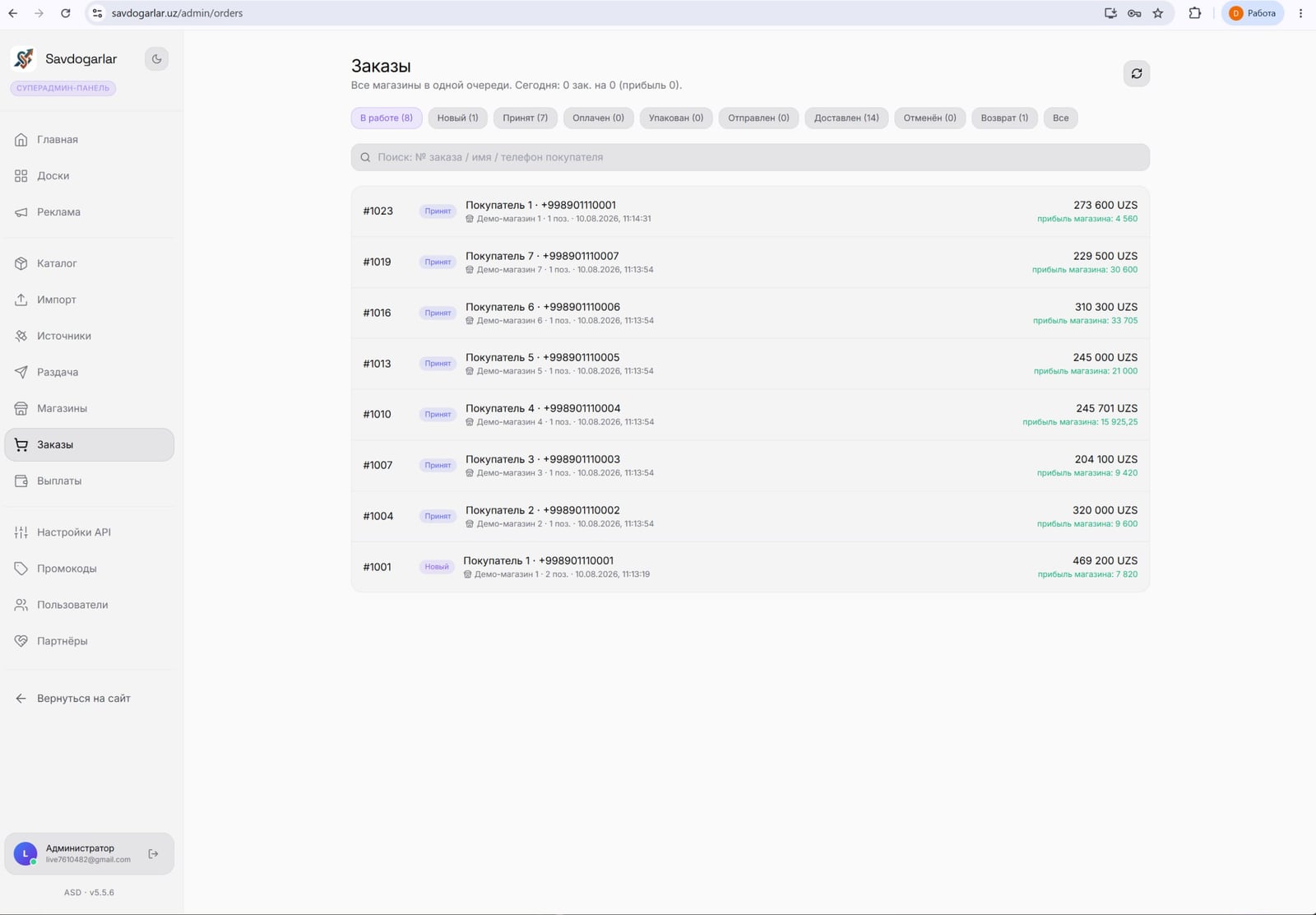
Dropshippers don't need to manage warehouses, packaging, or shipping themselves—they're the responsibility of the customer. All orders from all stores are collected into a single queue managed by the platform administrator, detailing who purchased, from which store, the amount, and the profit share that goes to each store. The customer accepts payment and ships the goods themselves—the partner only brings in the buyer.
How much does a partner earn and how is he paid?
Each store has its own sales percentage—you can set a general rule for all, or a custom rate for a specific partner. In the payouts section, the administrator can see how much each store has earned and how much they've already received, and can confirm each payout manually.
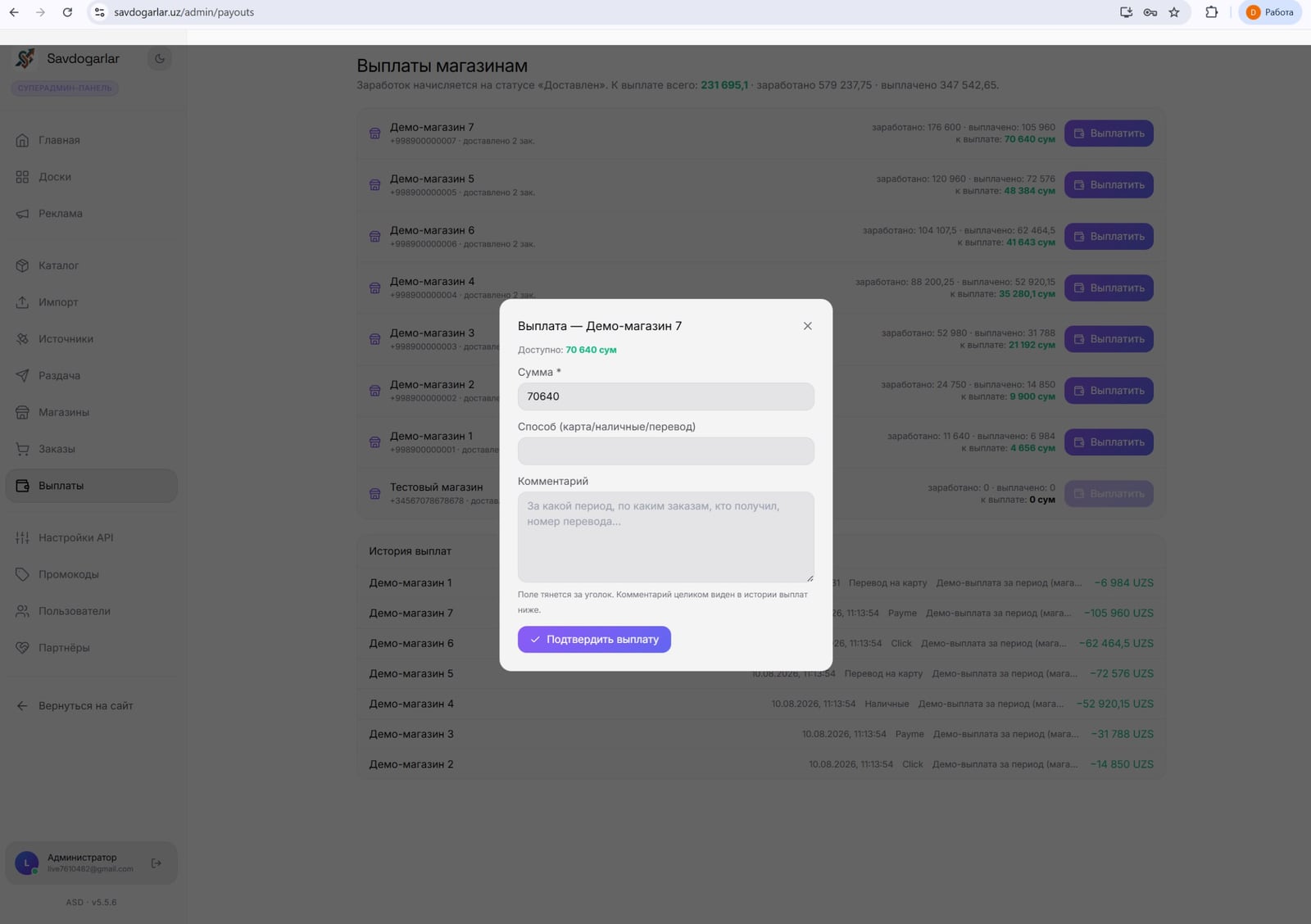
The dropshipper doesn't configure this themselves - only their own statistics are available in their account: what they sold and how much they earned.
Who is this platform suitable for?
For those who already have their own product catalog (own warehouse, wholesale purchasing, access to marketplaces) and want to sell through a network of partners rather than hire a full-time sales force. Three signs that this model is suitable:
- There are already several partners or potential sellers, and I don’t want to set up a store for each one manually.
- The catalog is updated frequently—items, prices, and inventory change faster than they can be maintained manually.
- Customers are already using Telegram and WhatsApp —there's no need to accustom them to a separate app or website.
If the catalog is small and static, and there's only one partner, a separate platform makes less sense: a regular store can handle this without an affiliate network add-on. The larger the affiliate network, the more expensive each manual operation becomes—setting up the store, distributing products, calculating payouts—and the faster the automation of these three steps pays for itself.
What does 1001site AI have to do with this?
Savdogarlar is based on the same idea as 1001site AI: the less manual work between "data available" and "a ready-made store," the faster a user starts selling. With 1001site AI, this works for the website itself—the builder creates a store or landing page based on your link or description in a few minutes, and then the dashboard's AI assistant edits the content. The difference is in the task: in the former, it's a store for each partner, while here, it's a website for a single business, but the principle of "minimal manual work between the idea and a ready-made store" is the same. You can try it here.
Sources
- Savdogarlar - the project's public website
- Apify Platform - Web Scraping and Automation
- E-commerce Price Monitoring - A Case Study Using Apify
- uzdaily.uz - about Telegram audience in Uzbekistan
- Post and discussion in Telegram channel
Questions and Answers
Is it possible to sell not only through Telegram, but also through WhatsApp?
Yes. Each partner's store opens wherever is most convenient for the customer: on Telegram channel, a WhatsApp channel, or via a direct web link—it's the same store across all three channels.
What to do with a catalog that is not on Ozon or Wildberries?
The admin panel has a separate import section: the catalog is uploaded as an XLSX or CSV file with up to 50,000 rows, using the SKU as the key; re-uploading updates the product cards without duplicates.
Can a dropshipper change prices in their store?
No. The platform administrator sets the markup and which products are delivered to a specific store. Dropshippers have access to their personal store, incoming orders, and earnings statistics.
Project links
Discussion
Post and comments in Telegram channelБизнес с ИИ | Через замочную скважину · 21 September 2026
Questions and Answers
Is it possible to sell not only through Telegram, but also through WhatsApp?
Yes. Each partner's store opens wherever is most convenient for the customer: on Telegram channel, a WhatsApp channel, or via a direct web link—it's the same store across all three channels.
What to do with a catalog that is not on Ozon or Wildberries?
The admin panel has a separate import section: the catalog is uploaded as an XLSX or CSV file with up to 50,000 rows, using the SKU as the key; re-uploading updates the product cards without duplicates.
Can a dropshipper change prices in their store?
No. The platform administrator sets the markup and which products are delivered to a specific store. Dropshippers have access to their personal store, incoming orders, and earnings statistics.
Subscribe to my Telegram channel
In the channel « Бизнес с ИИ | Через замочную скважину», I watch and talk about how clients who have contacted me use AI in their businesses. I encourage discussion—let me know in the comments, and I'll respond directly.
Similar projects
Telegram Store: How Products and Orders Flow Through the Site
A bot for products from your phone, automatic publishing, and order notifications – no manual messaging required.
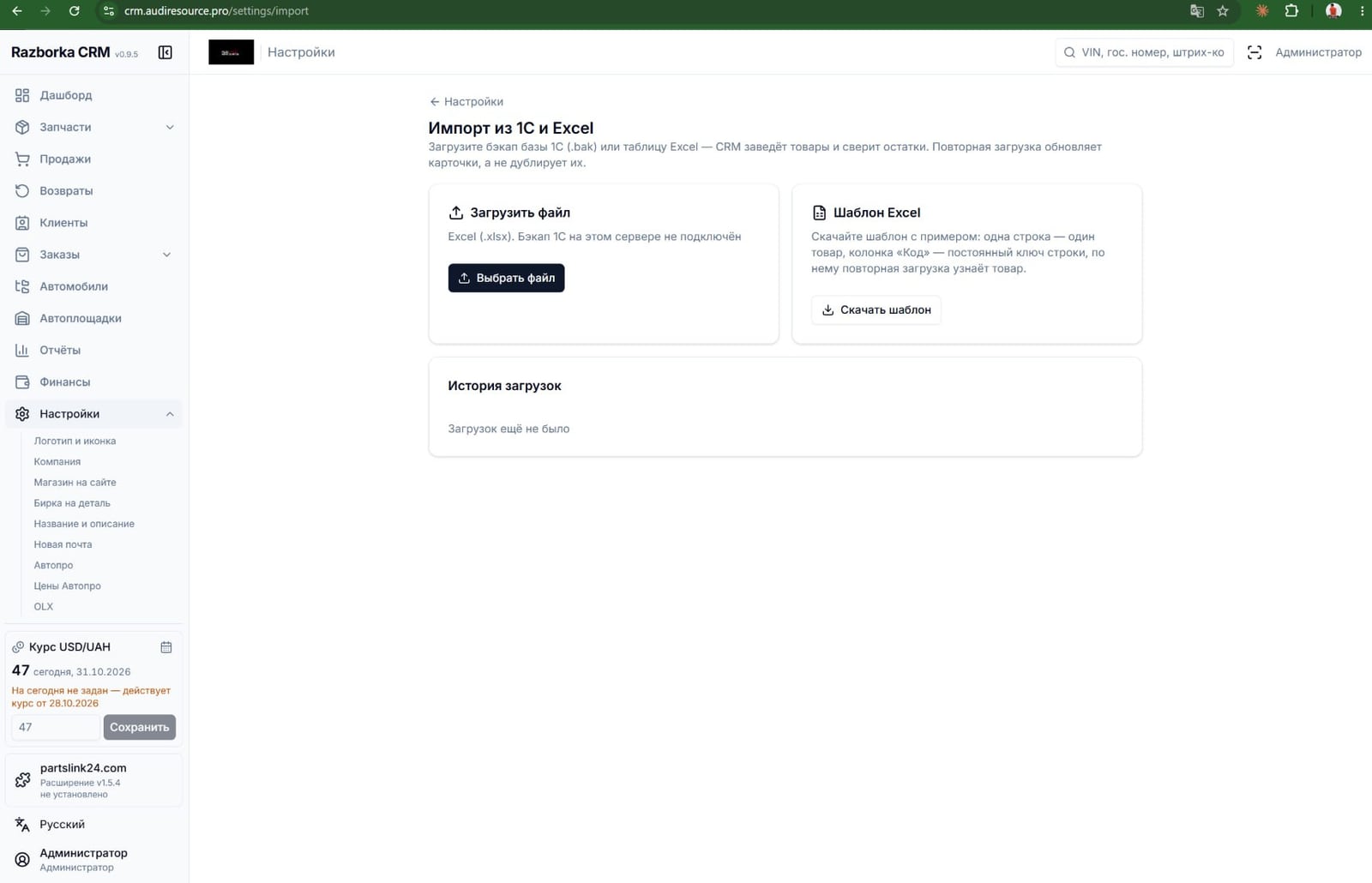
Import from 1C for auto dismantling: residuals and barcodes without duplicates
The fourth CRM case for Audi Resource: synchronization with 1C via GUID, balances without duplicates, barcodes and label printing, automatic publication on bulletin boards.

OmniFlow: How to shoot batches of videos in Google Flow and Google Vids
Case Study: The OmniFlow Chrome extension captures videos in batches to Google Flow and Google Vids via Claude —without API keys or per-second fees.