In short: for a simple static landing page, yes, without a single line of code. As soon as working logic is needed—a database form, payment, a personal account—debugging cycles begin, which eat up paid credits. Without an understanding of code, API, and deployment, it's difficult to complete such a site. Below are the numbers and quotes that support this conclusion.
Every week, I explore tools and approaches for building websites with AI: what really works for small businesses and what requires technical expertise. Subscribe to the channel to stay up to date.
What is Lovable and how does it work?
Lovable is an AI code generator: the user describes the app in a chat, and the output is real program code— React, a Supabase database, Stripe payments. Visual website builders work differently: the result is a ready-made website as a service, without the user having to deal with the source code.
The Swedish company (founded in 2023 in Stockholm) calls this approach "vibe coding": a human describes the task in natural language, and the AI writes the code. Lovable has two modes: Agent Mode, where the AI independently examines and edits the code, and Chat Mode for discussing changes. The code is synced with GitHub in real time, so it's always accessible—convenient if the project needs to be handed over to a human developer at some point.
The final result needs to be deployed online—that's a separate step. Lovable offers its own hosting (Lovable Cloud) with a subdomain or a paid domain, or export to Netlify and similar services. In October 2026, the company added deployment to a customer's own AWS or Azure account. Organizations and audit logs are features for IT departments of large teams; the average website owner typically doesn't need them.
How much does Lovable actually cost - with credits and hosting?
The price is based on credits for each AI action: editing a style, adding a form, setting up authorization—each request has its own cost, which is only visible after it's completed, without a preliminary estimate. This is a fundamentally different model than a fixed subscription for the entire website, and additional hosting fees and credit purchases are added on top if the built-in limit isn't sufficient by the end of the month.
| Rate | Price per month | With annual payment | Loans per month |
|---|---|---|---|
| Free | 0 € | - | about 30 (5 per day) |
| Pro | from 23 € | from 19 € | from 100 |
| Business | from 46 € | from €39 | from 100 |
| Enterprise | under contract | - | under contract |
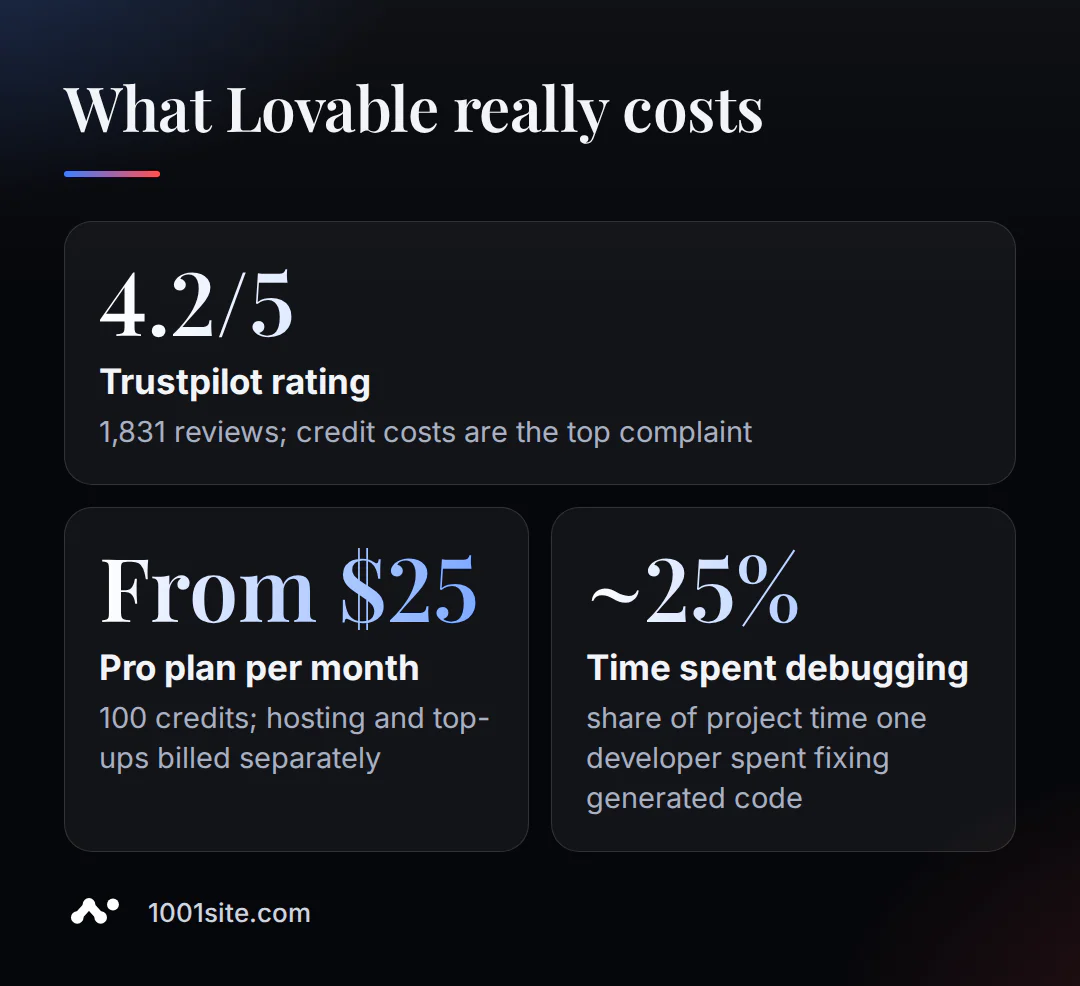
Prices are converted to euros based on the exchange rate on the review date. For the exact dollar amount, check the official page at lovable.dev/pricing. On top of the plan, there's the purchase of additional credits (around €14 for 50 credits on Pro) and a separate hosting fee: a small website costs around €1-5 per month, while an online store with significant traffic costs around €60. One pricing analysis directly cites a user complaint: "I don't know how many credits this will eat up. The result? I run out of credits faster than I expect" (eesel.ai, "A complete guide to Lovable pricing").
By comparison, a ready-made website builder typically sells the result for a fixed price or subscription, without a separate "how much the AI thought" counter or a separate hosting bill.
What do non-technical users who have already tried it say?
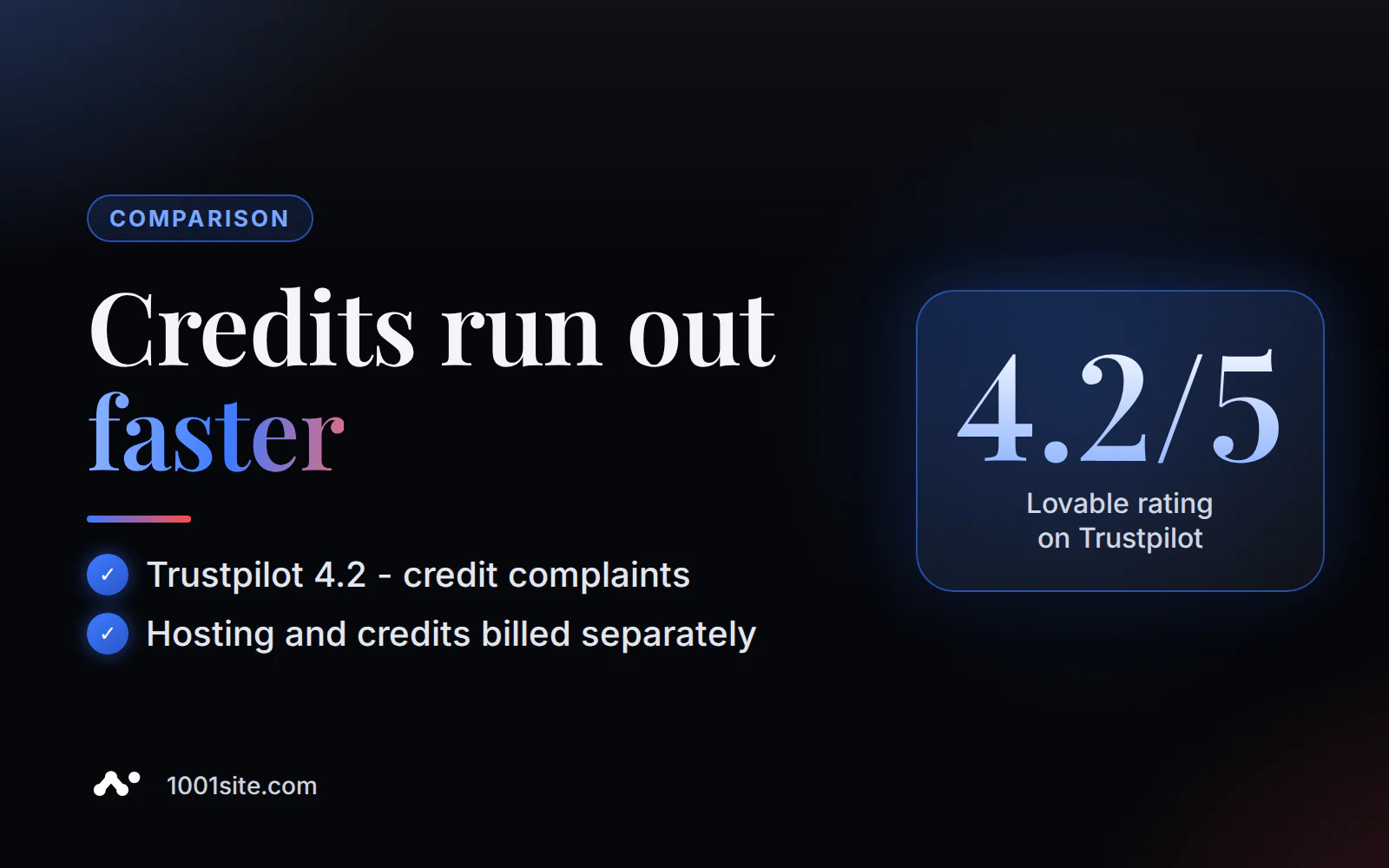
On Trustpilot, Lovable has a 4.2 out of 5 ratings based on 1,831 reviews (as of October 17, 2026)—an overall good rating, and most are satisfied with the speed of the first result. However, credit usage remains unpredictable across almost all independent sources, from Trustpilot to specialized reviews for small businesses, and work can stop mid-project without warning.
User Connor R. (USA) left a two out of five rating on Trustpilot with the caption: "Good tool, BUT SO EXPENSIVE!... now it just runs out before anything has been done." Another user, Hamza Khan (Qatar), gave it a one: "wasted all credits in just two days without building a single section."
Umair Ali Sadaqat, the author of a personalized analysis for small businesses (we.inc blog, September 2026), compared Lovable specifically to a website builder for a typical local business—a cafe, a dentist, a workshop—and wrote: "Lovable is a strong AI app builder, but as a small business website builder, it is credit-hungry and developer-leaning." "Credits burn on fixes. Debugging loops are the most common complaint in reviews."
Developer Taki Tajwaruzzaman Khan blogged about his eight months working with Lovable (dev.to). He described one incident as "spent two days fixing session management bugs because it didn't handle edge cases like concurrent logins or token refresh properly." He estimated that debugging the generated code takes about a quarter of the project's total time.
Who is Lovable best for?
Lovable is designed primarily for those who write code themselves or are willing to learn it if needed. The typical local business owner doesn't have this experience, and the product itself isn't designed for this reader profile. Who Lovable is really for is discussed below.
According to the company's own positioning and independent reviews, Lovable is best suited for four roles:
- developers who have access to a full-featured code editor for fine-grainediting;
- product managers and designers who need a quick prototype to demonstrate an idea;
- startup founders testing a hypothesis before hiring a team;
- agencies that prototype a client's project and hand over the code to engineers for refinement.
The company itself confirms this: the October 2026 Enterprise features—deployment to a customer's own AWS or Azure, Organizations, and audit log export—are designed for the IT departments of large companies. According to independent AI tools market analysts, most successful Lovable implementations involve either a technically skilled founder who refines the code themselves or an early handoff to an engineering team for security and scalability.
What pitfalls await a business owner without a programmer at Lovable?
Marketing promises "no code required," and for a simple landing page, that's true. Any business logic quickly leads to issues that a ready-made website builder handles automatically, but with Lovable, you have to solve them yourself.
| Question | Lovable | Ready-to-use AI-powered website builder |
|---|---|---|
| What does the user get? | Application source code | Ready-made website as a service |
| Is deployment required as a separate step? | Yes - your own hosting or export to Netlify/Vercel | No - the site is immediately accessible at |
| How is the price calculated? | Credits for each AI action, the amount is unknown in advance | Fixed subscription or one-time payment |
| SEO and indexing | Requires separate configuration (client renderer by default) | Pre-configured (server rendering) |
| Who is responsible for data security? | User (access rights to the database are configured manually) | Platform |
In March 2025, a specific issue was discovered: some Lovable sites had incorrectly configured database access permissions, resulting in content being publicly visible (see the "Security" section of the company's Wikipedia article). Built-in automatic checks proved insufficient, meaning that in practice, the project's creator is responsible for data security; it's not enabled out of the box.
Search is a particular pitfall. By default, Lovable generates a single-page application with browser-side rendering, and for a site that's important to search results, this requires additional configuration—unlike ready-made builders, which include server-side rendering and structured data out of the box.
How is 1001site AI route different from Lovable?
1001site AI closes the gap that Lovable leaves open for non-technical users: a website is built by an AI agent in a selected style from the catalog in 2-7 minutes after payment, without coding, without a separate deployment step, and without a credit counter for each AI action. Further, what specific tasks does this relieve the business owner of?
Content is filled via a link—to an old website, Instagram or Facebook profile, Telegram channel, or spreadsheet. Products, photos, and text are transferred automatically, eliminating the need to manually enter cards. Edits after launch are made by the account's AI assistant in a chat format similar to a messenger—"send a screenshot, and it will fix it." It operates using its own access key to the AI model ( Gemini, as well as Claude and ChatGPT)—the owner creates this key in the account of the desired model, and the service does not add a markup for each request to the AI, unlike the Lovable credit system.
Hosting, a domain with an automatic SSL certificate, and SEO (sitemap, structured data, server-side rendering) are pre-configured and don't require any additional solutions. The plan is fixed: "All Inclusive" - €45 per month (€25 for the first month with a promo code), "Turnkey" - €1,650 in a one-time payment if you want a complete turnkey website, without the owner's involvement. There's no trial period, but there's also no surprise bill for "AI overthinking."
You can create a website in one of the catalog's 1,000+ styles using the "Create Website" pop-up on the homepage—no coding or separate hosting required. If you're interested in how the AI assistant then edits your finished website with keywords (including Claude and ChatGPT via MCP), the mechanics are covered in the article "Create a Website with Claude Without Code."
How to create a business website without code in one evening
The code-free path is the same for a landing page, an online store, or a classifieds board—the only difference is the mode selection in the final step. The entire process takes just five steps, from choosing a style in the catalog to a ready-made website with a connected domain, without a line of code or separate hosting.
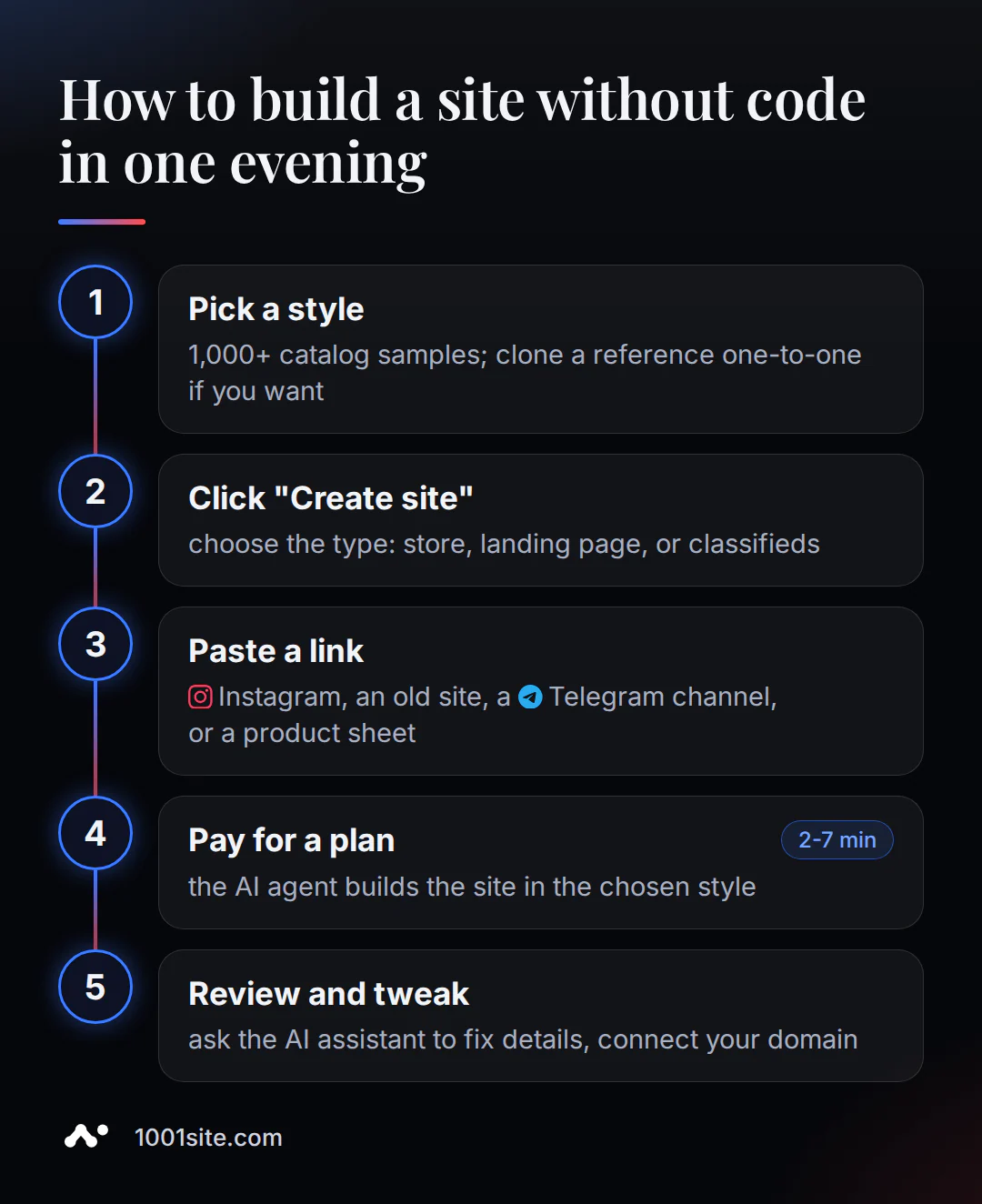
- Open the style catalog on 1001site.com and select a template that suits your theme—you can enable clone mode to replicate the reference exactly.
- Click "Create a website" and specify the type of website: online store, landing page, or classifieds.
- Insert a link to the content source - an old website, Instagram or Facebook profile, Telegram channel, a table with products - or describe the business in words.
- Choose a plan and pay: the AI agent will build a website in your chosen style in 2-7 minutes.
- Check your catalog and texts, ask your account's AI assistant to correct details with words, and connect your domain if you already have one.
A detailed mechanism for transferring a directory via a link is available in the 1001site knowledge base.
Who should choose Lovable, and who should choose a ready-made constructor?
For those who code themselves or have a developer on their team ready to take the project to production and ensure its security, Lovable offers flexibility unavailable in a ready-made website builder. For business owners who need a working website without hiring a dedicated code maintainer, the opposite solution is suitable: a ready-made AI builder designed specifically for this purpose.
The intermediate option is a simple business card page without any logic inside: here, Lovable plays to its strengths (quick prototyping, easy text editing), and complaints about credits and debugging are almost nonexistent because there is no complex logic to fix.
A similar analysis of the "subscription vs. one-time build" economics is available for other builders in the article "Wix or Shopify: When is it more profitable to switch to your own AI-powered website?"
Frequently asked questions
Is it possible to create an online store using Lovable without a programmer?
A simple product description page—yes, without a single line of code. A working store with a shopping cart, payment system, and order database is more complex: this requires database logic, and according to user reviews on Trustpilot and Capterra, it's at this stage that debugging cycles begin, which consume paid credits. A ready-made online store builder handles these tasks automatically, without requiring credits for every AI action.
How much does a Lovable website cost in euros?
The free plan provides about 30 credits per month—enough for a trial run, but usually insufficient for a production website. The paid Pro plan starts at €23 per month for 100 credits (as of the date of this review), and that doesn't include a separate hosting fee or additional credits if they run out early.
How is Lovable different from an AI website builder like 1001site?
Lovable outputs the app's source code, which you deploy and maintain yourself or with the help of a developer. The AI-powered website builder assembles the finished website as a service: hosting, domain, SSL, and updates are all handled by the platform; the user works with the style and content, not the code.
What happens if Lovable runs out of credits halfway through a project?
Work stops until additional credits are purchased (at a higher price than the built-in plan) or until a new billing period begins. Trustpilot users have reported situations where credits ran out before even one section of the website was ready—the service does not provide a preliminary cost estimate for a specific request.
Sources
- Lovable, official blog and documentation - https://lovable.dev/blog, https://docs.lovable.dev/tips-tricks/deployment-hosting-ownership
- Trustpilot reviews of lovable.dev - https://www.trustpilot.com/review/lovable.dev
- Capterra, Lovable reviews - https://www.capterra.co.uk/software/1081889/Lovable
- we.inc, Umair Ali Sadaqat, “Lovable Website Builder Review” - https://we.inc/blog/lovable-ai-website-builder-review
- dev.to, Taki Tajwaruzzaman Khan, “Can AI even make software” - https://dev.to/takitajwar17/can-ai-even-make-software-huh-is-it-any-good-oci
- nocode.mba, “Lovable Review 2026: Best AI App Builder?” - https://www.nocode.mba/articles/lovable-ai-app-builder
- eesel.ai, “A complete guide to Lovable pricing” - https://www.eesel.ai/blog/lovable-pricing
- alanbagi.com, “Can Lovable AI Create Business Websites” - https://www.alanbagi.com/blog/can-lovable-ai-create-business-websites
- Wikipedia, “Lovable (company)” - https://en.wikipedia.org/wiki/Lovable_(company)
For an overview of the dashboard's AI assistant and other ways to build a website without code, visit 1001site knowledge base. You can create a website in your own style using the "Create a Website" pop-up in the 1001site catalog.