
Autoblog with AI Agents: How a Human-Free Editorial Team Works

The article you're reading wasn't generated by a single "write an article about this post" prompt, but by an autoblog—a system composed of several AI agents with different roles, like a traditional editorial office, only without humans. Valery Danyuk, the author of 1001site AI, rebuilt the article generation system for his blog and released it as a separate open-source project in early October. I'll explore what this system consists of, how it differs from a typical neural network retelling of a post, and why it makes sense to go so far. If you run a blog yourself or create content for clients, here are the specific steps of the system, not generalities about "AI magic."
Why did you have to rebuild the article generation system?
The short answer: the old system was a dead end—it was expensive and there were almost no applications, even though articles were being published regularly.
The reason is how search itself has changed. The era of exact keyword matching is ending: search now evaluates text based on meaning—through context, synonyms, morphology, and heading structure. A system tailored to the old rules is meaningless under the new rules: you can enter a keyword ten times and still not answer the question people are actually searching for. The entire architecture had to be changed—how an article is created, who reviews it, and what happens after publication.
What agents does the editorial board now consist of?
In the post, the author describes the resulting setup as a fully-fledged editorial team—a journalist, photographer, proofreader, editor-in-chief, brand manager, and sales director—except all roles are filled by AI agents. In practice, each role's task is broken down into seven steps:
- Topic selection based on demand. The system uses Wordstat and Google Trends to understand what the audience is currently searching for. Topics aren't just randomly generated by the editor; they're driven by the audience's actual search interest.
- Competitor Analysis. The top 10 search results are analyzed for gaps—issues that competitors haven't addressed or have ignored. This new article addresses precisely what the search results have so far only superficially covered.
- Channel monitoring. A new post in the author's Telegram channel is picked up separately and adapted for SEO and the format cited by AI responses (AI Overviews, Perplexity)—that's how this case came about.
- Source material from a personal archive. The draft is written using the author's "second brain"—collected notes, case studies, and figures; at this stage, they are verified against primary sources.
- Editorial review. One pass checks the text and stop words, another removes bureaucratic language and typos. Checking stop words is not a formality: every commercial platform has its own list of prohibited and legally risky phrases, and one missed phrase can create real problems for a business.
- Interlinking and offer. Links to related materials are placed throughout the finished text, and where relevant, a product offer is carefully added. Links point to actual published pages, not random ones—otherwise, interlinking hinders the reader rather than helps them.
- Publication and verification. The article is published on the website, the system verifies that the page displays correctly, and automatically leaves a link to the article in the comments under the original Telegram post.

What a finished article looks like: a real-world example
None of the screenshots below are staged—these are the same pages from the 1001site blog that will open in your browser if you visit it right now. It's easiest to demonstrate the results using an already published text— a case study about an AI-powered equipment repair manual for a German manufacturer.
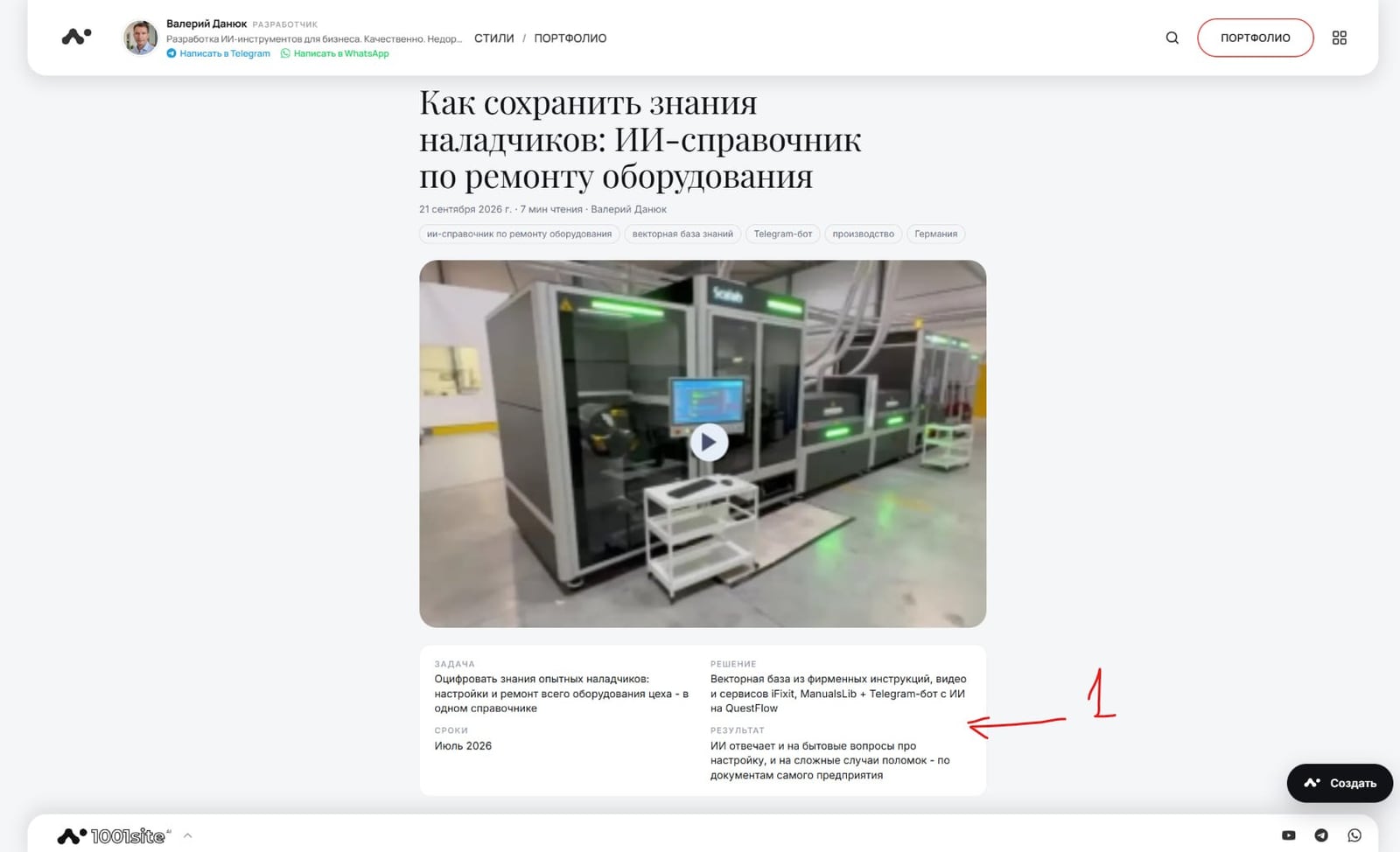
At the top is a title, a video insert, and a short summary: the client's task, what was done, the deadline, and the result, all in one line. This is designed specifically for those who decide in a few seconds whether to continue reading.
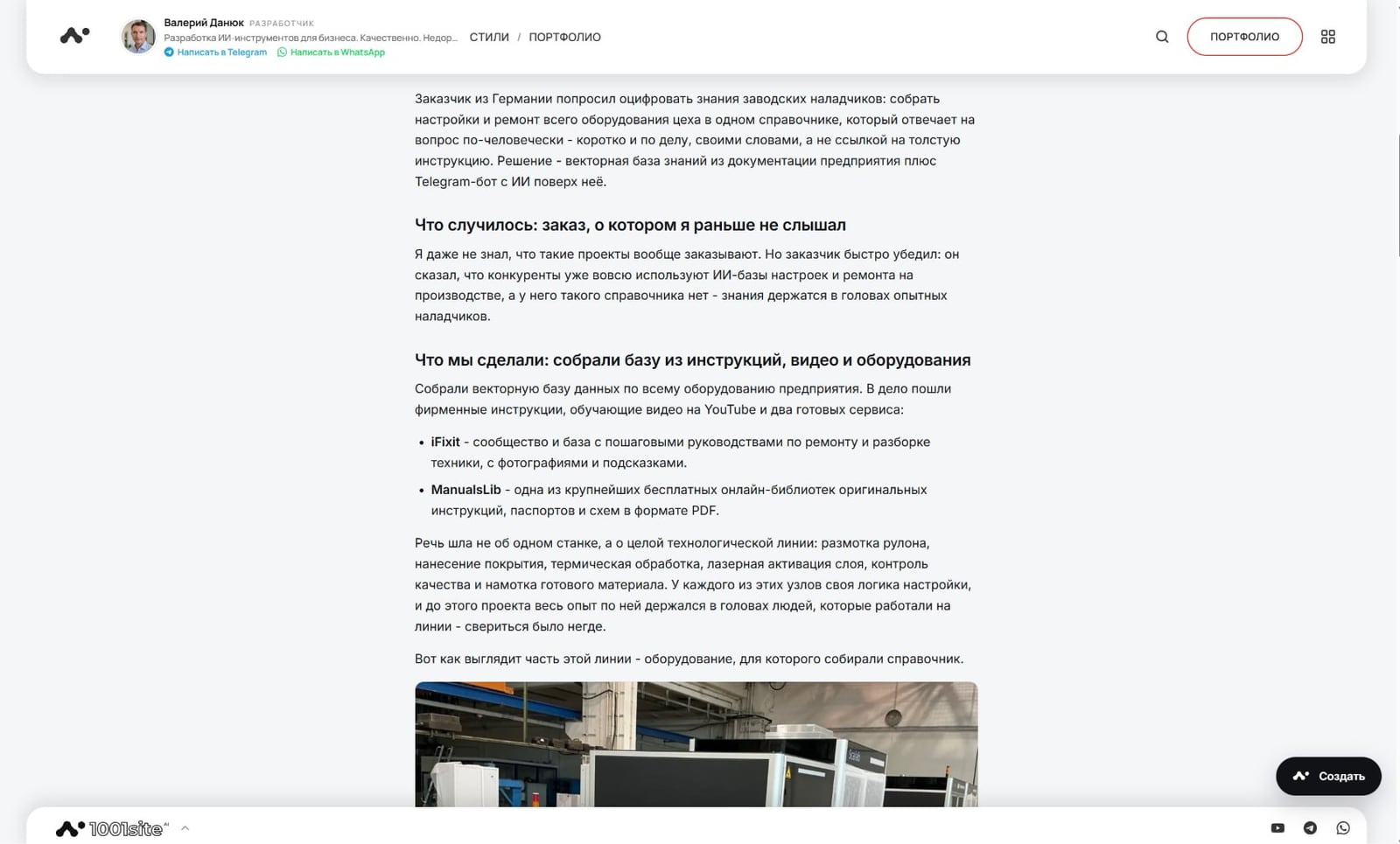
Next comes the body of the article with subheadings in the form of a question or story (“What happened,” “What we did”) and real photos of the object.
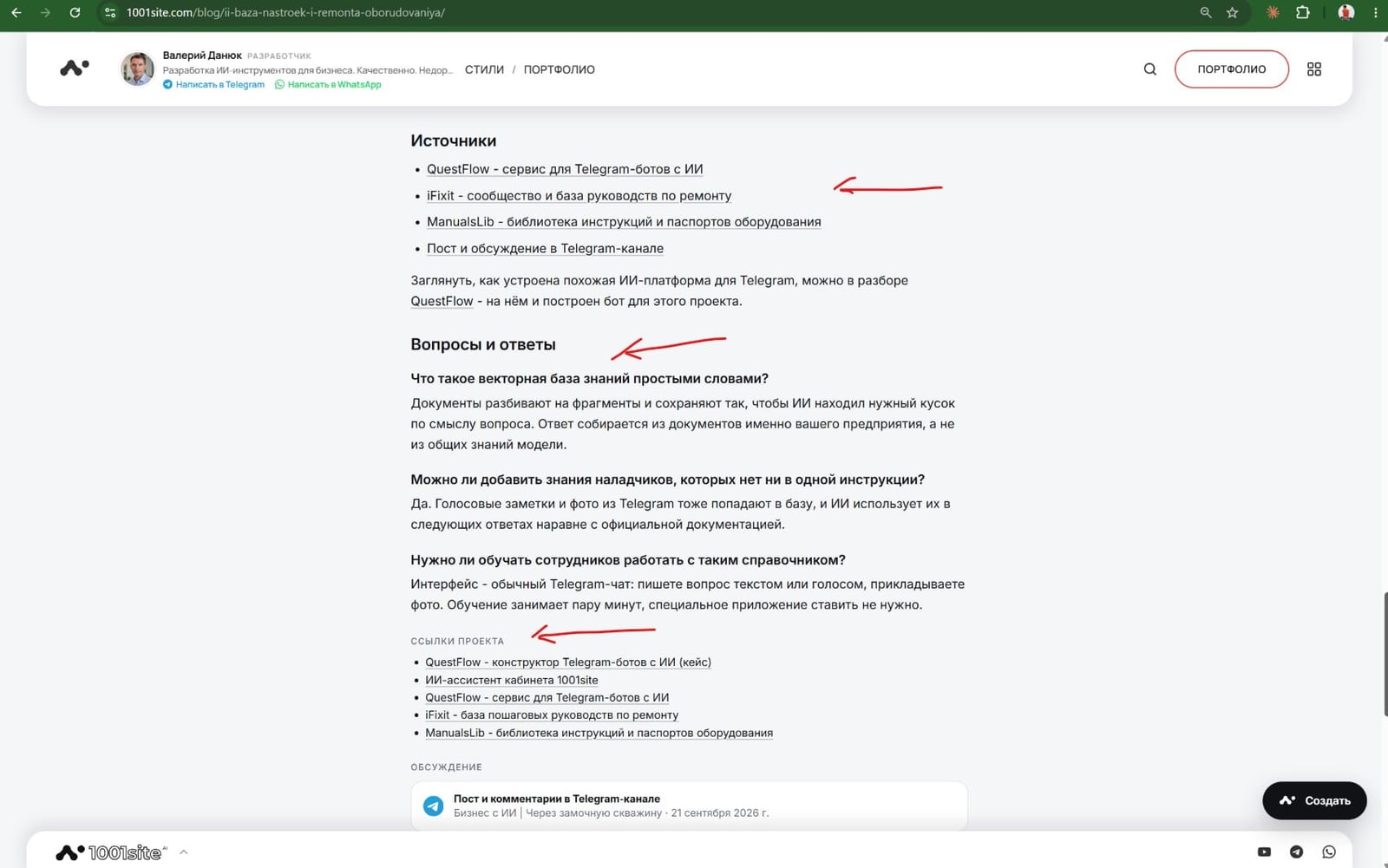
Below are sources, a Q&A section, and links to the project. These same three blocks also close the article you're reading now: they answer the question "Where is this confirmed?" asked by discerning readers.
Can we trust the "personal experience" that AI extracts?
The question is honest, and the answer isn't "yes, completely." The mere fact that the system includes a "fact-checking" step doesn't mean that any statement like "I checked" automatically becomes true. The agent doesn't present their work as a person's personal experience: figures and examples are included in the text only from verified archives with a source—or not at all. Any controversial or unverifiable detail is anonymized or deleted at this step.
This limitation reduces the risk of fictitious cases and figures precisely where automation usually fails most painfully – in the reader's trust in a specific statement.
Hence, a simple rule for checking any AI article: if a specific case or figure is cited without a source, it's a reason to be more cautious. In a text constructed according to this principle, each number should have a visible trace—an archived recording, a screenshot, or a public link, as in this article.
How much does such a system cost and can I try it for free?
It's free for personal use, and the code is openly available on GitHub. It's also free for active journalists—members of the National Union of Journalists of Ukraine and European journalistic organizations. Commercial use requires a paid license—the author doesn't specify the exact amount in the post; the current terms should be found in the repository itself. For freelancers or web studios that charge clients for content, this is a commercial scenario—the free personal license doesn't apply.
Who is this blog automation scheme suitable for?
A prime candidate is a freelancer or a small web studio managing blogs for several clients and struggling with a shortage of editing and fact-checking staff. For such a team, the most expensive part isn't the actual writing (AI alone can handle that), but the routine work around it: checking competitors, avoiding errors in numbers, adhering to the platform's legal restrictions, and carefully linking to the client's existing content. This approach covers precisely this routine: topic selection, fact-checking, stop words, and cross-linking.
Not everyone wants to understand and customize an open source project. Many still need a steady stream of articles for their website, and a similar automation principle is already built into 1001site AI, which hosts this blog. However, it focuses on the website itself, not the blog itself: page content is provided via a link, automatic publishing to Telegram and WhatsApp, and automatic SEO markup without manual configuration. The website is built and updated using the dashboard's AI assistant—the interface is designed like a messenger, so there's no need to write code for editing.
What's next: Automatic video cutting
The pipeline isn't completely closed yet: according to the author, a module for automatically cutting Reels and Shorts from existing content is planned for mid-October. This is a stated plan—the feature isn't yet operational, and the article makes no claims to the contrary.
Sources
- Post from the "Business with AI" channel: https://t.me/promtvibeadd/450
- Skill of articles (journalist) on GitHub: https://github.com/DanikVR/journalist
- Blog 1001site: https://1001site.com/blog/
Project links
Discussion
Post and comments in Telegram channelБизнес с ИИ | Через замочную скважину · 2 October 2026
Questions and Answers
How is this different from a single AI simply rewriting a post into an article?
A summary is one step and one prompt. There are more tasks here: the system automatically monitors popular topics, analyzes the top 10 competitor search results for gaps, checks facts against the author's personal archive, runs the draft through a separate check for stop words and jargon, and only then publishes and verifies that the page is displayed correctly. Each step is a separate role, just like in a regular editorial office.
Do I have to pay to use this system?
For personal use, no. The author has made the system available for free on GitHub. It's also free for active journalists—members of the National Union of Journalists of Ukraine and European journalistic organizations. Commercial use requires a paid license; the author doesn't specify the exact price in the post; the current terms are in the project repository.
How does the system choose what to write about?
There are two ways. Either she takes a ready-made topic from a new Telegram channel post and turns it into an article (as in this case), or she searches for the topic herself: she looks at Wordstat and Google Trends for active demand and analyzes the top 10 search results to find questions that competitors haven't addressed.
Is it possible to see examples of finished articles?
Yes, all articles published by the system are made publicly available on the [ 1001site blog](https:// 1001site.com /blog/) - including this text.
Does such a system completely replace a human editor?
No. It automates specific steps—topic selection, fact-checking against archives, stop words, cross-linking, and publication—but it doesn't invent the article's purpose or meaning for you: the system only verifies personal experience and figures against the source, rather than creating them from scratch.
Subscribe to my Telegram channel
In the channel « Бизнес с ИИ | Через замочную скважину», I watch and talk about how clients who have contacted me use AI in their businesses. I encourage discussion—let me know in the comments, and I'll respond directly.
Similar projects

Ctrl+Z Production: An AI-powered YouTube Video Studio Instead of Cheap Videos
Case study: For a YouTube channel with over 400,000 subscribers, we built an AI studio called Ctrl+Z Production – chat in Claude, 3D animation, and agents instead of cheap videos.

Antiques Auction Platform: What We Built in 7 Days
Fair bidding, seller lot moderation, and a demo mode to combat the empty catalog at launch.

Multi-currency accounting for auto dismantlers: a formula for replacing currency chaos
Oleg from Lutsk developed a multi-currency accounting formula for an Audi auto dismantling company, which we implemented in the CRM: daily exchange rate, receipts, expenses, Nova Poshta, and Telegram bot.