
Antiques Auction Platform: What We Built in 7 Days
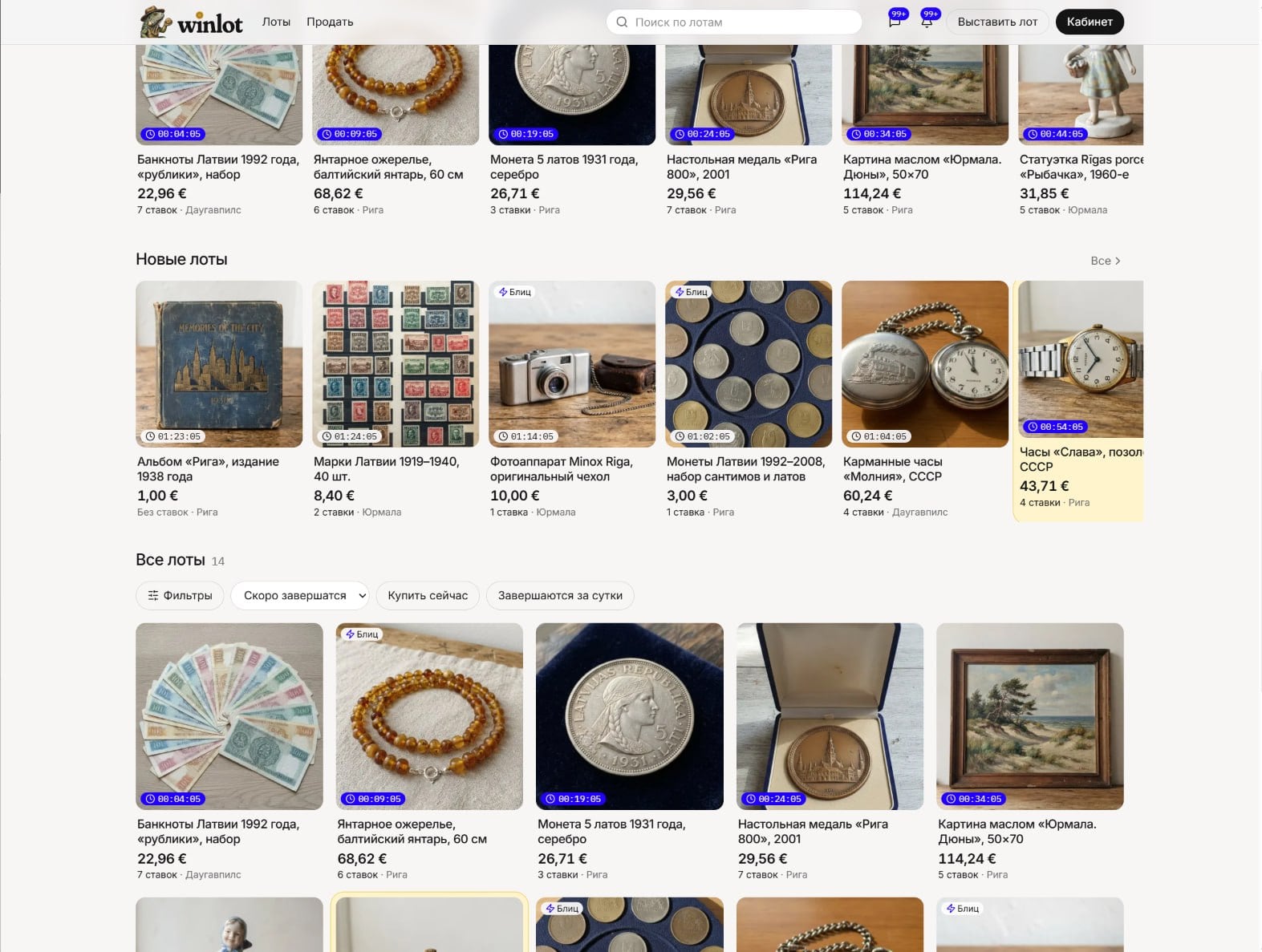
The client gave me 14 days to use the antiques auction platform. I completed it in 7 days: fair bidding rules, a seller's personal account with item moderation, a demo mode to combat the initial empty catalog, and an admin panel with catalog sections, disputes, and paid item promotion.
We cover these projects in their entirety, from brief to delivery, in our Telegram channel.
Why did the client need a new platform for an antiques auction?
In 2024, I was hired as the head of development for the ANKAND auction network in the Balkan Peninsula: a separate platform for each country – Croatia, Kosovo, Montenegro, North Macedonia, Slovenia, Albania, and Bosnia and Herzegovina. Development was only part of the job: the listing page served as a separate SEO landing page and was searchable, while a parser collected items from classifieds and converted them into "past auction" listings with real seller information – so the catalog wouldn't be empty during the first few weeks. Before registering, visitors were first sent to a social media subscription, new listings were automatically posted to groups, and the text and photos were processed by AI.
Building on this experience, a week ago I received a new order – an antiques auction. I began with an analysis: over time, buyers had become more sophisticated, online competition had increased, and repeating the old model exactly wouldn't work – the approach needed to be redesigned for a demanding audience of collectors.
How does fair bidding work for buyers at auction?
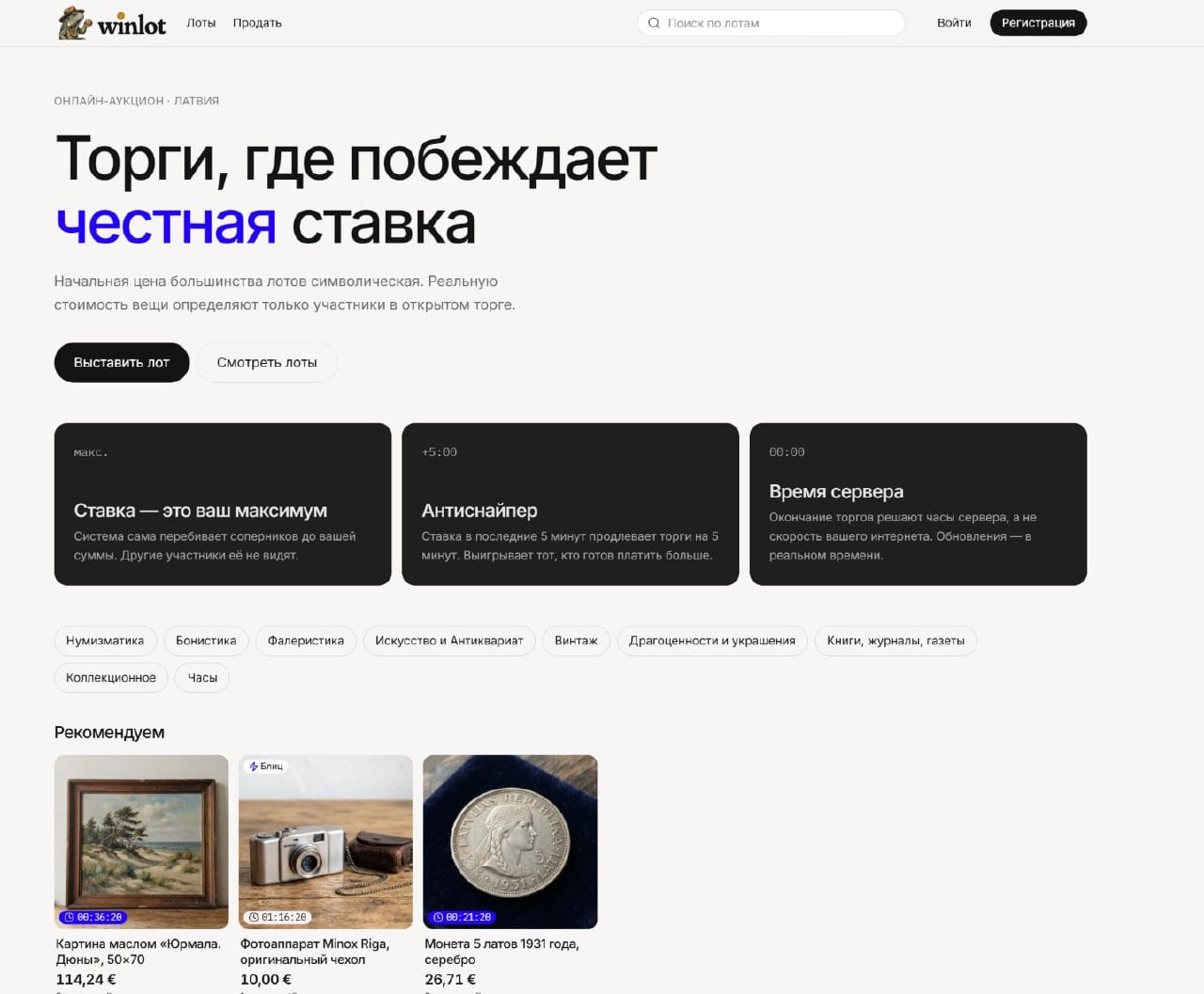
The platform is called Winlot, and the slogan on the main page is "Bidding where the fair bid wins." Three rules are displayed right on the first screen: your maximum bid (the system automatically outbids competitors up to the specified amount, invisible to other bidders); anti-sniper (a bid in the last five minutes extends the bidding for an additional five minutes, preventing an unnoticed bid a second before the end); and server time (the end of the auction is determined by the server clock, not the bidder's internet speed; updates are live). The sections are tailored to collectors: numismatics, bonistics, phaleristics, art and antiques, vintage, jewelry and jewelry, books and magazines, collectibles, and watches.
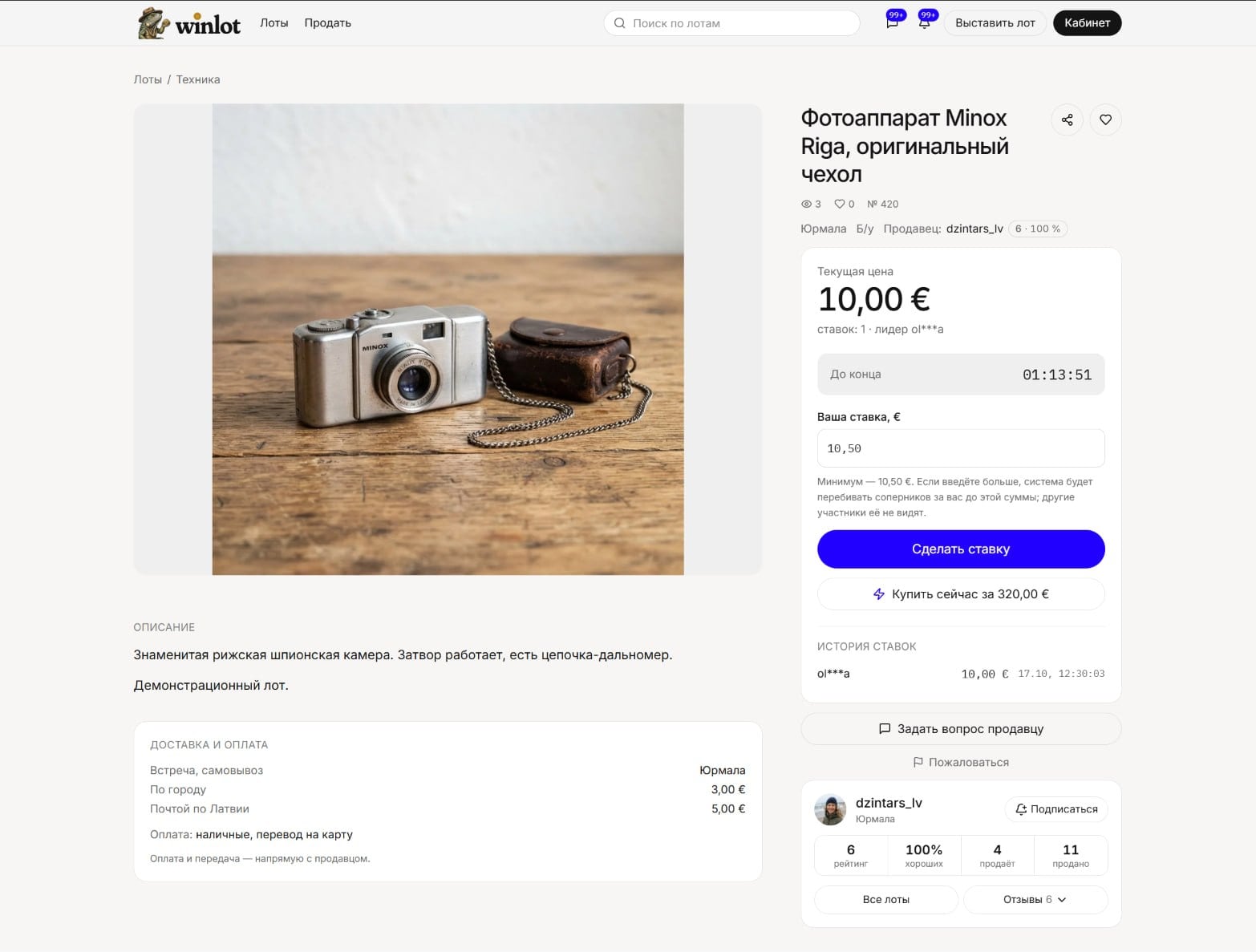
The item page displays the current price, number of bids and the leading bidder, a "Buy Now" button for a fixed price without bidding, bid history, delivery methods (pickup, local delivery, mail) and payment options (cash, bank transfer), as well as a seller card with a rating, number of transactions, and "Subscribe" and "Complain" buttons.
What's the difference between a custom auction platform and 1001site AI's ready-made classifieds platform?
Auction mechanics—bids, proxy bids up to the maximum, anti-sniper, bid extension—are not a website builder feature, but a separate development for a specific niche: they are individually assembled to suit the customer's brand and rules.
If you'd rather just submit ads at a fixed price with moderation instead of bidding, 1001site AI's ready-made "Classifieds" mode offers this: categories and attributes, manual and AI moderation, accepting ads from Telegram and WhatsApp, automatic posting, and paid promotion of lots—all in your account, without a developer.
| Criterion | Custom auction platform (winlot case study) | 1001site AI Classifieds |
|---|---|---|
| Mechanics of the deal | Bets, proxy bet to the max, anti-sniper, buyout now | Fixed price, advert is published and removed |
| Moderation | New sellers and items with stop words are reviewed after each edit. | Manual review or AI moderation based on your criteria |
| Applications are being accepted | Through the website, seller's personal account | Website, Telegram groups and private messages, WhatsApp |
| Monetization | Paid promotion of the lot, advertising | Paid ad promotion, your own AdSense, and banners |
| Launch date | Custom development for your niche and brand | Setting up a ready-made mode in the office, without a programmer |
If your niche doesn't specifically require auction mechanics, a website with categories, moderation, and bid acceptance can be built using 1001site AI: you choose the style, and the AI populates the site based on your link or description.
How does a seller list an item and get it moderated?
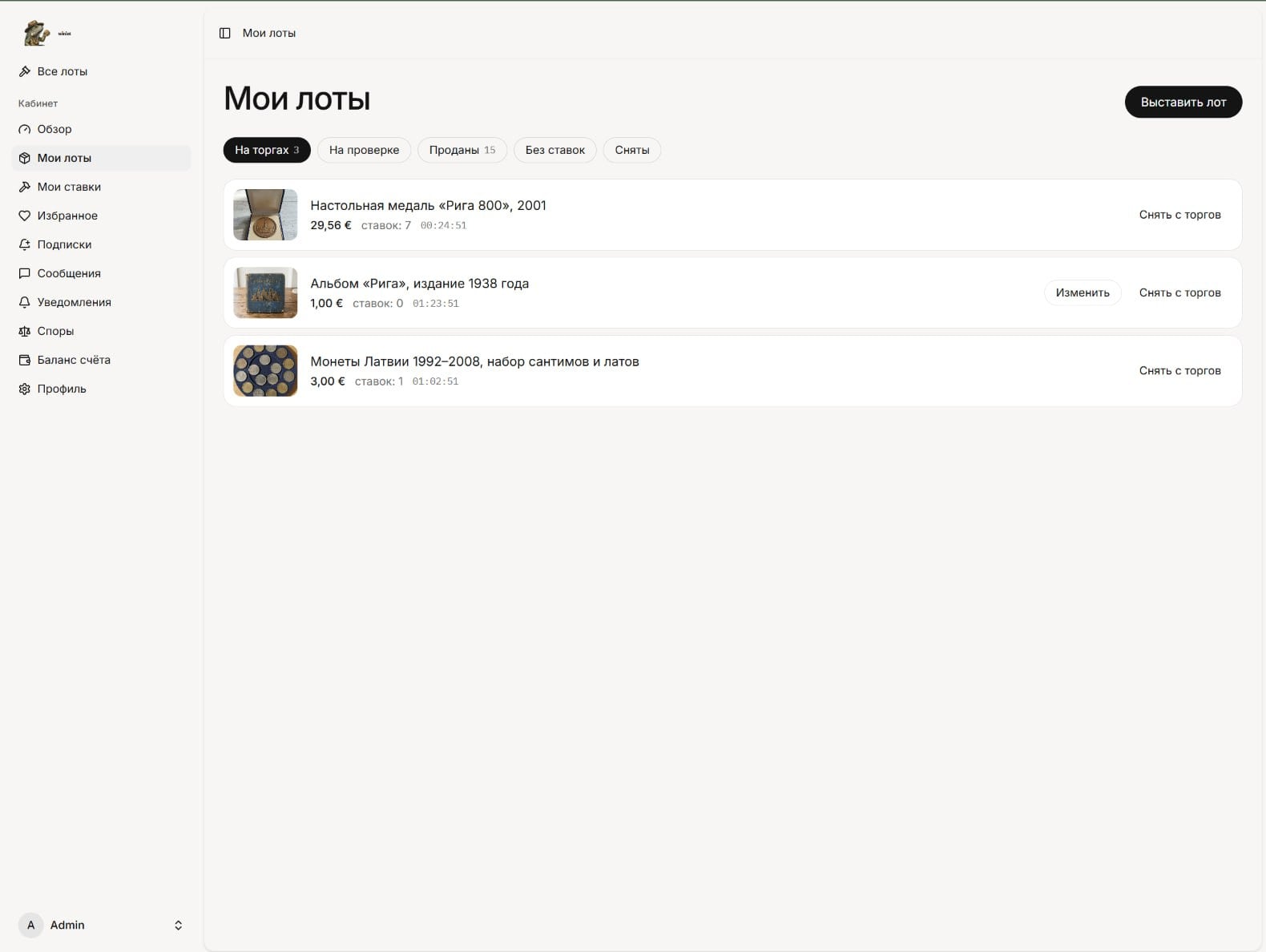
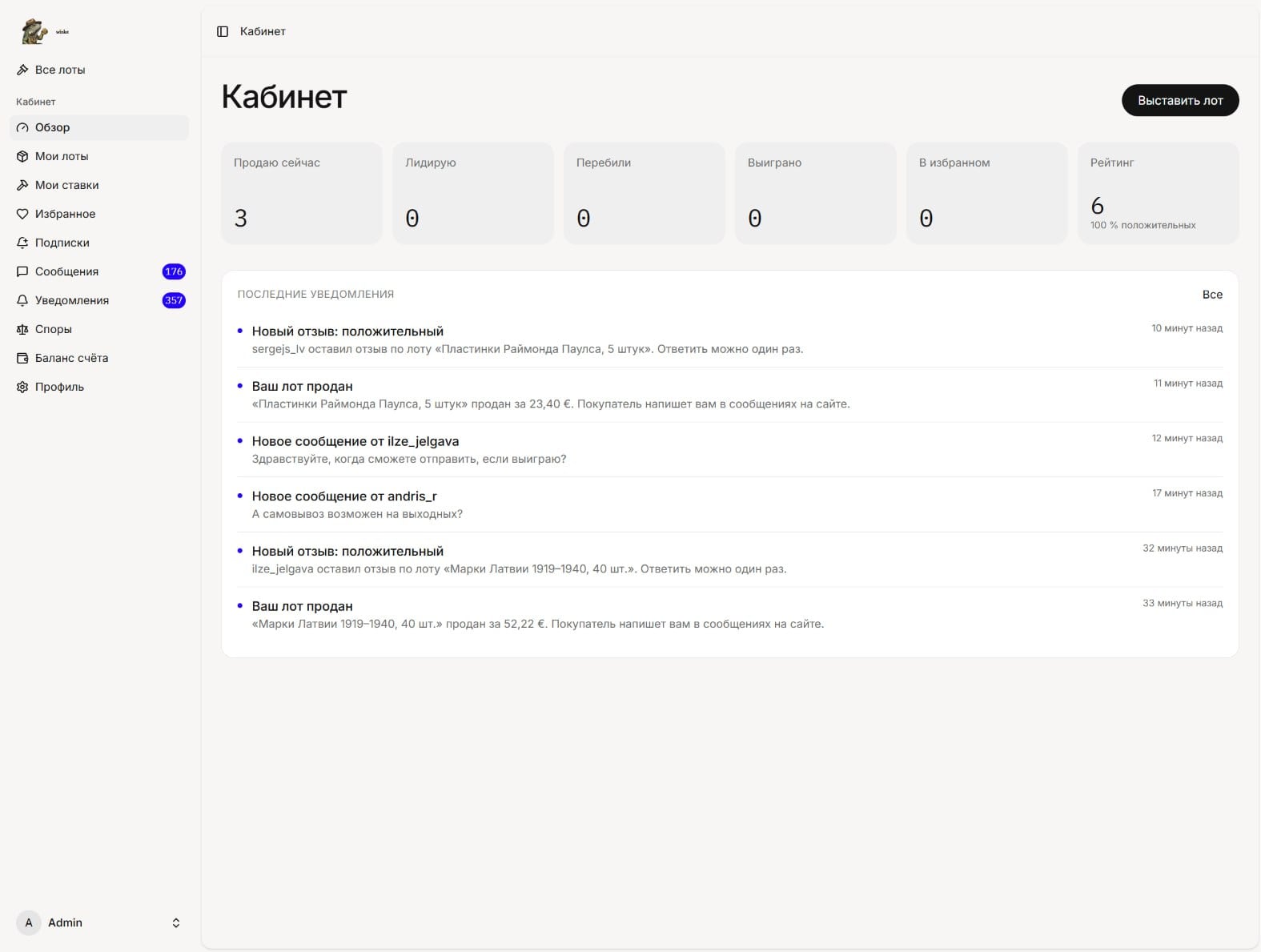
The seller has their own account: counters for "Selling Now," "Leading," "Outbid," "Won," "Favorites," and ratings; a notification feed for new reviews, sales, and messages; sections for "My Bids," "Favorites," "Subscriptions," "Messages," and "Account Balance." The "My Lots" section is divided into tabs for "At Auction," "Under Review," "Sold," "No Bids," and "Withdrawn"—meaning every new lot undergoes moderation before appearing in the general feed.
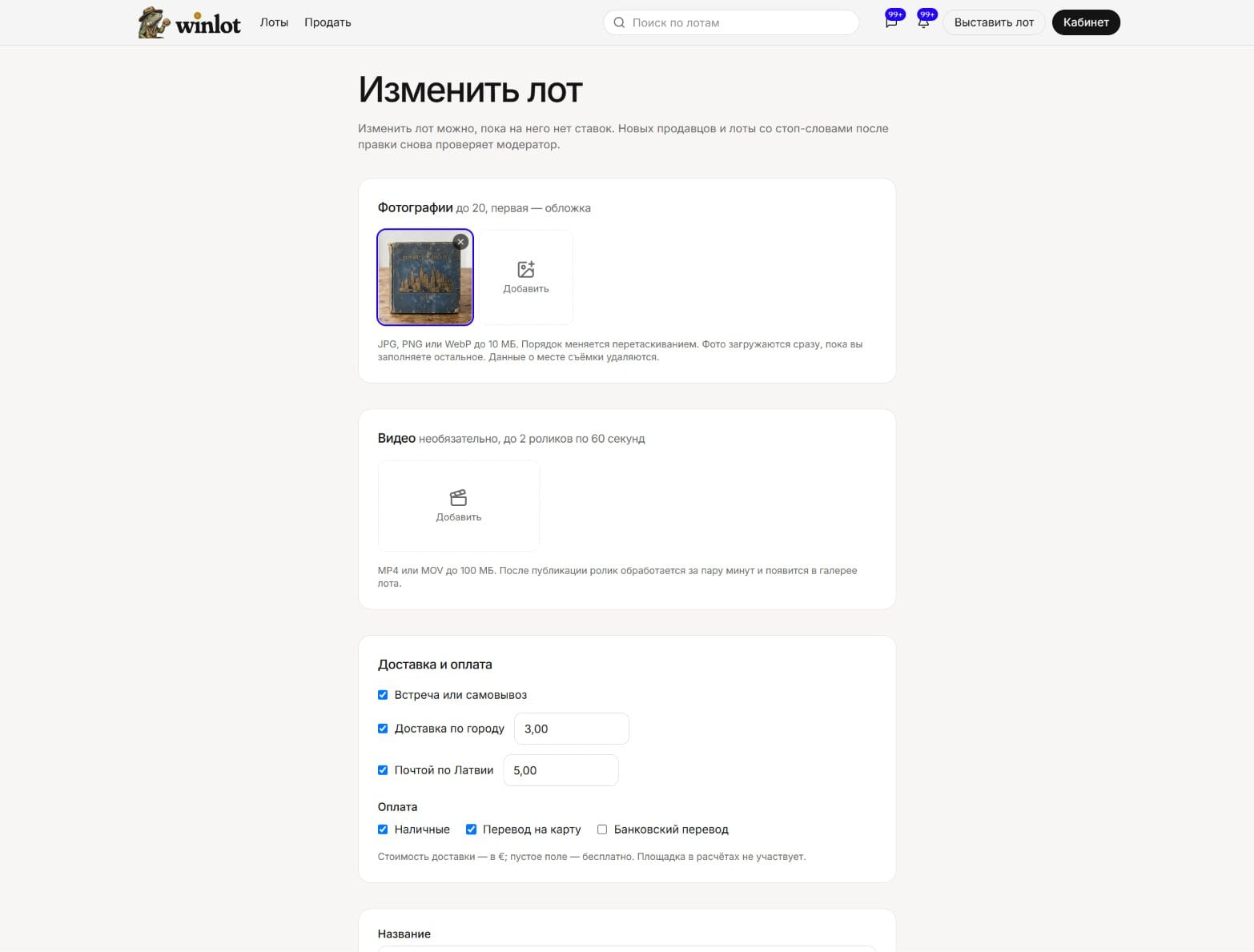
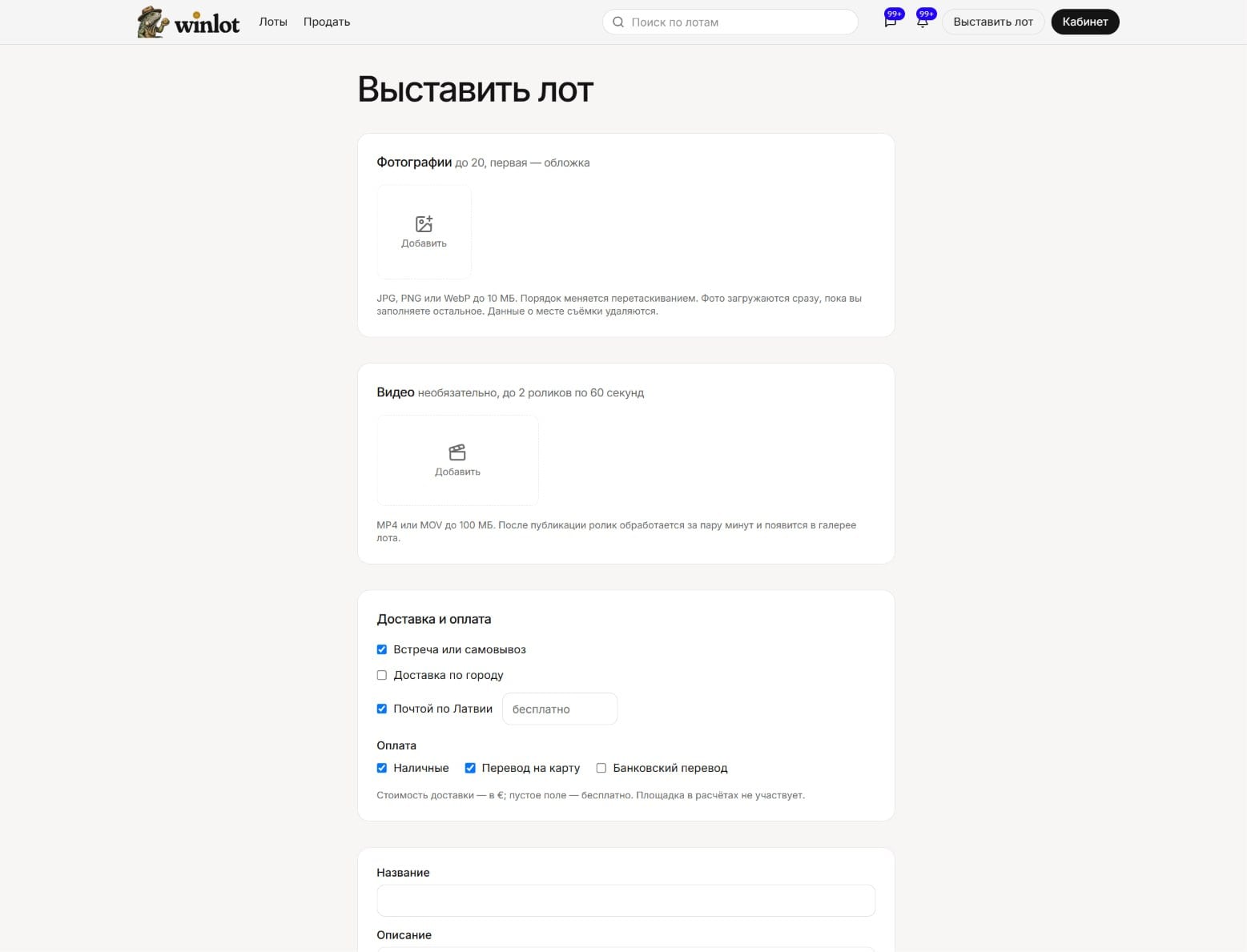
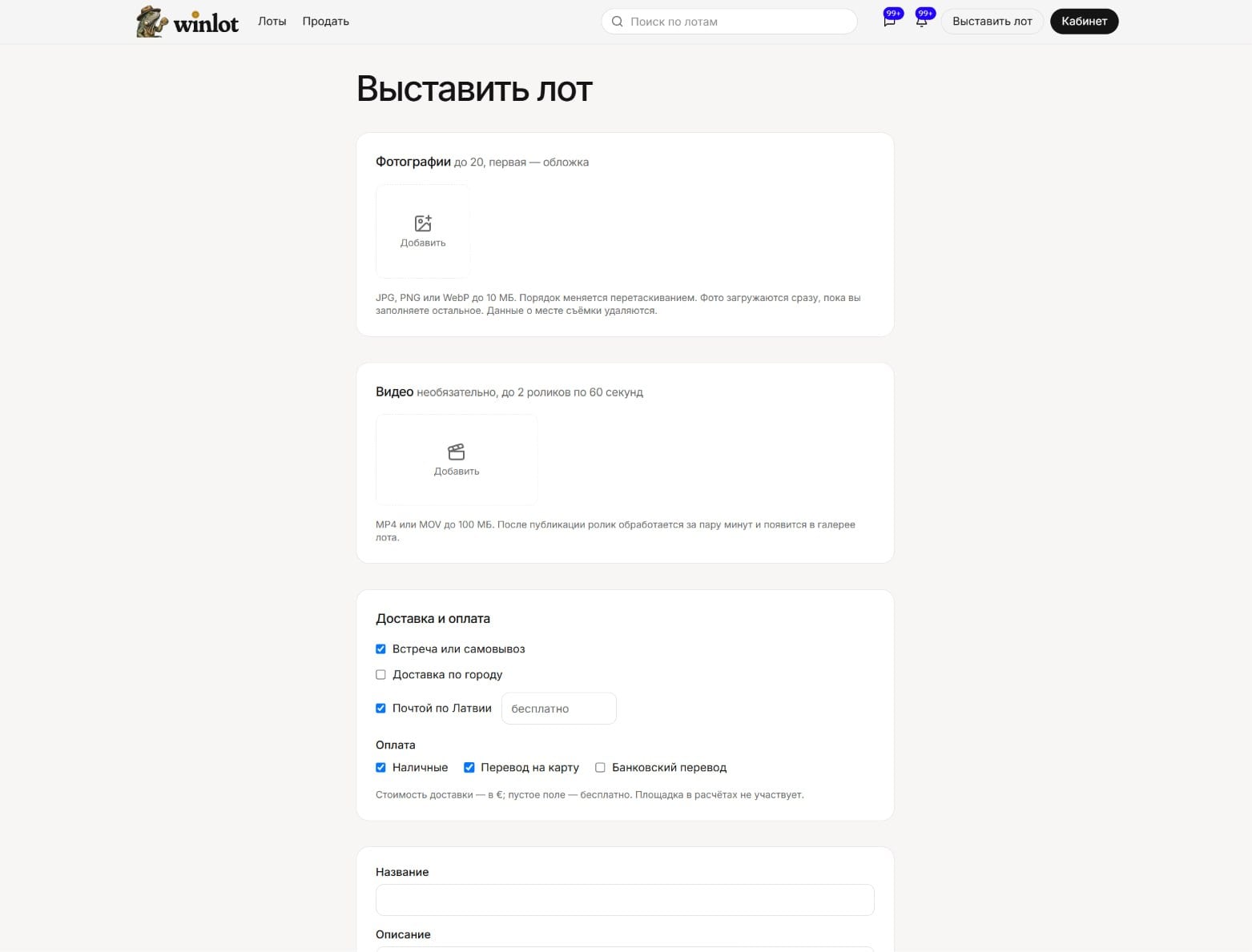
The listing form accepts up to 20 photos (the first becomes the cover) and up to two 60-second videos; location information is automatically removed upon upload. If a listing is edited by a new seller or contains stop words, it is resubmitted to a moderator for review after editing—this weeds out fraudulent and simply careless listings.
What does the auction owner see in the admin panel?
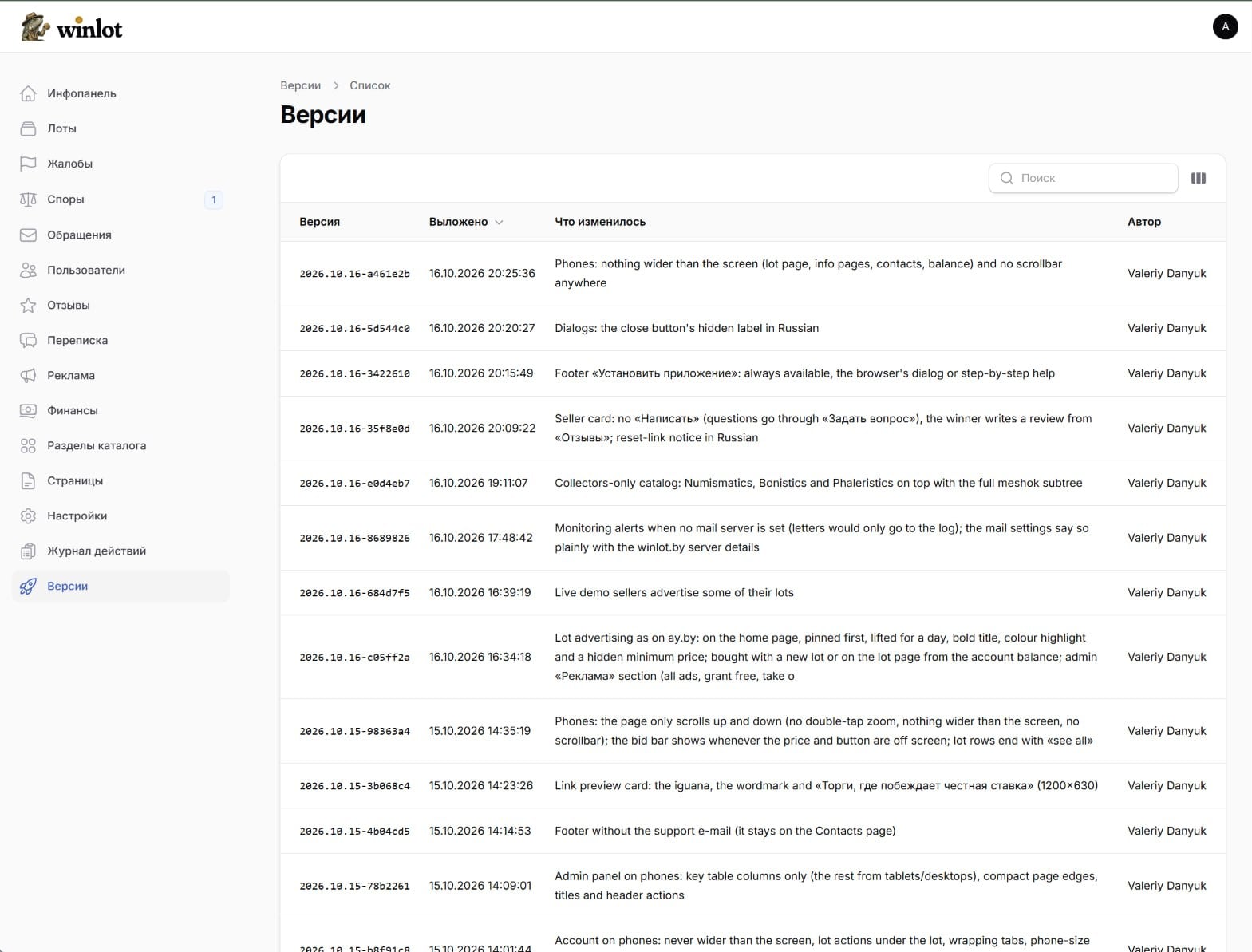
The admin panel is separate from the seller and buyer website: sections include "Listings," "Complaints," "Disputes," "Appeals," "Users," "Reviews," "Correspondence," "Advertising," "Finances," "Catalog Sections," "Pages," "Settings," and "Action Log." A separate "Versions" section displays the listing history—the screenshot shows that revisions were made several times a day, preventing the short development period from turning into one big release at the end.
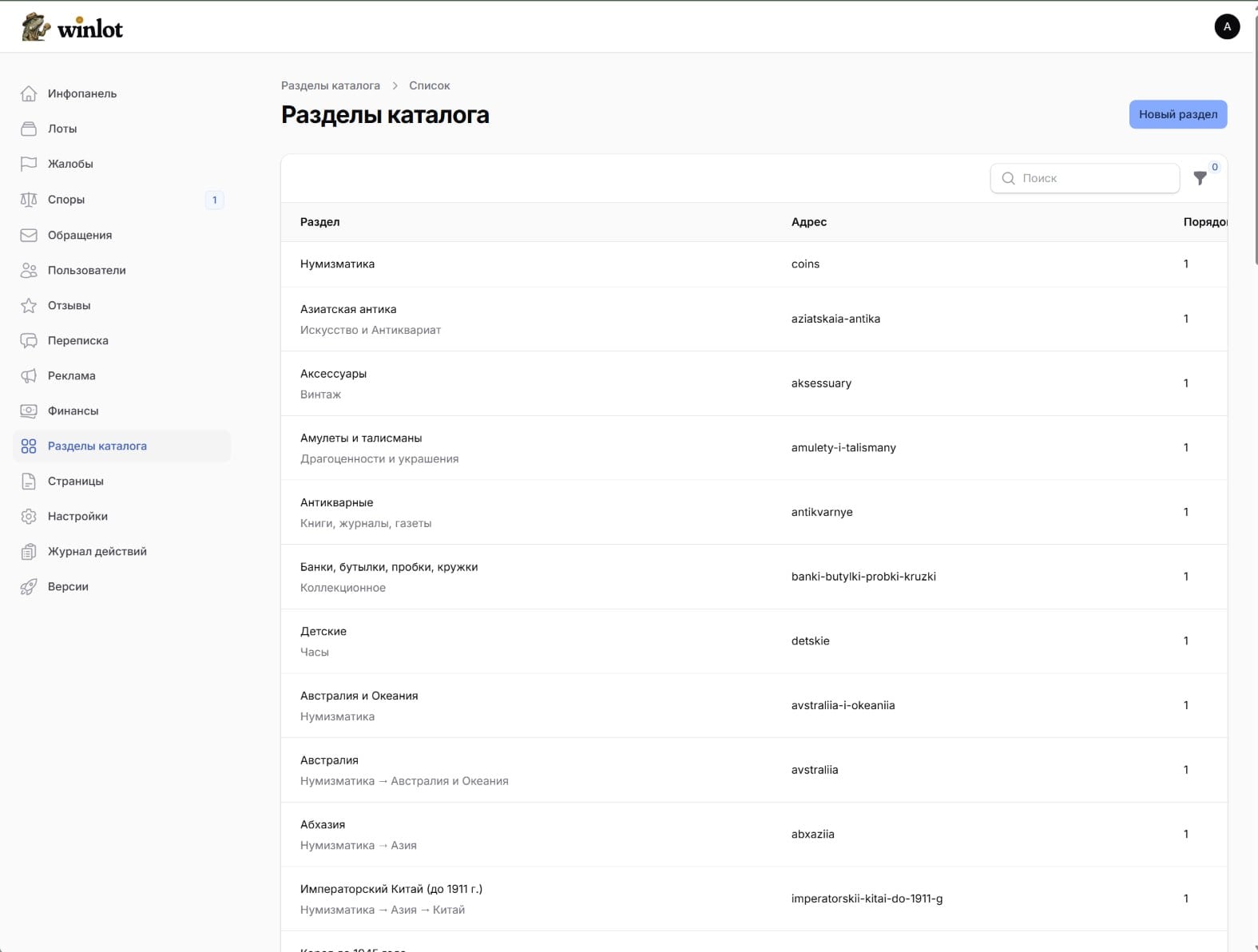
The category catalog is a multi-level tree: for example, "Numismatics → Asia → China → Imperial China (pre-1911)." This depth is exactly what a collector needs: they search for a specific category and find it in two clicks, without having to search through the general feed.
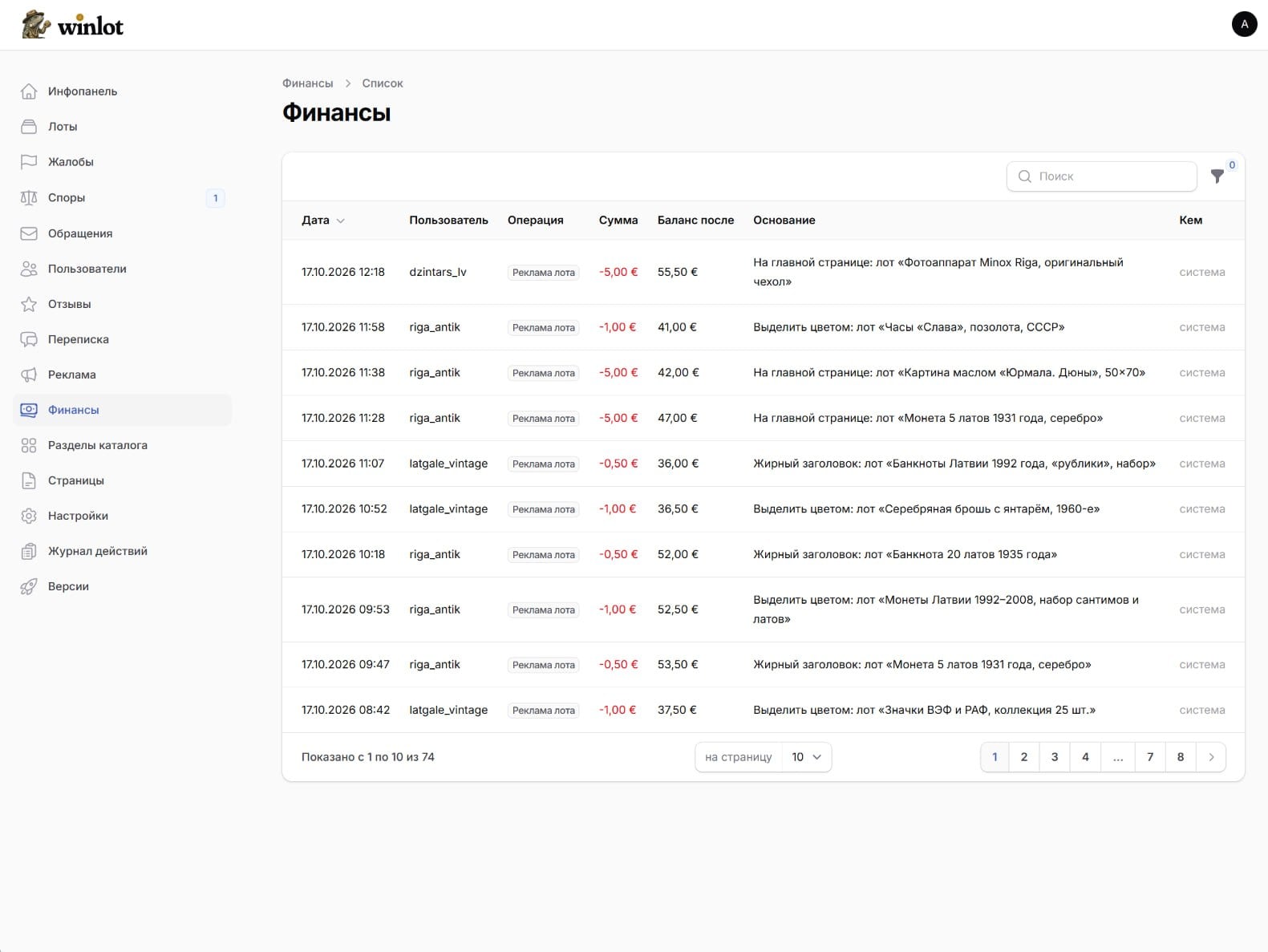
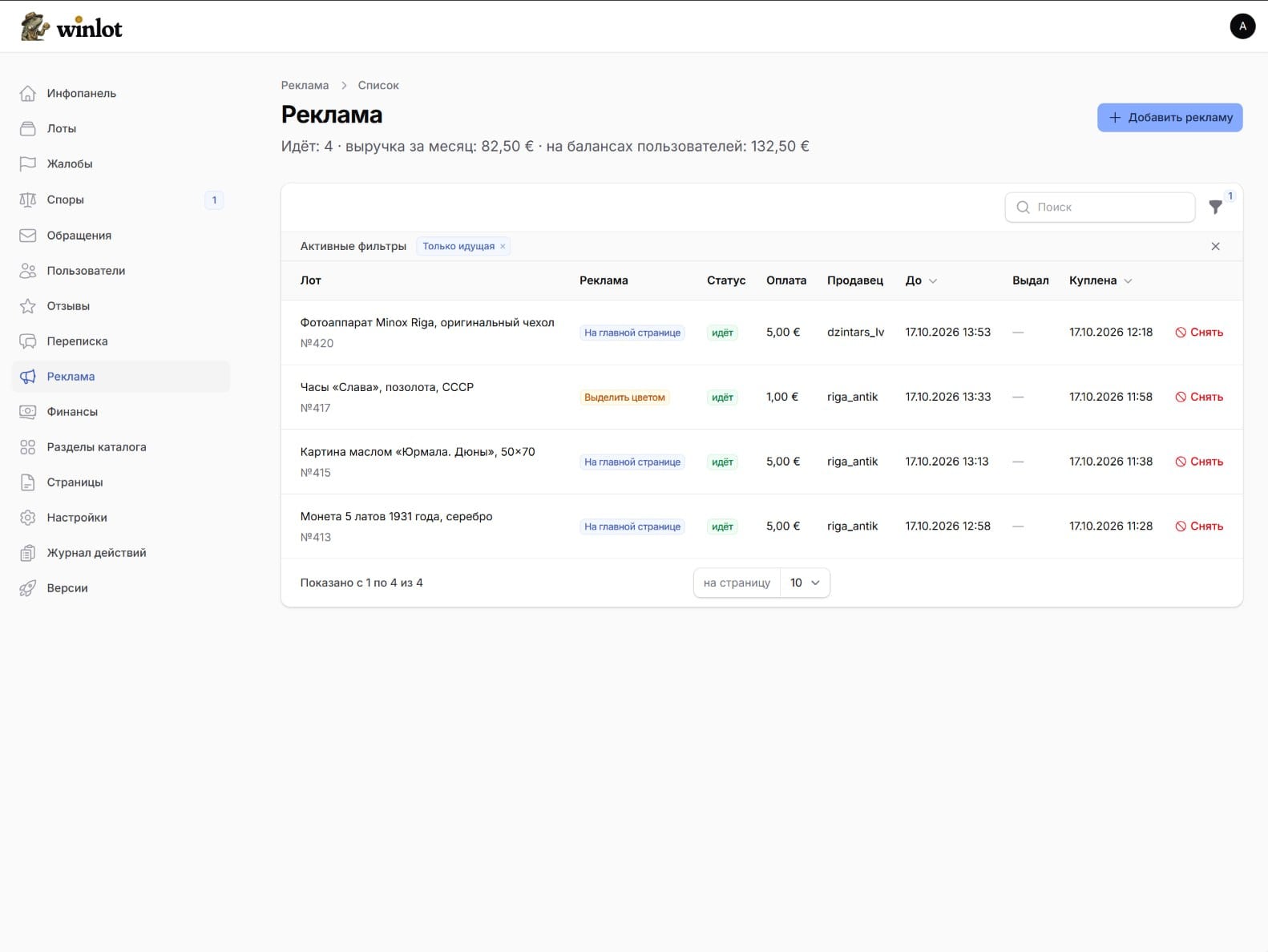
The platform makes money through paid promotion of items: "On the main page," "Highlight," "Bold title"—every seller action deducts money from their balance. The "Finance" section keeps a log of these deductions, and "Advertising" shows what is currently being promoted and how much revenue it generated over the month. At the time these screenshots were taken, the platform was running in demo mode for demonstration to the client—meaning the revenue figures and user numbers on these screens illustrate the promotion mechanics at work, not the results of an already running business.
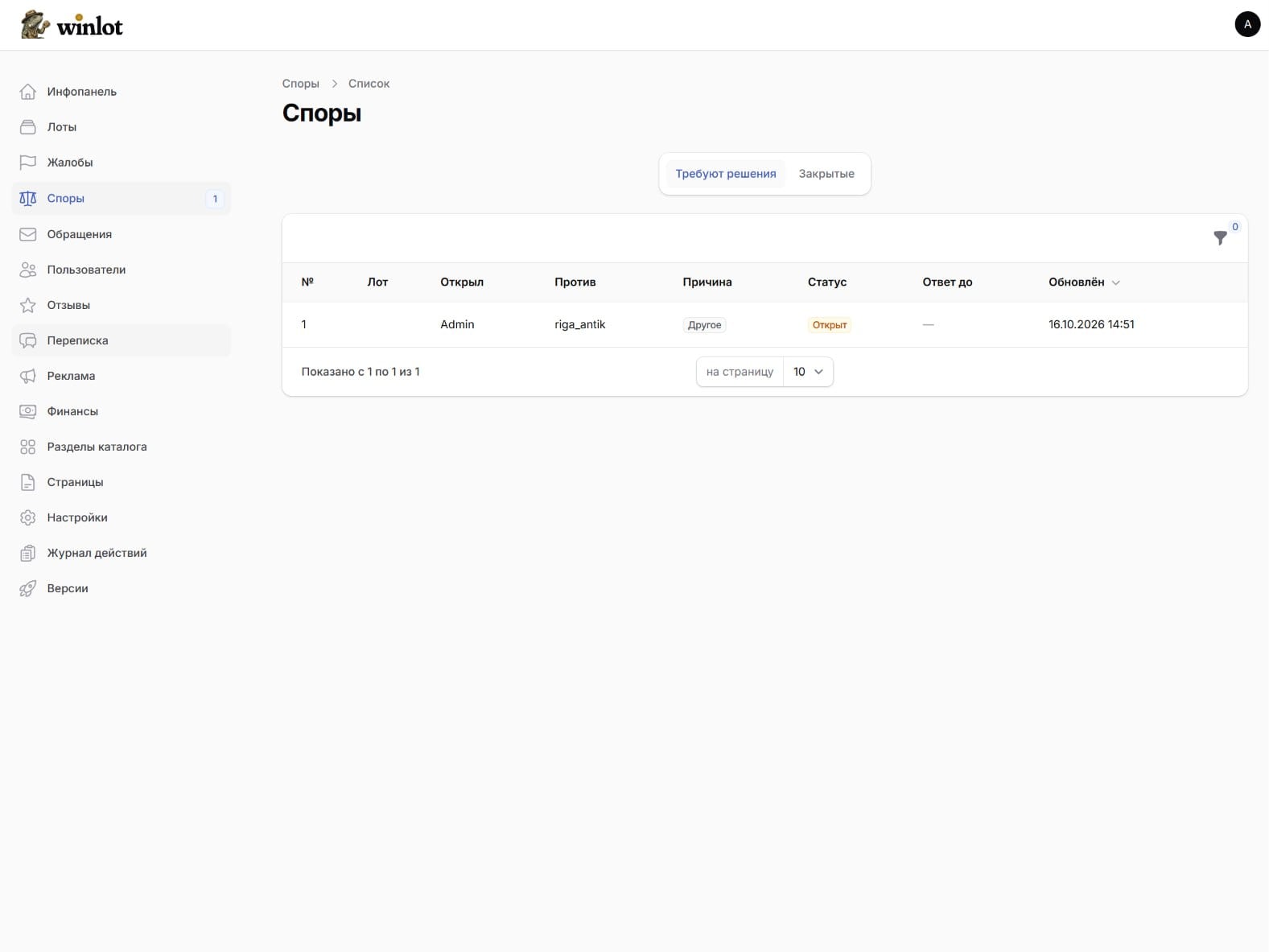
The "Disputes" section with the "Request Resolution" and "Closed" statuses allows the site administrator to open a dispute against the seller and track it separately from regular customer complaints.
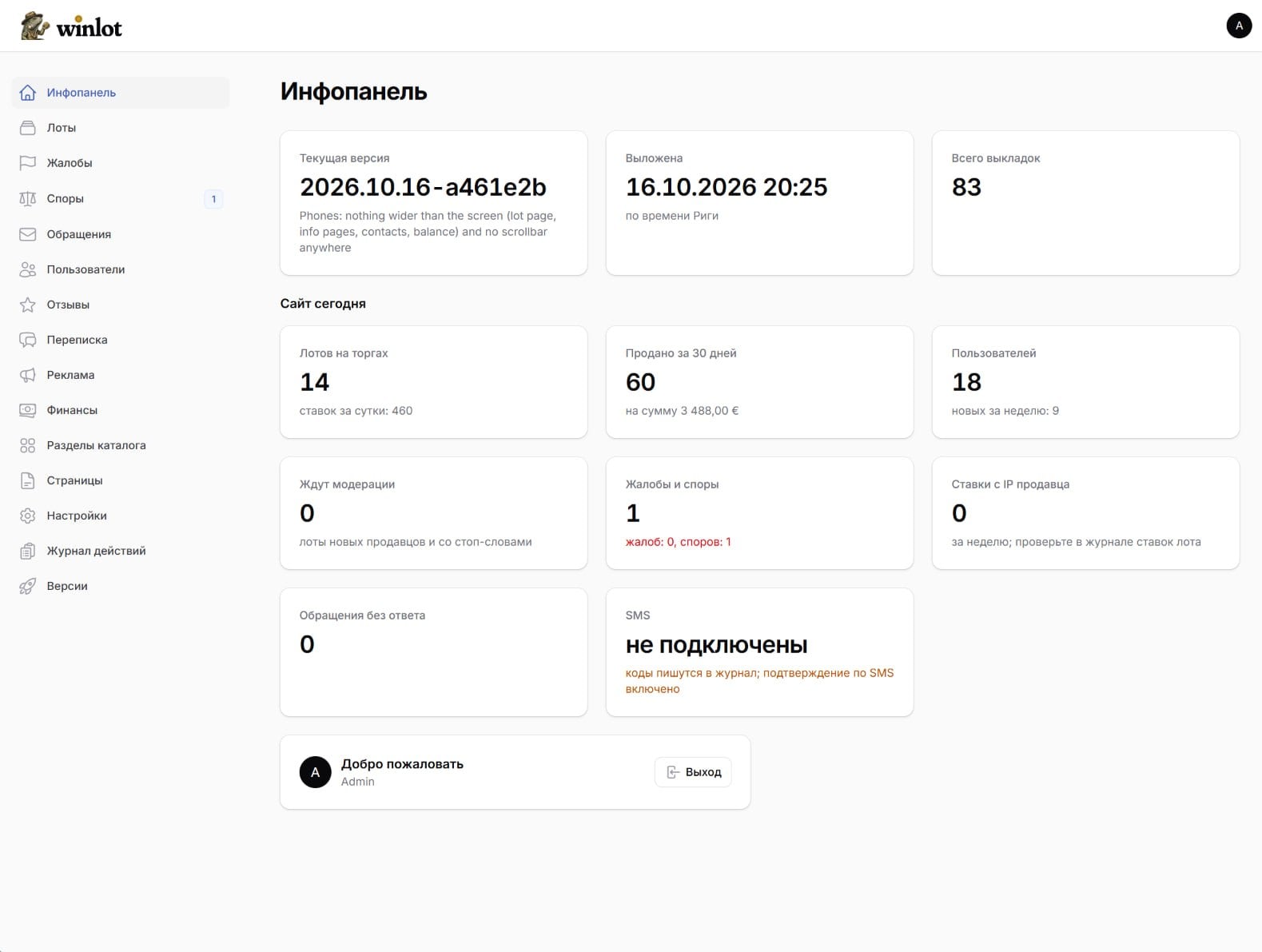
The dashboard displays the current site version and the total number of listings, the number of lots currently on sale, sales for the past 30 days, new users for the week, lots awaiting moderation, open complaints and disputes, and even bids from the seller's IP address on a single screen—this protects against price gouging, where the seller raises their own price.
How does the platform solve the problem of an empty catalog in the early days?
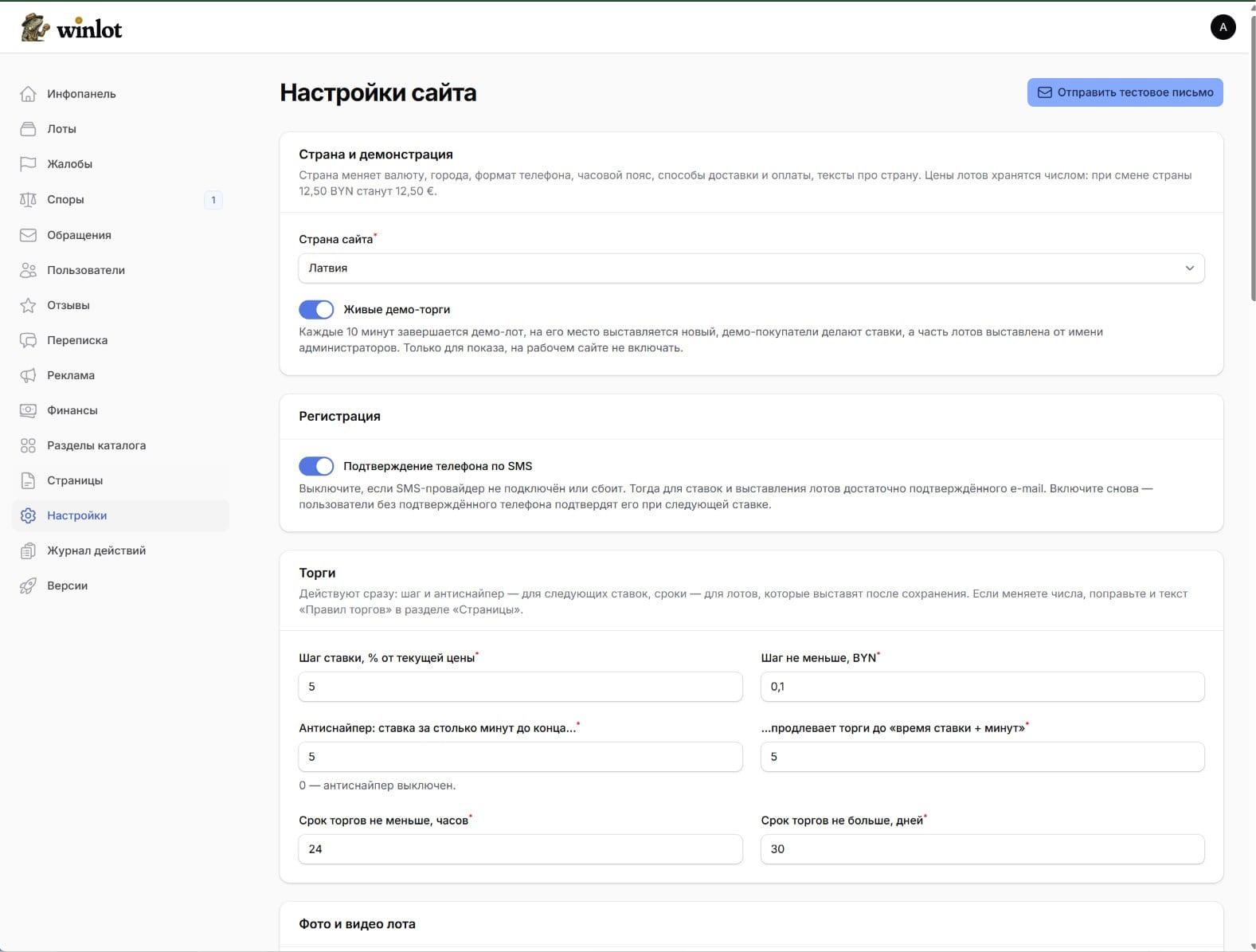
This was one of the challenges back when we were still on the ANKAND network: without products and bids at launch, the site looks dead and discourages both sellers and buyers. Winlot has a "Live Demo Bidding" toggle in the settings for this: a demo lot closes every 10 minutes, a new one takes its place, demo buyers place bids, and some lots are listed under the administrators' names—it's clearly marked: "For display only, do not enable on the live site." General bidding rules are also set there: bid increment as a percentage of the price, minimum bid increment, anti-sniper extension window and time, and minimum and maximum bidding duration (from 24 hours to 30 days). The site's country is a separate setting: a single toggle changes the currency, cities, phone format, time zone, and delivery texts.
How long did the development take and why did you complete it in 7 days instead of 14?
The client allocated 14 days for a new antiques auction. I completed the work in 7 days and filmed the process as a separate video analysis.
- I started not with code, but with a niche analysis - I didn't copy the ANKAND scheme exactly, but reassembled it for a more sophisticated antiques buyer.
- I put together the frontend: a listing feed, a listing card with a proxy bid and anti-sniper, and a seller's account with moderation.
- I assembled the admin panel: catalog sections, moderation, finance, advertising, disputes, and a version log - it shows that updates were released several times a day, not in one release at the end of the term.
- I delivered the work to the customer on the 7th day instead of the planned 14th, with a video review of the result.
Who is this custom auction platform suitable for?
Developing for an auction makes sense if:
- In your niche, bidding mechanics are important: proxy bid up to the maximum, anti-sniper, buy now at a fixed price.
- You have a narrow product category where the buyer values a specific catalog section—like the numismatics and bonistics sections at Winlot—rather than a general feed without any breakdowns.
- The site needs a controlled cold start: a demo mode or similar mechanism to prevent the catalog from appearing empty in the first days after launch.
If, instead, a website with categories, moderation, and a fixed-price application process is sufficient, 1001site AI can build such a website in your account without a programmer, using the ready-made "Classifieds" mode.
Readers' Questions
Why does an auction need a "live demo bidding" mode?
To prevent the catalog from appearing empty during the first few days, a demo lot closes every 10 minutes, demo buyers place bids, and some lots are listed under administrators' names. In the settings, it's clearly marked "for display only, do not enable on the live site"—there's no need to enable it on the live site with real sellers.
How is the anti-sniper different from a regular auction timer?
A standard timer simply runs out at the set time, and whoever finishes first wins. Anti-sniper extends the auction by a few minutes if a bid is received in the final minutes—this prevents a bidder who watches the auction until the very last second from snatching victory without anyone noticing.
A custom auction platform or a ready-made classifieds board 1001site AI – which one to choose?
If you need auction mechanics—bids, anti-sniper, maximum proxy bid—we offer a custom solution for your niche. If simply submitting ads with moderation and a fixed price is sufficient, you can build such a website on 1001site AI in your dashboard without a developer.
Is it possible to view lots without registration?
Yes, the feed and lot pages are open to everyone. Registration is required to place a bid or list your item—phone number verification via SMS is enabled in the winlot account.
Sources
- The author's post on Telegram channel: https://t.me/promtvibeadd/453
- Video about the ANKAND auction network: https://youtu.be/X24lUP0N1kI
- Video overview of the development of an antiques auction: https://youtu.be/FiWpDVgkuNI
- 1001site AI Classifieds Mode: https://1001site.com/wiki/mode-classifieds/
- Catalog categories and attributes: https://1001site.com/wiki/catalog-categories/
- Advertising and paid promotion on the website: https://1001site.com/wiki/ads/
A similar custom development case study: ERP, website, and Telegram bot for a car dismantling company in 6 days. If the task requires a ready-made mode, 1001site AI builds a website with categories and moderation in just a few minutes.
Project links
Discussion
Post and comments in Telegram channelБизнес с ИИ | Через замочную скважину · 18 October 2026
Questions and Answers
Why does an auction need a "live demo bidding" mode?
To prevent the catalog from appearing empty during the first few days, a demo lot closes every 10 minutes, demo buyers place bids, and some lots are listed under administrators' names. In the settings, it's clearly marked "for display only, do not enable on the live site"—there's no need to enable it on the live site with real sellers.
How is the anti-sniper different from a regular auction timer?
A standard timer simply runs out at the set time, and whoever finishes first wins. Anti-sniper extends the auction by a few minutes if a bid is received in the final minutes—this prevents a bidder who watches the auction until the very last second from snatching victory without anyone noticing.
A custom auction platform or a ready-made classifieds board 1001site AI – which one to choose?
If you need auction mechanics—bids, anti-sniper, maximum proxy bid—we offer a custom solution for your niche. If simply submitting ads with moderation and a fixed price is sufficient, you can build such a website on 1001site AI in your dashboard without a developer.
Is it possible to view lots without registration?
Yes, the feed and lot pages are open to everyone. Registration is required to place a bid or list your item—phone number verification via SMS is enabled in the winlot account.
Subscribe to my Telegram channel
In the channel « Бизнес с ИИ | Через замочную скважину», I watch and talk about how clients who have contacted me use AI in their businesses. I encourage discussion—let me know in the comments, and I'll respond directly.
Similar projects

Bulletin Board: How to Build a Website with AI Moderation Yourself
How to enable "bulletin board" mode, set up AI moderation, and accept applications from Telegram and WhatsApp – a step-by-step guide for a website without a developer.
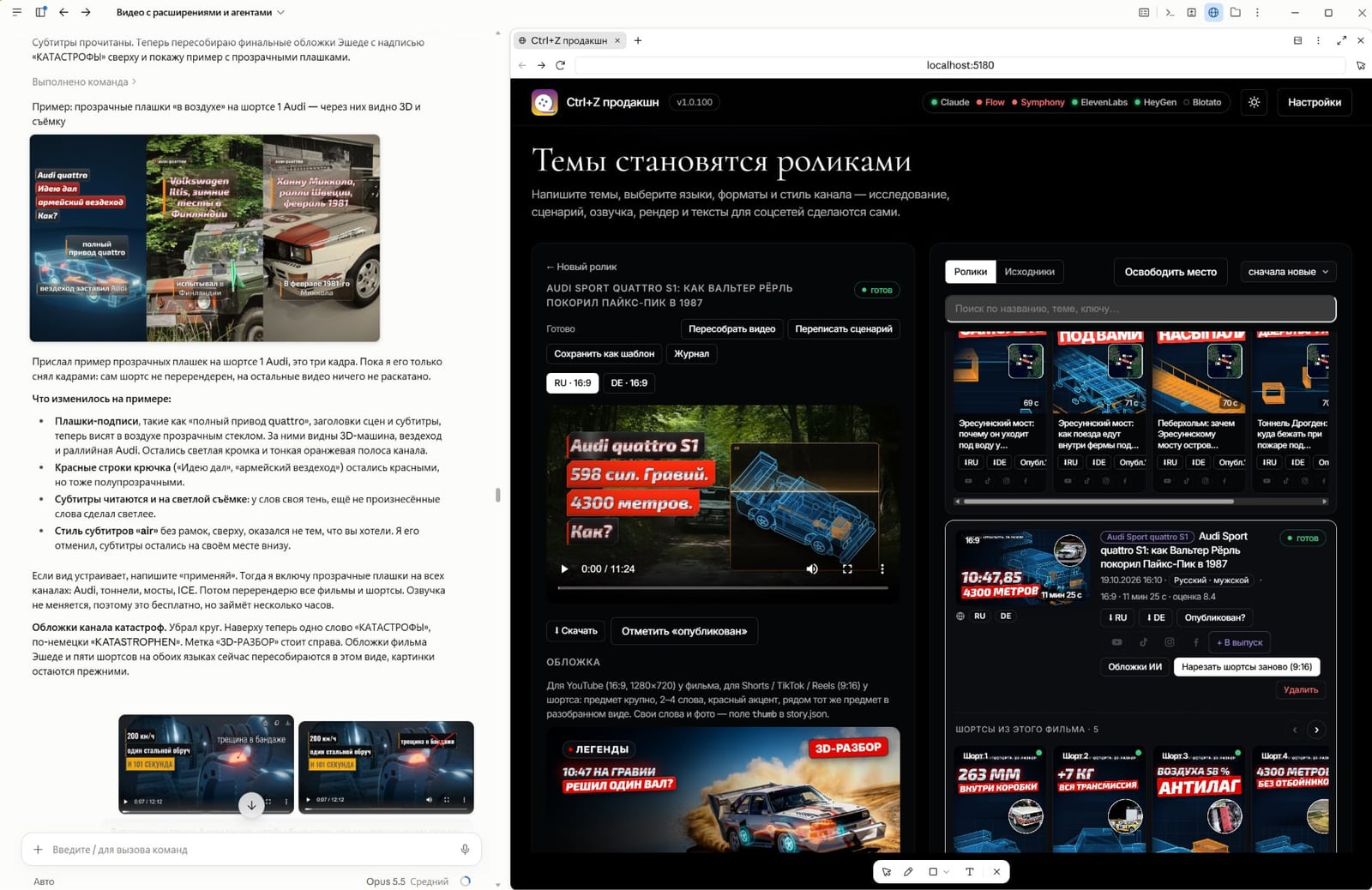
Ctrl+Z Production: An AI-powered YouTube Video Studio Instead of Cheap Videos
Case study: For a YouTube channel with over 400,000 subscribers, we built an AI studio called Ctrl+Z Production – chat in Claude, 3D animation, and agents instead of cheap videos.
Multi-currency accounting for auto dismantlers: a formula for replacing currency chaos
Oleg from Lutsk developed a multi-currency accounting formula for an Audi auto dismantling company, which we implemented in the CRM: daily exchange rate, receipts, expenses, Nova Poshta, and Telegram bot.