In 2026, you can get a small business website for anything from nothing (a free website builder plan without your own domain) to tens of thousands of euros for a complex custom online store. There are three realistic ways to get one: ordering from a studio or freelancer, building it yourself with a website builder with a monthly fee, or launching it through an AI-powered website builder with a subscription or one-time payment. Each has its own start-up price, hidden fees, and waiting period. The range in search results for the query "how much does a turnkey website cost" confirms this: top search results show prices ranging from several hundred to tens of thousands of euros—with no explanation for the difference.
How much does a website cost from a studio or a freelancer?
In short: in the US, custom development costs range from approximately €260 for a simple landing page from a freelancer to €20,000 and up for an online store from an agency. In Germany, it ranges from €1,000 for a one-page website to €40,000 for a complex store. In the UK, it ranges from approximately €950 to €10,500+.
This is what the ranges look like in the US and the EU (from freelancer to agency; prices in dollars converted to euros):
| Site type | USA | European Union (France) |
|---|---|---|
| Landing | ≈ 260-2600 € | from 1000-2500 € (Germany, one-pager) |
| Business card website | ≈ 700-8600 € | 1500-8000 € |
| Online store | ≈ 2150-21 500 € | 4,000–25,000 € |
| Corporate website or web service | ≈ 4300-100 000+ € | 8,000-100,000+ € |
In Germany, a Dresden-based agency quotes prices ranging from €1,000-€2,500 for a one-page website to €15,000-€40,000 for a complex online store, with multilingual support adding 30-50% to the estimate. In the UK, a 5-8-page website costs approximately €2,900-€5,300, while London-based studios charge 20-40% more than their regional counterparts.
The range isn't random: the price depends on whether the website is built using a ready-made CMS, a website builder, or coding from scratch. Without a breakdown, one studio's estimate cannot be compared with another.
What determines the price of a custom website?
The development itself almost never includes a domain, hosting, SSL certificate, post-delivery support, copywriting, and photography. Each item is added separately and charged on top of the studio's budget, but together they can double the final bill—especially if professional product photography and text for each page are required.
Typical extra charges that are easy to miss when first looking at the estimate:
| Expense item | Order of numbers |
|---|---|
| Domain | ≈ 9-17 € per year |
| Hosting | from ≈ 2 € per month (virtual) to ≈ 9-105 € (VPS) |
| SSL certificate | Often free, paid - about 26 € per year |
| Post-delivery support | ≈ 170-860 € per year for a small website |
| Copywriting | ≈ 1-8+ € per 1000 characters or ≈ 350-950 € per text package |
| Product photography | $25-$500+ per photo |
Estimates from different contractors for the same website often vary dramatically: content transfer alone can cost several hundred euros. The final cost is based on the work of a programmer, server administrator, and layout designer—and this formula isn't published in advance; it's only revealed in the specific invoice.
Another risk is that the contractor may stop responding mid-project due to overload of orders or personal issues, and advance payments without a contract are often non-refundable. This isn't a problem for freelancers and studios—the risk is mitigated by a contract and payment breakdowns, regardless of the transaction size.
How much does a website builder cost with a subscription fee?
In short: classic website builders like Tilda, Wix, Squarespace, Shopify, and Ecwid cost between $5 and $65 per month, depending on the plan, but the cost increases with each additional feature and often depends on the country you're paying from.
Current rates as of September 28, 2026, according to the official service pages:
| Constructor | Tariffs |
|---|---|
| Tilda | Personal ≈ 13 €/month, Business ≈ 22 €/month (up to 5 sites) |
| Wix | Light ≈ 15 €/month, Core ≈ 26 €/month, Business ≈ 34 €/month |
| Squarespace | Basic 15 €/month, Core 24 €/month, Advanced 42 €/month |
| Shopify | Basic 27 €/month, Grow 74 €/month, Advanced 384 €/month |
| Ecwid | Starter ≈ 4 €/month, Venture ≈ 30 €/month, Business ≈ 56 €/month |
Wix and Squarespace officially charge different prices depending on your country and currency. Wix's pricing page clearly states that prices are shown in dollars for reference, and the actual cost varies by region. Check the pricing page for your specific country to see the current price—the first number you see may not reflect the actual price.
The advantage of a website builder is the low entry threshold and familiar interface. The disadvantage is that the bill grows with your needs: your own domain, online store, service label removal, and advanced analytics are almost always included in the more expensive plans, and after a year or two, a subscription for a functional website easily exceeds what seemed like a "cheap website builder" at the start.
How much does it cost to build a website using an AI builder?
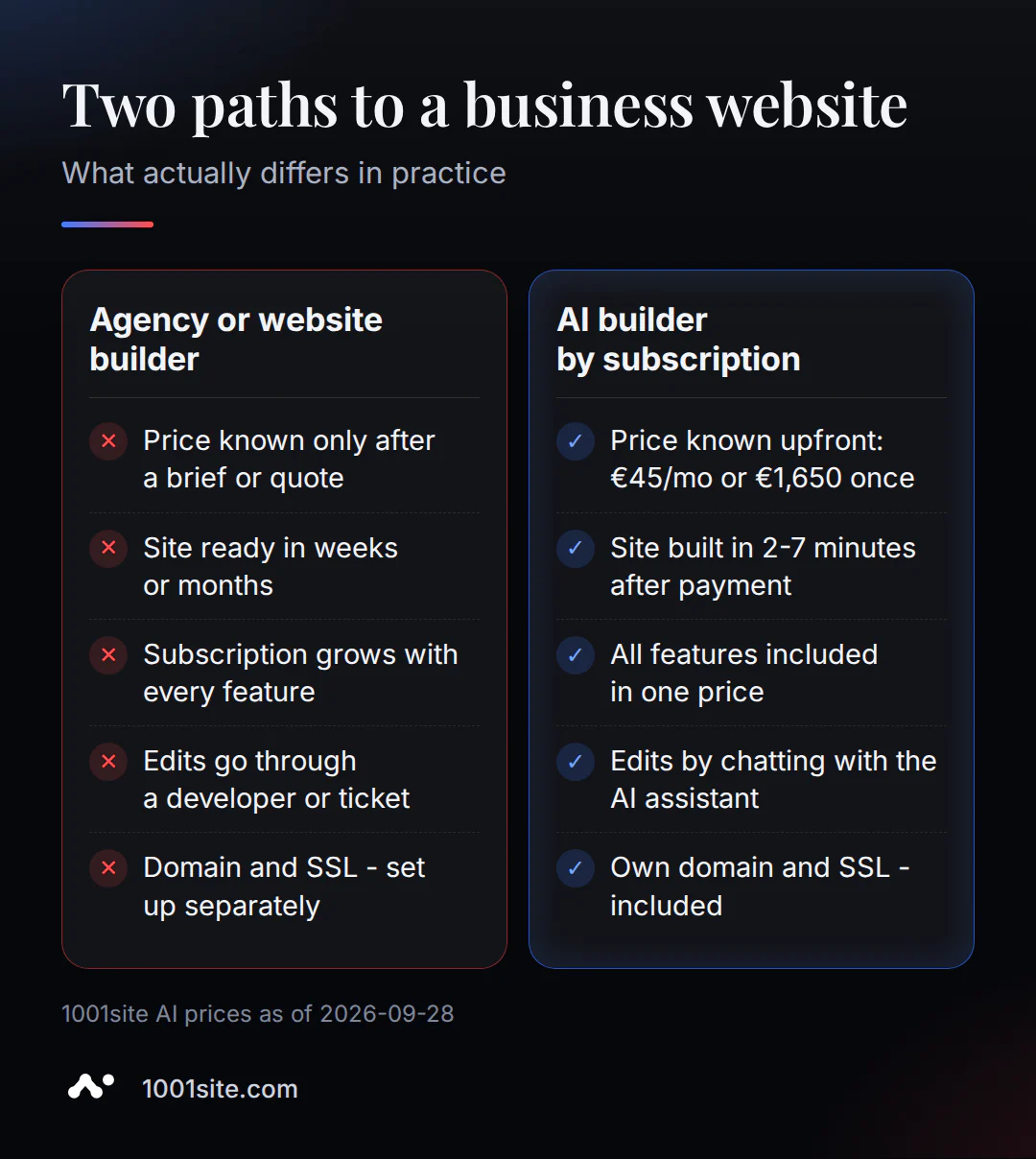
At 1001site AI, the price is known in advance and does not change during the work: €45 per month with a promo code of €25 for the first month, or €1,650 one-time payment for the “Turnkey” plan with 12 months of hosting free.
The "All Inclusive" plan is €45 per month, with the first month discounted at €25 using a promo code. This price includes a catalog of over 1,000 styles and website creation by an AI agent within 2-7 minutes of payment. Also included are an online store with payment via Stripe and Monobank, a classifieds service, applications accepted via Telegram and WhatsApp, your own domain with SSL, and automatic translation into 107 languages. You can cancel your subscription at any time; the website remains active until the end of your paid period.
The "Turnkey" plan costs €1,650 one-time. We build your website for you: style, structure, text, products, photos, Telegram and WhatsApp, payment, and training. All you need is the domain name, and 12 months of hosting is included. You can compare both plans and create your website at 1001site.com /#create.
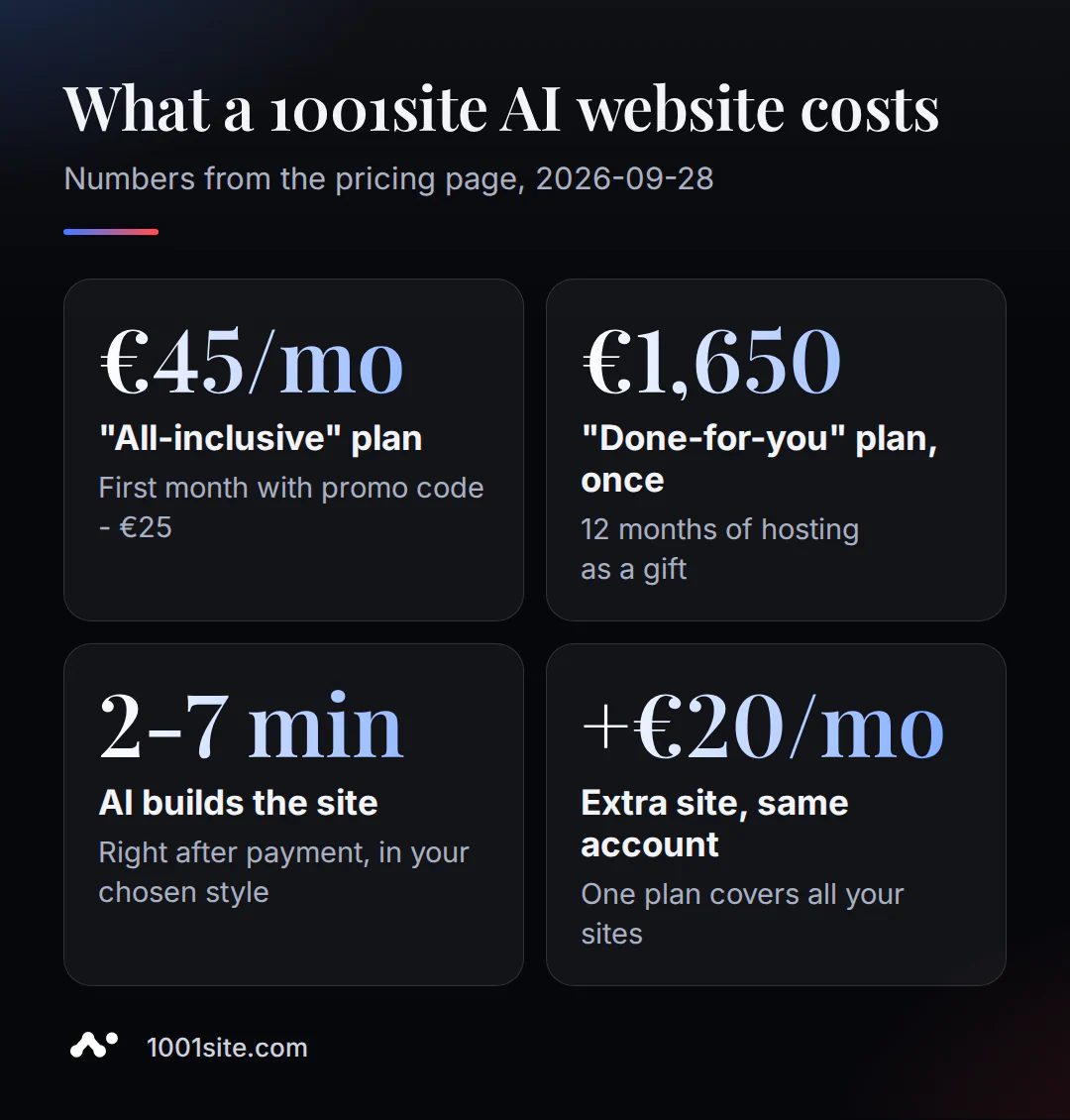
An additional website on the same account costs an additional €20 per month. This plan is valid for all websites per account. There is no trial period or free plan: the website launches immediately after payment, and the paid period is non-refundable because the service is digital.
Three methods in one table
Each method has its own strengths: a studio wins with flexibility and a unique solution, a builder wins with a familiar interface and low entry barrier, and an AI subscription wins with price transparency and launch speed. To ensure a fair comparison, below is the same five-criteria grid for all three methods: start price, launch time, additional fees, who makes revisions, and what happens after delivery.
| Criterion | Studio / freelancer | Constructor with a subscription fee | AI designer ( 1001site AI) |
|---|---|---|---|
| Starting price | Known after a brief or estimate | From ≈ 4-13 €/month | 45 €/month (25 € first month) or 1650 € one-time payment |
| Launch date | Weeks-months | Hours-days (hand assembled) | 2-7 minutes after payment |
| What is usually paid extra? | Domain, hosting, support, copywriting, photos | Your own domain, online store, advanced analytics | Additional website +20 €/month, AI assistant tokens with your own key |
| Who makes edits? | Performer, upon request | You yourself, through the block editor | You yourself, in words through an AI assistant |
| What happens after delivery? | Support agreement - separately | The subscription continues as long as the site is needed. | Subscription or one-time payment with no hidden renewals |
What's not included in the €45 per month price - honestly
The plan does not include AI provider tokens or additional websites beyond the initial one. You pay for tokens directly using your key, without any service markup, and each additional website costs an additional €20 per month. Other typical extras—SSL certificates, a catalog of over 1,000 styles, and translation into 107 languages—are already included in the €45 or €1,650 one-time fee.
The account's AI assistant—the one that edits the website's words, writes texts, and processes photos—runs on your own Gemini key (or on Claude and ChatGPT via MCP). This means you pay the provider directly for the neural network calls, at their rates, and the service doesn't charge a markup. For a website with several dozen products and regular edits, the API cost is usually lower than the hourly rate of a freelance layout designer, but no one will tell you the exact cost upfront—it depends on how many edits you request and which model you use.
The domain is a different story. 1001site AI issues and renews SSL certificates for free, but you purchase and pay for the domain itself separately, as with any of the three methods. And if you need multiple websites (for example, an online store and a landing page for a promotion), each additional one costs an additional €20 per month.
When more expensive doesn't mean better
In short: overpaying is justified if the business has a truly unique task. For a business card website, landing page, or standard online store, the extra thousands in the estimate are often spent on approvals and revisions.
Independent sources don't claim one method is better than another. Nielsen Norman Group notes that testing a website with five real users resolves "80% of site-level issues plus about half of page-level issues," and outsourcing such testing costs "less than $1,000." A website works if it's been tested with real visitors—regardless of who did it. Google Search Central recommends responsive design and a mobile-friendly version as the basis for indexing—and this is equally achievable with any of the three methods.
Signs that overpaying is justified include: a non-standard service cost calculation, integration with an internal warehouse system, or a non-standard order processing process. If the brief doesn't include any of these points, and the project is for a business card website or a regular online store, the extra thousand in the estimate will likely be spent on hours coordinating layouts instead of increasing functionality.
How to Avoid Overpaying for a Website: 5 Steps Before Paying
In short: before paying for any of the three options, compare offers based on the same criteria—the final figure in the estimate alone doesn't tell you anything. Below are five specific steps you should take before paying, regardless of whether you choose a studio, a builder, or an AI subscription.
- Ask for a breakdown of the estimate —domain, hosting, design, text, photos, and support—as separate line items. A single "turnkey website" quote without a breakdown isn't considered accurate.
- Find out what's included in post-delivery support —whether there's a separate contract, how much an hour of editing costs, and who owns the source files.
- Calculate the final price for the first year - the starting price won't tell you anything here: a subscription to the designer at ≈ €13/month quietly turns into €260+ per year if you add an online store and remove the service's branding.
- Check if you pay separately for the domain and SSL - some offers have this as a hidden extra charge, while others include it.
- If you want a precise price without briefings or phone calls, compare our ready-made plans. At 1001site AI, it's €45 per month (€25 for the first month with a promo code) or €1,650 one-time—both figures are visible on the 1001site.com /#create page before you pay.
Sources
- Project Cost Estimator - US Website Cost by Type, 2026
- Odilon Hugonnot - Website Price in France, 2026
- Tilda - official rates
- Wix - Official Pricing
- Squarespace - Official Pricing
- Shopify - Official Pricing
- Ecwid - official rates
- Kopf & Stift - Web Design Cost in Germany, 2026
- Zentus - Website Cost for Small Businesses in the UK
- Nielsen Norman Group - Cost of User Testing
- 1001site AI Pricing - Knowledge Base