
GPT-6 Astra and Claude Fable 5.1 have retired chatbots.

In September 2026, new versions of AI models were released—in my channel's post, I called them GPT-6 Astra and Claude Fable 5.1. After that, customer service bots began communicating with customers differently. A chatbot with buttons responds according to a script and gets stuck on the first non-standard question. An e-commerce agent automatically reads your posts on Instagram, Telegram, or your website, compiles a catalog from them, and guides the customer through to payment. I explained this difference using a post from my channel and a live demo at a sneaker store—and also showed how the same "give a link, get a catalog" principle is already at work in 1001site AI. This is useful if you sell through social media or instant messaging and are tired of manually tweaking bot scripts for each new customer question.
What is the difference between an agent and a chatbot?
The bot selects a predefined response based on a predefined script and stays within it. The agent decides what to respond to and what to do next, right up until the order is placed. Anthropic analyzed the architecture of this behavior in its article "The Anatomy of Effective Commerce Agents" (link in the "Sources" section)—similar principles are evident in the product discussed below.
| Sign | Chatbot with buttons | E-commerce agent |
|---|---|---|
| How to prepare | the script is written by a person by hand | He himself analyzes posts, photos, and prices via a link to the profile. |
| An unusual question | gets lost, calls the operator | selects the answer and the product from the catalog himself |
| Placing an order | usually no, just forwards the request | brings the dialogue to the point of payment and transfers the completed order |
| Support | We need a permanent administrator | No further configuration is required, the catalog is updated using the same link |
Old button-based bots were slow, often made mistakes with non-standard questions, and required the salesperson to constantly fine-tune the scripts. An agent builds responses from your own catalog, so this kind of daily manual support isn't required.
How an agent assembles a catalog from a single link
In practice, it's a three-step process. You have a point of sale—a website, Instagram, Telegram channel, or TikTok —and your posts already feature products and services.
- You give the agent a link to this point.
- The agent analyzes posts, texts, photos, and prices and compiles a catalog from them without adding anything of their own.
- The agent communicates with the buyer like a seller: clarifies what the buyer needs, offers options, and places the order.

An agent works where you already sell—on social media, messengers, or your website—and understands buyers' text, photos, videos, audio, and voice messages before offering a response.

It then offers the buyer to install your storefront on their phone as an app and sends push notifications: discounts, new items, the desired size that is back in stock, and order status.


What the buyer sees when the agent starts
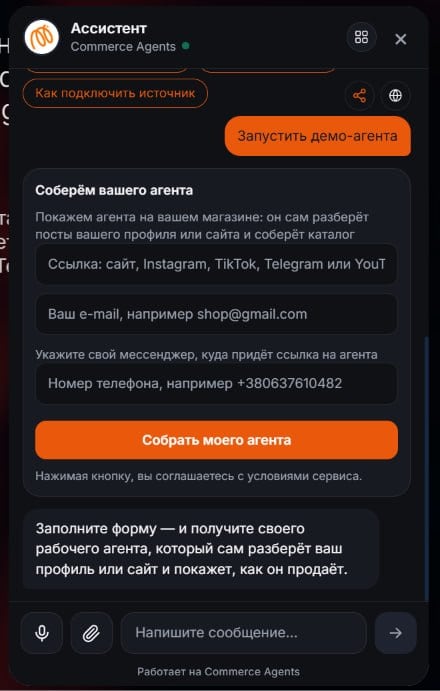
To keep things simple, I ran a demo on a real sneaker store on Instagram. First, there was the launch form: a link to a profile or website, e-mail, and messenger, where a link to a ready-made agent would be sent.
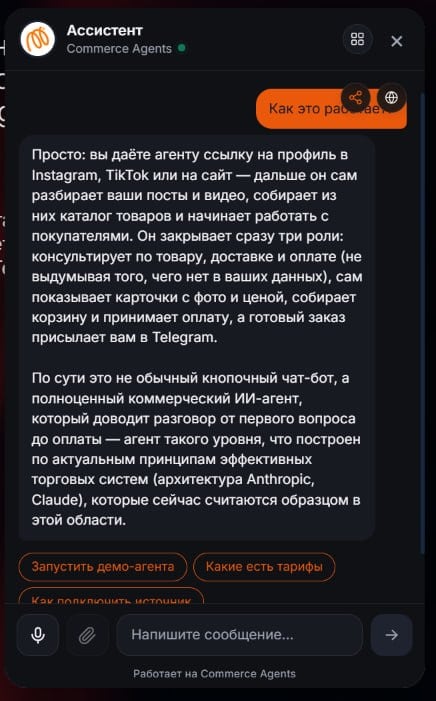
The agent then explains the process to the buyer: parsing through profile posts and videos, compiling a catalog from them, and leading the conversation from the first question to payment, without inventing anything that isn't in the seller's data.
How does product selection and ordering work?
At the leader_style8 sneaker store, checkout takes just one screen: the selected item, size, and price are automatically entered, and the buyer only needs to provide contact information and a delivery address. Payment is accepted by card, Google Pay, or Apple Pay and goes directly to the seller's account.
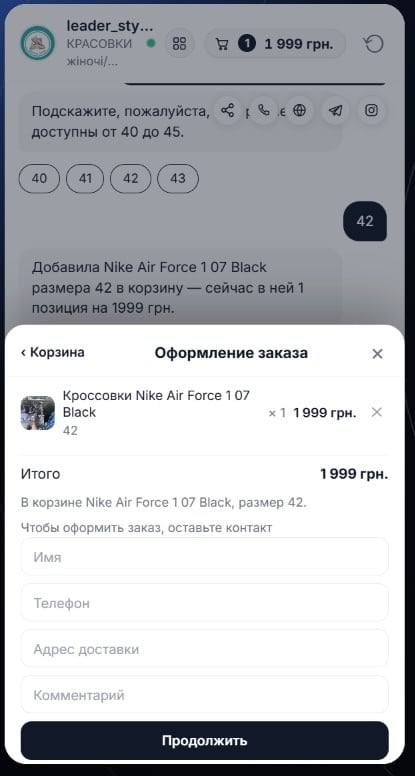
The agent takes the buyer to this screen themselves. First, they specify the size using the buttons and add the selected model to the cart.
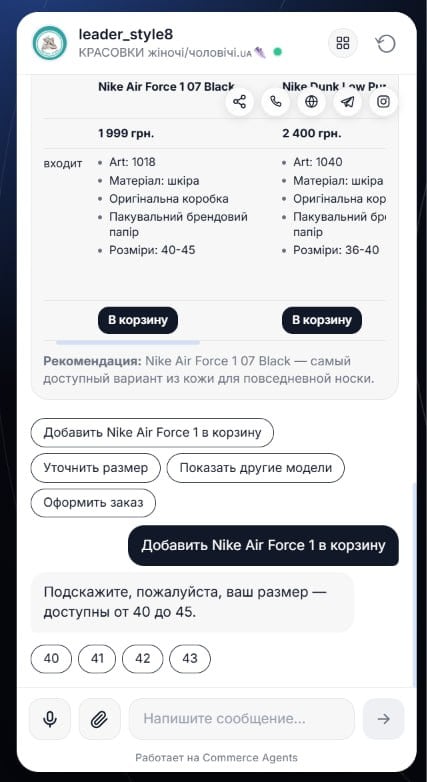
If a buyer is unsure between two pairs, the agent compares them by composition, size range and price and gives a short recommendation.
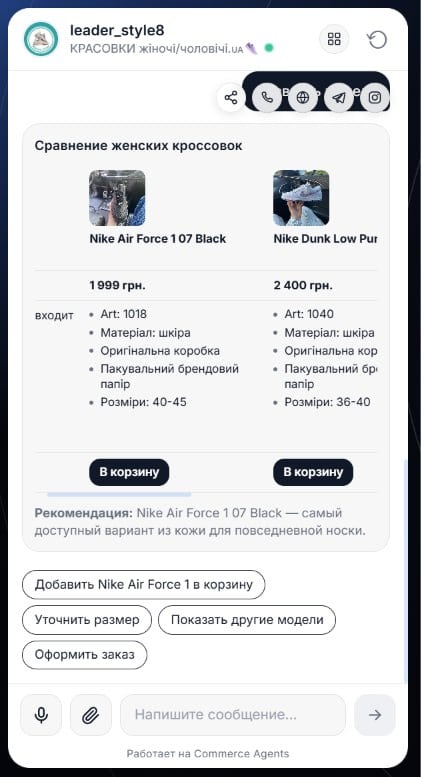
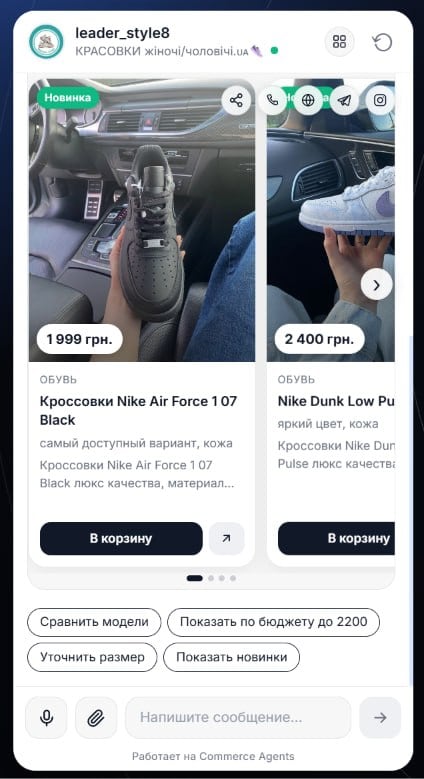
The agent creates product cards with photos, prices, and an "Add to Cart" button from a catalog collected via a link.
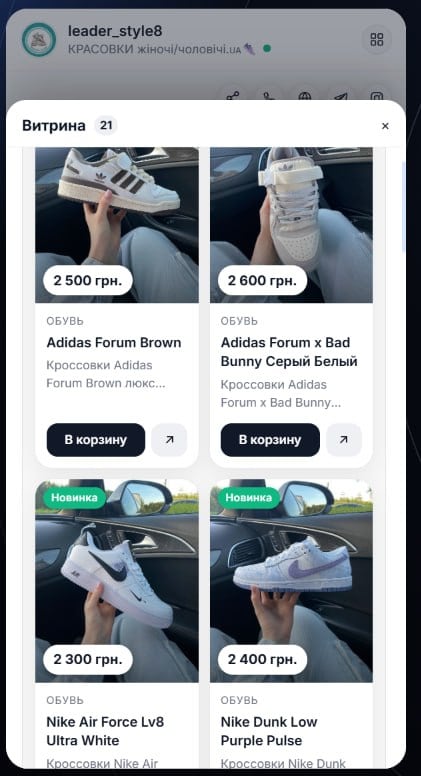
The request “show other models” immediately opens the entire store window.
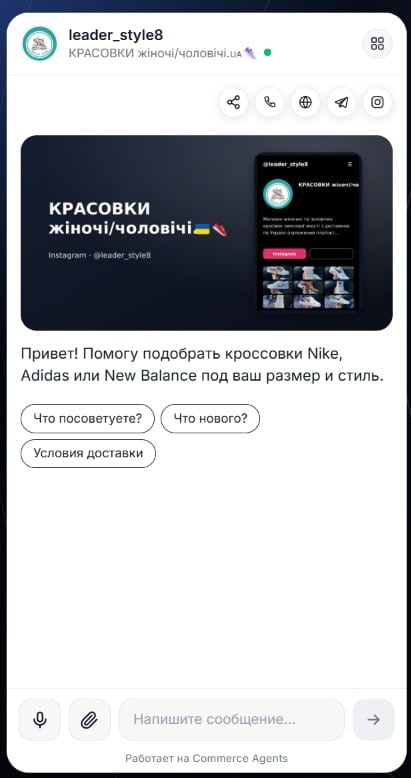
And the whole dialogue begins with a simple greeting right on the store window on Instagram.
The agent handles only routine inquiries. According to the author, when an important event occurs—for example, if a customer urgently needs a wholesale order—the agent calls a human for assistance: the store owner immediately receives a Telegram notification with a link to join the conversation. The catalog, conversations, and orders are all collected in a single account, ensuring a ready-made list of requests is always at hand.
According to the product's author, a deep analysis of 100 posts costs approximately €2.10 (compared to around €12 for the previous analysis method), and the average response to a customer is around €0.020, compared to €0.100 or higher for earlier solutions. This is the author's benchmark, not an independent measurement, but the order of magnitude of these figures demonstrates why the agent can be kept running 24/7.
Where can I see ready-made agents?
According to the product, demo agents have already been configured on the storefronts of over 100 businesses across various niches: from a Korean cosmetics store and a shoe retailer to a bag and backpack brand. Each storefront can be opened and a question about a specific product can be asked—the agent responds in the buyer's preferred language, available in 108 languages.

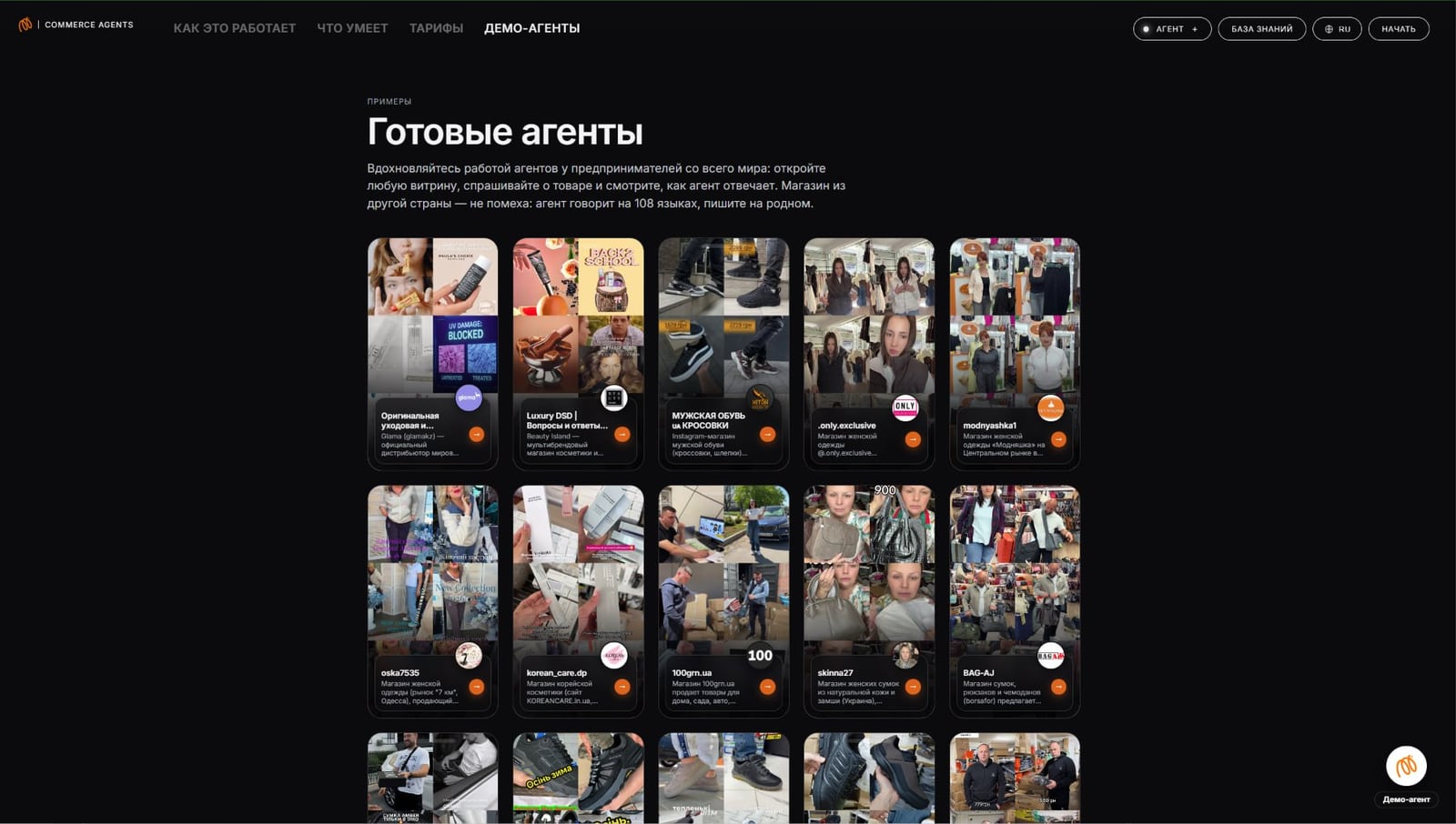
The final product slide boils it down to three steps: provide a link to Instagram, TikTok, YouTube, or a website – the agent will examine the product and demonstrate it there. The demo is free and runs on GPT, Claude, and Gemini technologies.

The video on my YouTube channel explains the process and shows how the agent continues the conversation to the end.
Who is this approach suitable for?
For those already selling through Instagram, Telegram, or TikTok and tired of manually answering the same questions about sizes, composition, and delivery times, an agent saves the most time. Another example is when selling to customers from different countries: an agent answers in everyone's language without having to translate cards separately. If you currently have five products and one manager who knows everything, the benefit isn't as noticeable: the time savings increase with the number of inquiries and products in the catalog.
Do you need a separate website if you already have such an agent?
A messenger agent and a website aren't competitors, but rather two showcases of the same catalog. At 1001site the same "give a link, get a catalog" principle is built into the "Create a Website" pop-up: paste a link to your old website, Instagram, Facebook, TikTok, Telegram channel, or product listing, and the AI transfers the name, logo, description, and product listings to the new site.
The website itself is then managed by an AI assistant. It runs on your own API key ( Gemini, Claude, or ChatGPT), with no service charge for tokens, and edits the website on command using words. The website can also be switched to an online store, landing page, or message board mode, and it also connects to external assistants via MCP if you're already using Claude, ChatGPT, or Gemini for business messaging.
You can get this bundle—a catalog via a link plus a website with an AI assistant—through 1001site AI: choose a style from the catalog, then the AI builds a website, online store, or classifieds site within minutes of payment.
Sources
- Post from the "Business with AI" channel: https://t.me/promtvibeadd/446
- Anthropic: The anatomy of effective commerce agents - https://claude.com/blog/the-anatomy-of-effective-commerce-agents
- Commerce Agents (demo and pricing) - https://comag.vibevox.pro/
Project links
Discussion
Post and comments in Telegram channelБизнес с ИИ | Через замочную скважину · 21 September 2026
Questions and Answers
Is this just a smarter chatbot, or is it really something else?
The difference isn't in the politeness of the responses, but in the action. The bot selects a pre-written response based on a human script. The agent itself reads your posts, compiles a catalog from them, and escalates the conversation to payment, activating the store's tools—product cards, shopping cart, and checkout.
What models does the agent work on in 1001site?
Gemini, Claude, or ChatGPT - on your own API keys (the access key to the neural network that you obtain yourself from Google, Anthropic, or OpenAI), without the service's markup for tokens.
What does an agent do if he can't answer a buyer's question?
According to the author, when an important event occurs—for example, a request for a wholesale order—the agent calls for help: the store owner immediately receives a Telegram notification with a link to join the person-to-person conversation.
Is it possible to get a similar AI assistant on your own website, not just in a messenger?
Yes, that's what 1001site AI is for: you paste a link to your old website, Instagram, or product listing—the AI migrates the catalog, and then the dashboard's dedicated AI assistant, also using your API key, responds on the website. The "All Inclusive" plan is €45 per month, with the first month discounted by €25 using a promo code.
Subscribe to my Telegram channel
In the channel « Бизнес с ИИ | Через замочную скважину», I watch and talk about how clients who have contacted me use AI in their businesses. I encourage discussion—let me know in the comments, and I'll respond directly.
Similar projects

AI Telegram Bot for Online Stores: The DANSOY Case Study
A combination of accounting, website, and Telegram bot with AI, using the example of the DANSOY online sauce store: the bot selects a recipe, a product matching it, and sells it in two clicks.

TrendTraffic: How to Make AI-Powered TikTok Videos 4X Cheaper
Case Study: How a Chrome extension connected HeyGen, Google Flow, and NotebookLM with the TrendTraffic video editor for TikTok and Instagram, dramatically reducing the cost of AI-powered video.

WordPress website development with AI assistant: showcase website, online store, Telegram Mini App, and neural assistant — €299 and 3 days
What's included in a WordPress website with artificial intelligence for €299: premium Elementor design, a WooCommerce online store, Telegram Mini App, a 24/7 neural assistant, and an AI blog. Delivery time: 3 days, and you provide hosting and a domain. Reviews from 200+ clients.